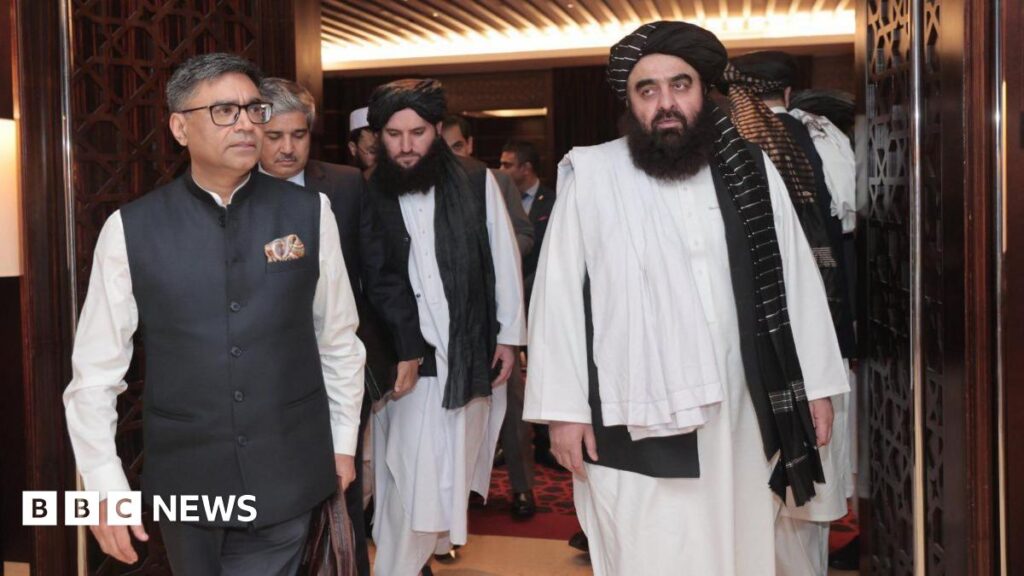
Since the Taliban’s return to power in Afghanistan, countries have adopted varied approaches toward the regime, balancing diplomatic engagement with concerns over human rights and security. China, for example, has gone far: it has actively engaged with the Taliban, focusing on security and economic interests, and even has an ambassador in the country.
No country has formally recognised the Taliban government, but up to 40 countries maintain some form of diplomatic or informal relations with it.
That’s why experts like Jayant Prasad, a former Indian ambassador to Afghanistan, are more circumspect about India’s outreach.
For the past three years, he says, India has maintained contact with the Taliban through a foreign service diplomat. India had closed its consulates in Afghanistan during the civil war in the 1990s and reopened them in 2002 after the war ended. “We didn’t want this hiatus to develop [again], so we wanted to engage. It is very simply a step up in relations,” he says.
India has “historical and civilisational ties, external” with Afghanistan, Foreign Minister S Jaishankar told parliament in 2023. India has invested more than $3bn (£2.46bn) in over 500 projects across Afghanistan, including roads, power lines, dams, hospitals and clinics. It has trained Afghan officers, awarded thousands of scholarships to students and built a new parliament building.
This reflects a lasting geopolitical reality. “Irrespective of the nature of the regime in Kabul – monarchical, communist, or Islamist – there has been a natural warmth between Delhi and Kabul,” The Indian Express newspaper noted, external.
Mr Kugelman echoes the sentiment. “India has an important legacy as a development and humanitarian aid donor in Afghanistan, which has translated into public goodwill from the Afghan public that Delhi is keen not to lose,” he says.
Interestingly, relations with Delhi appear to be easing amid rising tensions between Afghanistan and Pakistan. Pakistan claims the hardline Pakistani Taliban (TTP) operates from sanctuaries in Afghanistan.
Last July, Pakistan’s Defence Minister Khawaja Asif told the BBC that Pakistan would continue attacks on Afghanistan as part of an operation aimed at countering terrorism. Days before talks between India and the Taliban, Pakistani airstrikes killed dozens in eastern Afghanistan, according to the Afghan government. The Taliban government condemned the strikes as violations of its sovereignty.
BBC News

Khamrah by Lattafa for Men - 3.4 oz EDP Spray
4% Off
Ghost Sweetheart Eau de Toilette | Pineapple, Jasmine and Sandalwood | Perfume for Women 50 ml
50% Off
Marc Jacobs Dot Eau De Parfum for Women, 100 ml
42% Off
Ted Baker W Eau de Toilette for Her, Fig Leaf, White Peony and Violet Top Notes, Pink Orchid and Raspberry Middle Notes, 75ml
£11.77 (£15.69 / 100 ml) (as of 22/05/2026 03:17 GMT +01:00 - More infoProduct prices and availability are accurate as of the date/time indicated and are subject to change. Any price and availability information displayed on [relevant Amazon Site(s), as applicable] at the time of purchase will apply to the purchase of this product.)
Ted Baker Woman Pink Eau de Toilette Spray Floral Green Feminine Fragrance, Opening Notes are Fresh Peach, Bergamot and Tangerine with Warm Musk, Vanilla and Vetiver Base, 100ml
11% Off
Vera Wang Princess Eau de Toilette - 30 ml

Choco Musk 50ml Eau De Parfum for men and women | Chocolate Musk by Jannat Aromas
17% Off
Christina Aguilera Signature Eau de Parfum (50ml) Floral, Fruity & Exotic Scent, Luxury Fragrance for Women
9% Off
Calvin Klein - Eau De Toilette CKIN2U - Calvin Klein Women, Ladies Perfume, Women's Perfume, Calvin Klein Perfume, Calvin Klein One - 150 ml
5% Off
Jimmy Choo Flash Eau de Parfum, 60 ml (Pack of 1)
3% Off
Fruit of the Loom Men's Heavy T Shirt, White, XL UK
28% Off
ATNKE LED Lighted Beanie Cap,USB Rechargeable Running Hat Ultra Bright 4 LED Waterproof Light Winter Warm Gifts for Men and Women/Pink
17% Off
Men's 1/4 Zip Pullover UK Sale Clearance, Fleece Sweatshirt Casual Jumper Long Sleeve T-shirt Top Stand Collar Sweater Plain Pullover Sports Leisure Workwear Quarter Zip Sweater Lightweight Jumpers
£5.88 (as of 12/11/2025 00:52 GMT +01:00 - More infoProduct prices and availability are accurate as of the date/time indicated and are subject to change. Any price and availability information displayed on [relevant Amazon Site(s), as applicable] at the time of purchase will apply to the purchase of this product.)
Crevice Cleaning Brush, Bathroom Tile Groove Gap Cleaning Brush,Premium Crevice Cleaning Tool Aluminum Support with 15° Angle Magic Brush, Thin Brush for Home Kitchen
19% Off
Wireless Earbuds, Bluetooth 5.3 Headphones in Ear with HiFi Stereo Deep Bass, 4 ENC Noise Cancelling Mic Wireless Earphones 40H Playtime, Bluetooth Earbuds Dual LED Display, IP7 Waterproof, USB-C
42% Off