 BBC
BBCVeteran civil rights campaigner and activist Eamon Melaugh has died at the age of 92.
Mr Melaugh was heavily involved with the civil rights movement in Londonderry and co-founded the Derry Housing Action Committee (DHAC) in in 1968, which campaigned for better housing conditions and provision for Catholic families.
He also became well known as the voice behind the microphone of the pirate station Radio Free Derry which broadcast during the Battle of the Bogside in August 1969.
Three days of violent clashes during the Battle of the Bogside are regarded by many as the beginning of the Troubles in Northern Ireland.
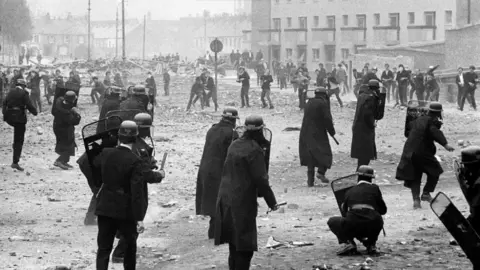
Rising tensions between the nationalist residents of the Bogside in Derry and the RUC (Royal Ulster Constabulary) over a scheduled Apprentice Boys parade in the city brought British troops on to the streets of Northern Ireland for the first time.
After three days of fighting, a truce was called and the barricades surrounding the Bogside were replaced by a white line.
During the unrest, Mr Melaugh and fellow activist Eamonn McCann operated intermittent broadcasts from Radio Free Derry, based in the Rossville Street flats.
The makeshift pirate radio station’s schedule was comprised of music, interviews, updates and political commentary.
The radio equipment, which was smuggled to Northern Ireland from over the border in the Republic of Ireland, was later uncovered by soldiers during house searches in the Bogside in the years after 1969.

Eamonn McCann described Mr Melaugh as a “distinctive character” who played “a huge role in the early civil rights movement in Derry”.
“He was an eloquent and uncompromising person who didn’t suffer fools gladly.
“I had many run-ins with Eamon and if he didn’t agree with me – which happened on many occasions – he would tell me, often quite bluntly.
“He was incredibly honest and direct, which was quite unusual at that time.”
Mr McCann fondly remembers his time with Mr Melaugh in the Derry Housing Action Committee and during their time together at Radio Free Derry.
“The station may have been limited in terms of actual range, but certainly not limited in impact.
“Eamon was one of the main announcers and had a style and confidence that resonated with those listening.
“That period, that station, became an important part of the history of our city.”
He said Mr Melaugh will be remembered as one of the “defining characters of the civil rights movement in Derry who made a distinct and valuable contribution to the people who live here”.
Mr Melaugh died peacefully at his home, surrounded by family, on Monday.
His Requiem Mass will take place at St Columba’s Church, Longtower, on Wednesday, with burial afterwards in Derry’s City Cemetery.
BBC News

Khamrah by Lattafa for Men - 3.4 oz EDP Spray
4% Off
Ghost Sweetheart Eau de Toilette | Pineapple, Jasmine and Sandalwood | Perfume for Women 50 ml
50% Off
Marc Jacobs Dot Eau De Parfum for Women, 100 ml
42% Off
Ted Baker W Eau de Toilette for Her, Fig Leaf, White Peony and Violet Top Notes, Pink Orchid and Raspberry Middle Notes, 75ml
£11.77 (£15.69 / 100 ml) (as of 09/07/2026 03:55 GMT +01:00 - More infoProduct prices and availability are accurate as of the date/time indicated and are subject to change. Any price and availability information displayed on [relevant Amazon Site(s), as applicable] at the time of purchase will apply to the purchase of this product.)
Ted Baker Woman Pink Eau de Toilette Spray Floral Green Feminine Fragrance, Opening Notes are Fresh Peach, Bergamot and Tangerine with Warm Musk, Vanilla and Vetiver Base, 100ml
11% Off
Vera Wang Princess Eau de Toilette - 30 ml

Choco Musk 50ml Eau De Parfum for men and women | Chocolate Musk by Jannat Aromas
17% Off
Christina Aguilera Signature Eau de Parfum (50ml) Floral, Fruity & Exotic Scent, Luxury Fragrance for Women
9% Off
Calvin Klein - Eau De Toilette CKIN2U - Calvin Klein Women, Ladies Perfume, Women's Perfume, Calvin Klein Perfume, Calvin Klein One - 150 ml
5% Off
Jimmy Choo Flash Eau de Parfum, 60 ml (Pack of 1)
3% Off
Fruit of the Loom Men's Heavy T Shirt, White, XL UK
28% Off
ATNKE LED Lighted Beanie Cap,USB Rechargeable Running Hat Ultra Bright 4 LED Waterproof Light Winter Warm Gifts for Men and Women/Pink
17% Off
Men's 1/4 Zip Pullover UK Sale Clearance, Fleece Sweatshirt Casual Jumper Long Sleeve T-shirt Top Stand Collar Sweater Plain Pullover Sports Leisure Workwear Quarter Zip Sweater Lightweight Jumpers
£5.88 (as of 12/11/2025 00:52 GMT +01:00 - More infoProduct prices and availability are accurate as of the date/time indicated and are subject to change. Any price and availability information displayed on [relevant Amazon Site(s), as applicable] at the time of purchase will apply to the purchase of this product.)
Crevice Cleaning Brush, Bathroom Tile Groove Gap Cleaning Brush,Premium Crevice Cleaning Tool Aluminum Support with 15° Angle Magic Brush, Thin Brush for Home Kitchen
19% Off
Wireless Earbuds, Bluetooth 5.3 Headphones in Ear with HiFi Stereo Deep Bass, 4 ENC Noise Cancelling Mic Wireless Earphones 40H Playtime, Bluetooth Earbuds Dual LED Display, IP7 Waterproof, USB-C
42% Off