 [
[

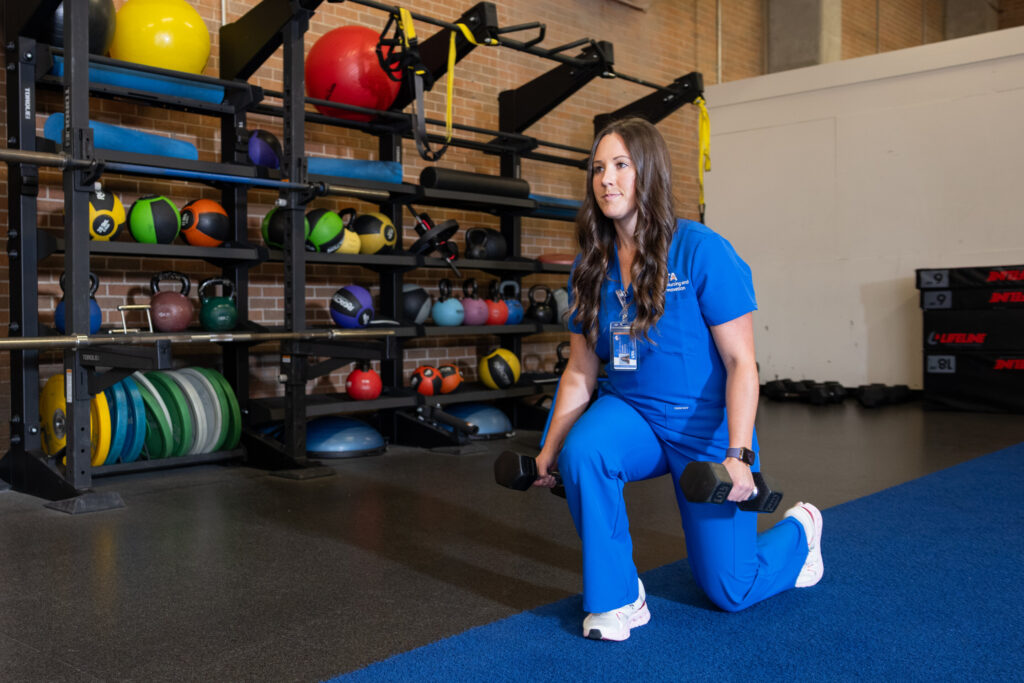
Chandler Browning always dreamed of being part of The University of Texas at Arlington’s nationally recognized nursing program and pursuing her goal of becoming a certified registered nurse anesthetist. Now in her first semester as a nursing student, she is experiencing firsthand UTA’s latest innovation in nursing education: treating nurses as “clinical athletes.”
The Clinical Athlete Framework applies performance science principles to the physical and cognitive demands of clinical practice, helping future nurses develop the strength, endurance and resilience needed to succeed in one of health care’s most demanding professions.
“The Clinical Athlete initiative shows that the departments aren’t afraid to work with each other,” said Browning, who played on UTA’s women’s golf team and graduated last spring with a bachelor’s degree in exercise science before pursuing a nursing degree. “It’s awesome to see educators come together to promote student health, safety and education.”
Tyler Garner, program director of exercise science and clinical associate professor, and Cynthia Koomey, associate chair of undergraduate nursing and clinical assistant professor, are leading UTA’s Clinical Athlete Framework initiative.
As health care systems nationwide face workforce shortages and high rates of burnout, UTA faculty see an opportunity to better prepare and support nurses before they enter the profession. By treating nurses as “clinical athletes,” the program focuses not only on physical conditioning but also on recovery and long-term well-being.
Students learn about the importance of proper sleep, nutrition and strategic breaks to help reduce the risk of injury, fatigue and burnout, the latter of which is becoming a troubling trend in the nursing profession. Research has shown that burnout affects one in five nursing students globally, while one in three nurses leave their first position within the first year. According to the American Nurses Foundation, 69% of nurses younger than 25 report symptoms of burnout.
The American Nurses Association lists exercise among its strategies to combat burnout, saying physical activity has proven stress-alleviating effects and that improved strength and cardiovascular fitness can make the physical demands of nursing less strenuous. While the benefits of strength and cardiovascular fitness for nurses have long been recognized, the Clinical Athlete Framework offers an innovative approach by developing programming tailored specifically to those needs.
“What we’re trying to do with the Clinical Athlete Framework is get nurses included in the conversation about occupational athletes,” said Garner, a UTA alum.
“Nurses have a very physically intense job. They’re on their feet all day, lifting patients, lifting equipment and pushing beds.”
Koomey recalled the demands of the job when she worked at a Level I trauma hospital. Nurses often worked three consecutive 12-hour shifts and frequently added four hours to a fourth consecutive shift, stretching that workday to 16 hours, she said.
“Then, when you add in not just the number of hours that you’re working in a four-day stretch, but also the number of steps that you take during each shift, I mean, it can easily be 30,000 steps per shift,” said Koomey, a UTA alumna.
“Pushing those ICU beds through the halls … it’s just tremendously demanding work.”
Garner said nurses should be considered occupational athletes alongside first responders such as firefighters, police officers and emergency medical personnel.
“There’s an entire framework built around the demands of their jobs; nursing is never included in those conversations,” Garner said.
“What we’re trying to do is bridge that gap and start to incorporate the exercise science of nursing practice so we can develop exercise and training interventions for what we’re calling clinical athletes.”
Garner added that strength development is a key part of the framework because nurses experience higher-than-average rates of musculoskeletal disorders, according to the Bureau of Labor Statistics.
“One thing we want to try to do is get nurses stronger so that they’re able to better handle the physical load,” Garner said.
“A big emphasis over here in exercise science is the role of structured strength training as a means of injury prevention.”
So far, the response has been overwhelmingly positive among colleagues and students.
As Browning noted, “UTA really wants students to succeed. I feel like they’re preparing us not only to be great nurses, but also to be great caregivers.”
Key medical concepts


Citation:
Training nurses like athletes (2026, September 12)
retrieved 12 September 2026
from https://medicalxpress.com/news/2026-09-nurses-athletes.html
This document is subject to copyright. Apart from any fair dealing for the purpose of private study or research, no
part may be reproduced without the written permission. The content is provided for information purposes only.

Khamrah by Lattafa for Men - 3.4 oz EDP Spray
4% Off
Ghost Sweetheart Eau de Toilette | Pineapple, Jasmine and Sandalwood | Perfume for Women 50 ml
50% Off
Marc Jacobs Dot Eau De Parfum for Women, 100 ml
42% Off
Ted Baker W Eau de Toilette for Her, Fig Leaf, White Peony and Violet Top Notes, Pink Orchid and Raspberry Middle Notes, 75ml
£11.77 (£15.69 / 100 ml) (as of 14/09/2026 05:03 GMT +01:00 - More infoProduct prices and availability are accurate as of the date/time indicated and are subject to change. Any price and availability information displayed on [relevant Amazon Site(s), as applicable] at the time of purchase will apply to the purchase of this product.)
Ted Baker Woman Pink Eau de Toilette Spray Floral Green Feminine Fragrance, Opening Notes are Fresh Peach, Bergamot and Tangerine with Warm Musk, Vanilla and Vetiver Base, 100ml
11% Off
Vera Wang Princess Eau de Toilette - 30 ml

Choco Musk 50ml Eau De Parfum for men and women | Chocolate Musk by Jannat Aromas
17% Off
Christina Aguilera Signature Eau de Parfum (50ml) Floral, Fruity & Exotic Scent, Luxury Fragrance for Women
9% Off
Calvin Klein - Eau De Toilette CKIN2U - Calvin Klein Women, Ladies Perfume, Women's Perfume, Calvin Klein Perfume, Calvin Klein One - 150 ml
5% Off
Jimmy Choo Flash Eau de Parfum, 60 ml (Pack of 1)
3% Off
Fruit of the Loom Men's Heavy T Shirt, White, XL UK
28% Off
ATNKE LED Lighted Beanie Cap,USB Rechargeable Running Hat Ultra Bright 4 LED Waterproof Light Winter Warm Gifts for Men and Women/Pink
17% Off
Men's 1/4 Zip Pullover UK Sale Clearance, Fleece Sweatshirt Casual Jumper Long Sleeve T-shirt Top Stand Collar Sweater Plain Pullover Sports Leisure Workwear Quarter Zip Sweater Lightweight Jumpers
£5.88 (as of 12/11/2025 00:52 GMT +01:00 - More infoProduct prices and availability are accurate as of the date/time indicated and are subject to change. Any price and availability information displayed on [relevant Amazon Site(s), as applicable] at the time of purchase will apply to the purchase of this product.)
Crevice Cleaning Brush, Bathroom Tile Groove Gap Cleaning Brush,Premium Crevice Cleaning Tool Aluminum Support with 15° Angle Magic Brush, Thin Brush for Home Kitchen
19% Off
Wireless Earbuds, Bluetooth 5.3 Headphones in Ear with HiFi Stereo Deep Bass, 4 ENC Noise Cancelling Mic Wireless Earphones 40H Playtime, Bluetooth Earbuds Dual LED Display, IP7 Waterproof, USB-C
42% Off