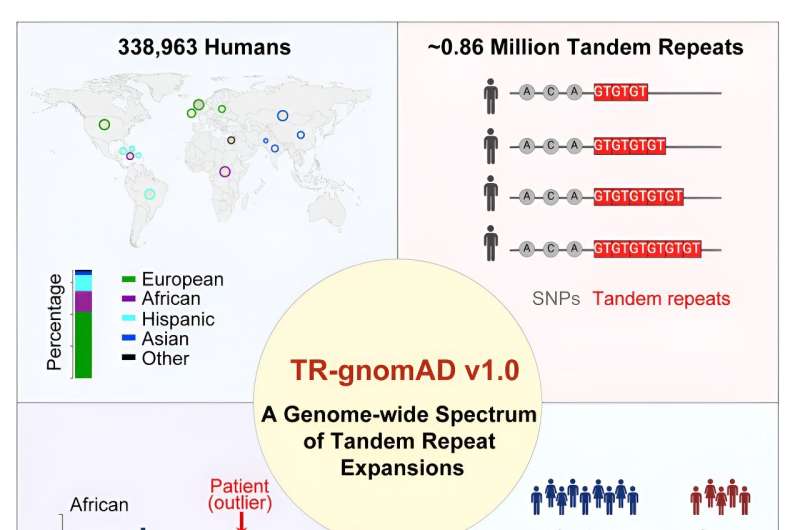
A research team led by the University of California, Irvine has built the first genetic reference maps for short lengths of DNA repeated multiple times which are known to cause more than 50 lethal human diseases, including amyotrophic lateral sclerosis, Huntington’s disease and multiple cancers.
The UC Irvine Tandem Genome Aggregation Database enables researchers to study how these mutations—called tandem repeat expansions—are connected to diseases, to better understand health disparities and to improve clinical diagnostics.
The study, published online today in the journal Cell, introduces the UC Irvine TR-gnomAD, which addresses a critical gap in current biobank genome sequencing efforts. Although TR expansions constitute about 6 percent of our genome and substantially contribute to complex congenial conditions, scientific understanding of them remains limited.
“This groundbreaking project positions UC Irvine as a leader in human and medical genetics by addressing the critical gap in the ability to interpret TR expansions in individuals with genetic disorders,” said Wei Li, the Grace B. Bell Chair and professor of bioinformatics and co-corresponding author.
“The TR-gnomAD advances our ability to determine how certain diseases might affect diverse groups of people based on variations in these mutations among ancestries. Genetic consulting companies can then develop products to interpret this information and accurately report how certain traits might be linked to different groups of people and diseases.”
To build the database, the team utilized two software tools to analyze the genomic data of 338,963 participants across 11 sub-populations. Of the .91 million TRs identified, .86 million were of high enough quality to be retained for further study. It was also discovered that 30.5 percent of them had at least two common alternative forms of a gene caused by a mutation located in the same place on a chromosome.
“Although we’ve successfully genotyped a substantial number of TRs, that is still just a fraction of the total number in the human genome,” Li said. “Our next steps will be to prioritize the integration of a greater number of high-quality TR and include more underrepresented ancestries, such as Australian, Pacific Islander and Mongolian, as we move closer to realizing personalized precision medicine.”
More information:
Ya Cui et al, A genome-wide spectrum of tandem repeat expansions in 338,963 humans, Cell (2024). DOI: 10.1016/j.cell.2024.03.004
Citation:
Research team builds first tandem repeat expansions genetic reference maps (2024, April 5)
retrieved 5 April 2024
from https://medicalxpress.com/news/2024-04-team-tandem-expansions-genetic.html
This document is subject to copyright. Apart from any fair dealing for the purpose of private study or research, no
part may be reproduced without the written permission. The content is provided for information purposes only.

Khamrah by Lattafa for Men - 3.4 oz EDP Spray
4% Off
Ghost Sweetheart Eau de Toilette | Pineapple, Jasmine and Sandalwood | Perfume for Women 50 ml
50% Off
Marc Jacobs Dot Eau De Parfum for Women, 100 ml
42% Off
Ted Baker W Eau de Toilette for Her, Fig Leaf, White Peony and Violet Top Notes, Pink Orchid and Raspberry Middle Notes, 75ml
£11.77 (£15.69 / 100 ml) (as of 04/09/2026 04:57 GMT +01:00 - More infoProduct prices and availability are accurate as of the date/time indicated and are subject to change. Any price and availability information displayed on [relevant Amazon Site(s), as applicable] at the time of purchase will apply to the purchase of this product.)
Ted Baker Woman Pink Eau de Toilette Spray Floral Green Feminine Fragrance, Opening Notes are Fresh Peach, Bergamot and Tangerine with Warm Musk, Vanilla and Vetiver Base, 100ml
11% Off
Vera Wang Princess Eau de Toilette - 30 ml

Choco Musk 50ml Eau De Parfum for men and women | Chocolate Musk by Jannat Aromas
17% Off
Christina Aguilera Signature Eau de Parfum (50ml) Floral, Fruity & Exotic Scent, Luxury Fragrance for Women
9% Off
Calvin Klein - Eau De Toilette CKIN2U - Calvin Klein Women, Ladies Perfume, Women's Perfume, Calvin Klein Perfume, Calvin Klein One - 150 ml
5% Off
Jimmy Choo Flash Eau de Parfum, 60 ml (Pack of 1)
3% Off
Fruit of the Loom Men's Heavy T Shirt, White, XL UK
28% Off
ATNKE LED Lighted Beanie Cap,USB Rechargeable Running Hat Ultra Bright 4 LED Waterproof Light Winter Warm Gifts for Men and Women/Pink
17% Off
Men's 1/4 Zip Pullover UK Sale Clearance, Fleece Sweatshirt Casual Jumper Long Sleeve T-shirt Top Stand Collar Sweater Plain Pullover Sports Leisure Workwear Quarter Zip Sweater Lightweight Jumpers
£5.88 (as of 12/11/2025 00:52 GMT +01:00 - More infoProduct prices and availability are accurate as of the date/time indicated and are subject to change. Any price and availability information displayed on [relevant Amazon Site(s), as applicable] at the time of purchase will apply to the purchase of this product.)
Crevice Cleaning Brush, Bathroom Tile Groove Gap Cleaning Brush,Premium Crevice Cleaning Tool Aluminum Support with 15° Angle Magic Brush, Thin Brush for Home Kitchen
19% Off
Wireless Earbuds, Bluetooth 5.3 Headphones in Ear with HiFi Stereo Deep Bass, 4 ENC Noise Cancelling Mic Wireless Earphones 40H Playtime, Bluetooth Earbuds Dual LED Display, IP7 Waterproof, USB-C
42% Off