
 [
[


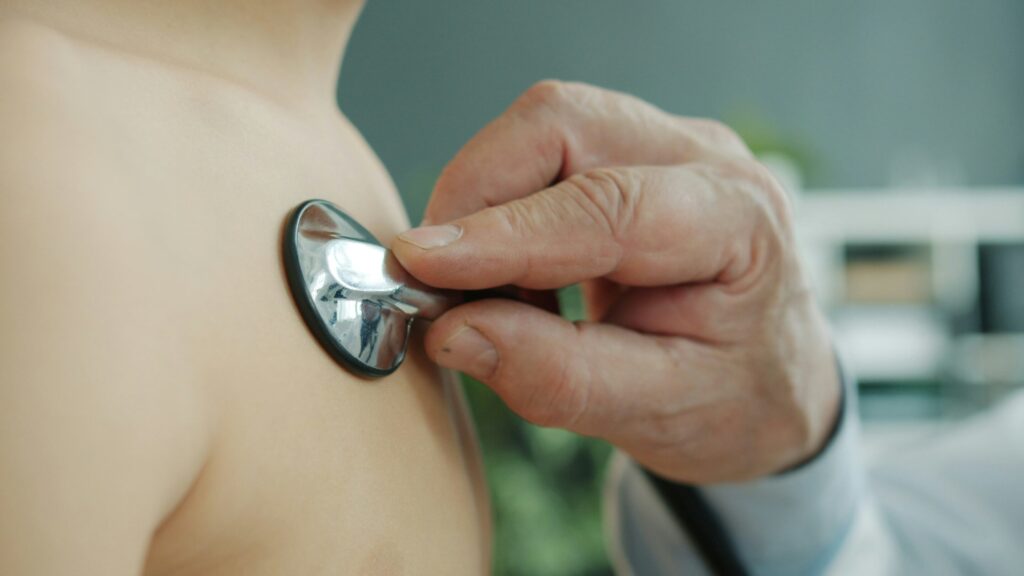
When a child has symptoms that could be pneumonia, doctors often listen to the child’s lungs with a stethoscope to help make a diagnosis. But a new national study led by physician-scientists at Ann & Robert H. Lurie Children’s Hospital of Chicago and PECARN finds that doctors may not always hear or interpret the same things when examining the same child, illustrating limitations of the physical examination.
The study, published Aug. 20 in JAMA Network Open, found that doctors often disagreed about common lung sounds used to help diagnose pneumonia, including crackles, decreased breath sounds and rhonchi. The findings suggest that a physical exam alone may not always provide enough information to confidently diagnose pneumonia in children.
“Doctors rely heavily on what they hear when listening to a child’s lungs, but our study shows that two doctors can examine the same child and come away with different findings,” said the study’s principal investigator and senior author Todd Florin, MD, MSCE, associate division head for academic affairs and research and attending physician in emergency medicine at Lurie Children’s; scientific director of research development and co-director of the Center for Pediatric Acute & Critical Care Research & Innovation at Stanley Manne Children’s Research Institute; and professor and associate chair of research in the Department of Pediatrics at Northwestern University Feinberg School of Medicine. “This can make diagnosing pneumonia challenging and points to the need for better tools to help us make these decisions.”
Pneumonia is one of the most common respiratory infections in children, leading to nearly 2 million outpatient visits and 375,000 emergency department visits each year in the United States. Current guidelines recommend that doctors diagnose pneumonia based on a child’s symptoms and physical exam, without routinely using a chest X-ray, when children are otherwise healthy and can be treated at home.
Doctors did not always hear the same thing
Researchers looked at 252 children ages 3 months to 17 years who were diagnosed with pneumonia at one of seven pediatric emergency departments across the country. Each child was examined by two doctors within an hour of each other. The doctors independently recorded what they heard and saw during the physical exam.
The researchers found that some of the most common lung sounds used to identify pneumonia were not consistently recognized by both doctors.
Wheezing and signs that a child was working harder to breathe were more consistently identified but still did not reach the study’s standard for strong agreement.
“The results showed that several findings traditionally considered important—such as decreased breath sounds and crackles—were identified inconsistently between emergency department providers,” said Shubhada Hooli, MD, MPH, assistant professor of pediatrics at Baylor College of Medicine.
The researchers also found similar results among children who went home from the emergency department and those who were admitted to the hospital.
Better tools could help doctors make decisions
Accurately diagnosing pneumonia is important because a wrong diagnosis can mean a child receives treatment they do not need or does not receive treatment they do need.
The study notes that about two-thirds of children with community-acquired pneumonia experience side effects from antibiotics. Better ways to identify pneumonia could help doctors determine which children are most likely to benefit from antibiotics and which children may not need them.
The researchers say more objective tools could eventually help doctors make more consistent diagnoses. These could include electronic stethoscopes that record lung sounds, computer programs that analyze those sounds, improved imaging techniques and blood or other tests that look for signs of pneumonia.
“A stethoscope will continue to be an important tool for doctors,” said Florin. “But we need to find ways to make the diagnosis of pneumonia more accurate and consistent. Better tools could help us avoid unnecessary antibiotics while making sure children who truly have pneumonia get the treatment they need.”
The study was conducted through the Pediatric Emergency Care Applied Research Network (PECARN), a national research network that brings together pediatric emergency departments across the country to improve emergency care for children.
Publication details
Shubhada Hooli et al, Reliability of Physical Examination Findings in Youths Diagnosed With Pneumonia, JAMA Network Open (2026). DOI: 10.1001/jamanetworkopen.2026.30074
Journal information:
JAMA Network Open
Key medical concepts


Citation:
Physical exams alone may not reliably diagnose pneumonia in children, national study finds (2026, August 29)
retrieved 29 August 2026
from https://medicalxpress.com/news/2026-08-physical-exams-reliably-pneumonia-children.html
This document is subject to copyright. Apart from any fair dealing for the purpose of private study or research, no
part may be reproduced without the written permission. The content is provided for information purposes only.

Khamrah by Lattafa for Men - 3.4 oz EDP Spray
4% Off
Ghost Sweetheart Eau de Toilette | Pineapple, Jasmine and Sandalwood | Perfume for Women 50 ml
50% Off
Marc Jacobs Dot Eau De Parfum for Women, 100 ml
42% Off
Ted Baker W Eau de Toilette for Her, Fig Leaf, White Peony and Violet Top Notes, Pink Orchid and Raspberry Middle Notes, 75ml
£11.77 (£15.69 / 100 ml) (as of 02/10/2026 05:09 GMT +01:00 - More infoProduct prices and availability are accurate as of the date/time indicated and are subject to change. Any price and availability information displayed on [relevant Amazon Site(s), as applicable] at the time of purchase will apply to the purchase of this product.)
Ted Baker Woman Pink Eau de Toilette Spray Floral Green Feminine Fragrance, Opening Notes are Fresh Peach, Bergamot and Tangerine with Warm Musk, Vanilla and Vetiver Base, 100ml
11% Off
Vera Wang Princess Eau de Toilette - 30 ml

Choco Musk 50ml Eau De Parfum for men and women | Chocolate Musk by Jannat Aromas
17% Off
Christina Aguilera Signature Eau de Parfum (50ml) Floral, Fruity & Exotic Scent, Luxury Fragrance for Women
9% Off
Calvin Klein - Eau De Toilette CKIN2U - Calvin Klein Women, Ladies Perfume, Women's Perfume, Calvin Klein Perfume, Calvin Klein One - 150 ml
5% Off
Jimmy Choo Flash Eau de Parfum, 60 ml (Pack of 1)
3% Off
Fruit of the Loom Men's Heavy T Shirt, White, XL UK
28% Off
ATNKE LED Lighted Beanie Cap,USB Rechargeable Running Hat Ultra Bright 4 LED Waterproof Light Winter Warm Gifts for Men and Women/Pink
17% Off
Men's 1/4 Zip Pullover UK Sale Clearance, Fleece Sweatshirt Casual Jumper Long Sleeve T-shirt Top Stand Collar Sweater Plain Pullover Sports Leisure Workwear Quarter Zip Sweater Lightweight Jumpers
£5.88 (as of 12/11/2025 00:52 GMT +01:00 - More infoProduct prices and availability are accurate as of the date/time indicated and are subject to change. Any price and availability information displayed on [relevant Amazon Site(s), as applicable] at the time of purchase will apply to the purchase of this product.)
Crevice Cleaning Brush, Bathroom Tile Groove Gap Cleaning Brush,Premium Crevice Cleaning Tool Aluminum Support with 15° Angle Magic Brush, Thin Brush for Home Kitchen
19% Off
Wireless Earbuds, Bluetooth 5.3 Headphones in Ear with HiFi Stereo Deep Bass, 4 ENC Noise Cancelling Mic Wireless Earphones 40H Playtime, Bluetooth Earbuds Dual LED Display, IP7 Waterproof, USB-C
42% Off


