


 Getty Images
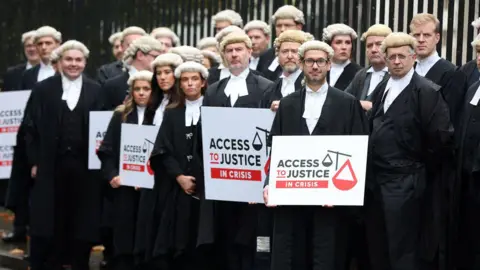
Striking barristers declined to continue working on 12 high risk cases in Northern Ireland, The Nolan Show has learned.
It is understood the cases include nine serious domestic violence cases, one rape and two serious sexual assaults – one involving a minor.
The strike, which began on 5 January, means that no Crown Court cases involving people who require legal aid can proceed while the dispute continues.
In a statement, the Bar Council said it is “dedicated towards resolution and doing what is possible to mitigate the worst effects of this action” on the most vulnerable.
Justice Minister Naomi Long told The Nolan Show that 13 cases had been identified as having victims at continued risk from the accused.
“So far my understanding is that the Criminal Bar have only agreed to proceed with one of those cases and have refused the other 12,” she said.
 PA Media
Long added that “significantly vulnerable” people were being affected.
“I think it’s very hard to appreciate just how distressing, how disruptive and how traumatising this is for victims and witnesses,” she said.
“It’s also incredibly challenging for those who are accused of these crimes, many of whom because of the very serious nature of them will be on remand in prison yet have not been convicted of any offence.”
 Pacemaker
Last week, Long said her department does not have the adequate funds available to award barristers a pay uplift.
The chair of the Bar Council of Northern Ireland, Donal Lunny KC, said the strike was called because Crown Court legal aid fees have not risen in 20 years.
Long said they “have already had a 16% uplift to their fees”.
On Wednesday, she told The Nolan Show some of those struggling in the profession “are suffering as a result of a small number of barristers who are hording cases”.
She said one barrister earned more than £3.8m from legal aid alone in 2025.
“That is the equivalent of what 53 other barristers earned together,” she said.
She added: “I am willing to look at pay, I’m willing to look at rates – I’m not taking anything off the table and never have.”
‘Urgent and pragmatic solution’
In its statement, the Bar Council said it remains committed to constructive engagement with the Department of Justice and other parties to “resolve issues and arrive at a place where criminal barristers can make a full return to Crown Court work”.
“No-one should be under any doubt, this action was a last resort.
“Self-employed criminal barristers want to be in court, running and resolving these cases.”
It added: “Rather than engage in further media or debate across the airwaves at this time, we should engage urgently in mediation.
“That is the only way of achieving the urgent and pragmatic solution necessary to enable criminal barristers to get back to work and victims to have the access to justice that they deserve”.
BBC News

Khamrah by Lattafa for Men - 3.4 oz EDP Spray
4% Off
Ghost Sweetheart Eau de Toilette | Pineapple, Jasmine and Sandalwood | Perfume for Women 50 ml
50% Off
Marc Jacobs Dot Eau De Parfum for Women, 100 ml
42% Off
Ted Baker W Eau de Toilette for Her, Fig Leaf, White Peony and Violet Top Notes, Pink Orchid and Raspberry Middle Notes, 75ml
£11.77 (£15.69 / 100 ml) (as of 09/10/2026 06:28 GMT +01:00 - More infoProduct prices and availability are accurate as of the date/time indicated and are subject to change. Any price and availability information displayed on [relevant Amazon Site(s), as applicable] at the time of purchase will apply to the purchase of this product.)
Ted Baker Woman Pink Eau de Toilette Spray Floral Green Feminine Fragrance, Opening Notes are Fresh Peach, Bergamot and Tangerine with Warm Musk, Vanilla and Vetiver Base, 100ml
11% Off
Vera Wang Princess Eau de Toilette - 30 ml

Choco Musk 50ml Eau De Parfum for men and women | Chocolate Musk by Jannat Aromas
17% Off
Christina Aguilera Signature Eau de Parfum (50ml) Floral, Fruity & Exotic Scent, Luxury Fragrance for Women
9% Off
Calvin Klein - Eau De Toilette CKIN2U - Calvin Klein Women, Ladies Perfume, Women's Perfume, Calvin Klein Perfume, Calvin Klein One - 150 ml
5% Off
Jimmy Choo Flash Eau de Parfum, 60 ml (Pack of 1)
3% Off
Fruit of the Loom Men's Heavy T Shirt, White, XL UK
28% Off
ATNKE LED Lighted Beanie Cap,USB Rechargeable Running Hat Ultra Bright 4 LED Waterproof Light Winter Warm Gifts for Men and Women/Pink
17% Off
Men's 1/4 Zip Pullover UK Sale Clearance, Fleece Sweatshirt Casual Jumper Long Sleeve T-shirt Top Stand Collar Sweater Plain Pullover Sports Leisure Workwear Quarter Zip Sweater Lightweight Jumpers
£5.88 (as of 12/11/2025 00:52 GMT +01:00 - More infoProduct prices and availability are accurate as of the date/time indicated and are subject to change. Any price and availability information displayed on [relevant Amazon Site(s), as applicable] at the time of purchase will apply to the purchase of this product.)
Crevice Cleaning Brush, Bathroom Tile Groove Gap Cleaning Brush,Premium Crevice Cleaning Tool Aluminum Support with 15° Angle Magic Brush, Thin Brush for Home Kitchen
19% Off
Wireless Earbuds, Bluetooth 5.3 Headphones in Ear with HiFi Stereo Deep Bass, 4 ENC Noise Cancelling Mic Wireless Earphones 40H Playtime, Bluetooth Earbuds Dual LED Display, IP7 Waterproof, USB-C
42% Off