 [
[

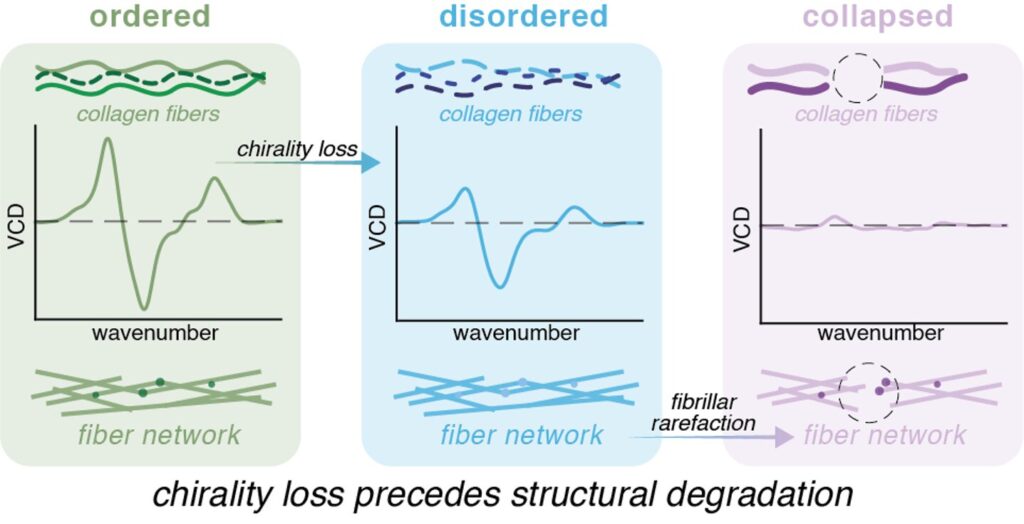
An international team led by researchers at Hiroshima University has developed a new way to detect subtle, early-stage changes in human skin collagen before any visible signs of damage appear. The study, published in ACS Nano, reveals that the molecular organization and supramolecular chirality—or structural handedness—of dermal collagen collapse before the visible fiber network actually thins or fragments.
Collagen is a hierarchical material that forms a highly organized network that supports skin’s structure and mechanical strength. Traditional imaging methods can easily identify visible deterioration, such as fiber thinning or loss of connectivity. However, these structural failures represent late stages of tissue remodeling.
“One way to think about our findings is that conventional imaging methods can show the ‘bricks’ of a collagen structure, but they may miss subtle changes in how those bricks are arranged,” said Ali Haider, first author of the study and a graduate research fellow at Hiroshima University’s International Institute for Sustainability with Knotted Chiral Meta Matter (WPI-SKCM²).
“It’s similar to detecting changes in the arrangement of words and sentences in a book before any pages appear damaged or missing.”
Tracking hidden collagen changes
To uncover these hidden patterns, the team integrated advanced optical imaging with chiroptical spectroscopy, including synchrotron radiation vacuum-ultraviolet circular dichroism (SR-VUVCD) and multidimensional quantum cascade laser vibrational circular dichroism (MultiD-QCL-VCD). This framework allowed them to map both the presence of collagen and its chiral structural coherence in the same physical tissue section.

When structure breaks before mass
The results demonstrated a distinct decoupling between collagen mass and structural order: Tissue samples retained their bulk collagen content and coverage even after their underlying supramolecular chirality coherence had severely degraded.
“The key message of this paper is that collagen should not be viewed only as a visible fiber network but as a hierarchical material whose function depends on organization across multiple length scales,” said Katsuya Inoue, a professor at WPI-SKCM² and one of the study’s corresponding authors.
“Our study shows that advanced correlative methods can reveal changes in this hidden organization that are not apparent from morphology alone.”
A framework for earlier intervention
The researchers’ goal is to establish a comprehensive framework that integrates molecular chirality, supramolecular organization and macroscopic tissue architecture. This could provide insights for medical interventions, wound healing and biomaterial design, allowing researchers to evaluate tissue integrity before irreversible macroscopic breakdown occurs.
Publication details
Correlative multimodal framework reveals supramolecular chirality loss preceding fibrillar rarefaction in dermal collagen, ACS Nano (2026). DOI: 10.1021/acsnano.6c06602
Journal information:
ACS Nano
Clinical categories


Citation:
New optical method reveals early collagen damage invisible in skin scans (2026, July 16)
retrieved 16 July 2026
from https://medicalxpress.com/news/2026-07-optical-method-reveals-early-collagen.html
This document is subject to copyright. Apart from any fair dealing for the purpose of private study or research, no
part may be reproduced without the written permission. The content is provided for information purposes only.

Khamrah by Lattafa for Men - 3.4 oz EDP Spray
4% Off
Ghost Sweetheart Eau de Toilette | Pineapple, Jasmine and Sandalwood | Perfume for Women 50 ml
50% Off
Marc Jacobs Dot Eau De Parfum for Women, 100 ml
42% Off
Ted Baker W Eau de Toilette for Her, Fig Leaf, White Peony and Violet Top Notes, Pink Orchid and Raspberry Middle Notes, 75ml
£11.77 (£15.69 / 100 ml) (as of 16/07/2026 03:58 GMT +01:00 - More infoProduct prices and availability are accurate as of the date/time indicated and are subject to change. Any price and availability information displayed on [relevant Amazon Site(s), as applicable] at the time of purchase will apply to the purchase of this product.)
Ted Baker Woman Pink Eau de Toilette Spray Floral Green Feminine Fragrance, Opening Notes are Fresh Peach, Bergamot and Tangerine with Warm Musk, Vanilla and Vetiver Base, 100ml
11% Off
Vera Wang Princess Eau de Toilette - 30 ml

Choco Musk 50ml Eau De Parfum for men and women | Chocolate Musk by Jannat Aromas
17% Off
Christina Aguilera Signature Eau de Parfum (50ml) Floral, Fruity & Exotic Scent, Luxury Fragrance for Women
9% Off
Calvin Klein - Eau De Toilette CKIN2U - Calvin Klein Women, Ladies Perfume, Women's Perfume, Calvin Klein Perfume, Calvin Klein One - 150 ml
5% Off
Jimmy Choo Flash Eau de Parfum, 60 ml (Pack of 1)
3% Off
Fruit of the Loom Men's Heavy T Shirt, White, XL UK
28% Off
ATNKE LED Lighted Beanie Cap,USB Rechargeable Running Hat Ultra Bright 4 LED Waterproof Light Winter Warm Gifts for Men and Women/Pink
17% Off
Men's 1/4 Zip Pullover UK Sale Clearance, Fleece Sweatshirt Casual Jumper Long Sleeve T-shirt Top Stand Collar Sweater Plain Pullover Sports Leisure Workwear Quarter Zip Sweater Lightweight Jumpers
£5.88 (as of 12/11/2025 00:52 GMT +01:00 - More infoProduct prices and availability are accurate as of the date/time indicated and are subject to change. Any price and availability information displayed on [relevant Amazon Site(s), as applicable] at the time of purchase will apply to the purchase of this product.)
Crevice Cleaning Brush, Bathroom Tile Groove Gap Cleaning Brush,Premium Crevice Cleaning Tool Aluminum Support with 15° Angle Magic Brush, Thin Brush for Home Kitchen
19% Off
Wireless Earbuds, Bluetooth 5.3 Headphones in Ear with HiFi Stereo Deep Bass, 4 ENC Noise Cancelling Mic Wireless Earphones 40H Playtime, Bluetooth Earbuds Dual LED Display, IP7 Waterproof, USB-C
42% Off