 [
[


Immunotherapy that targets tumor-associated macrophages, a type of immune cell in the tumor microenvironment, works only if the cells have a functional system of molecules that enables them to respond to the treatment. This is shown in a new study from Karolinska Institutet, published in the journal Nature Communications. The findings may help identify which tumors could respond to the treatment and open up new combination therapies for cancer.
Immunotherapy has improved treatment for many cancer patients, but not everyone responds to treatment. To develop better therapies, greater knowledge is needed about the mechanisms that determine whether a treatment works.
In the current study, the researchers investigated an immunotherapeutic strategy that targets macrophages in the tumor microenvironment. Macrophages can either support or counteract the body’s defense against cancer, depending on how they are programmed. The treatment aims to alter the function of the macrophages so that they instead help the immune system fight the tumor.
The researchers found that the treatment depends on a group of receptors known as endosomal Toll-like receptors, particularly TLR9. When these receptors were absent, the macrophages remained in an immunosuppressive state, and the treatment did not affect tumor growth.
“Without these receptors, the treatment is ineffective. This knowledge makes it possible to investigate whether tumors are sensitive to this type of treatment, and it also paves the way for new combination therapies,” says Mikael Karlsson, professor at the Department of Microbiology, Tumor and Cell Biology at Karolinska Institutet.
Enhanced effect
The study also shows that the treatment effect could be enhanced when the researchers combined the immunotherapy with substances that activate TLR9. The results suggest that TLR9 could be used to boost the response and make the treatment more effective.
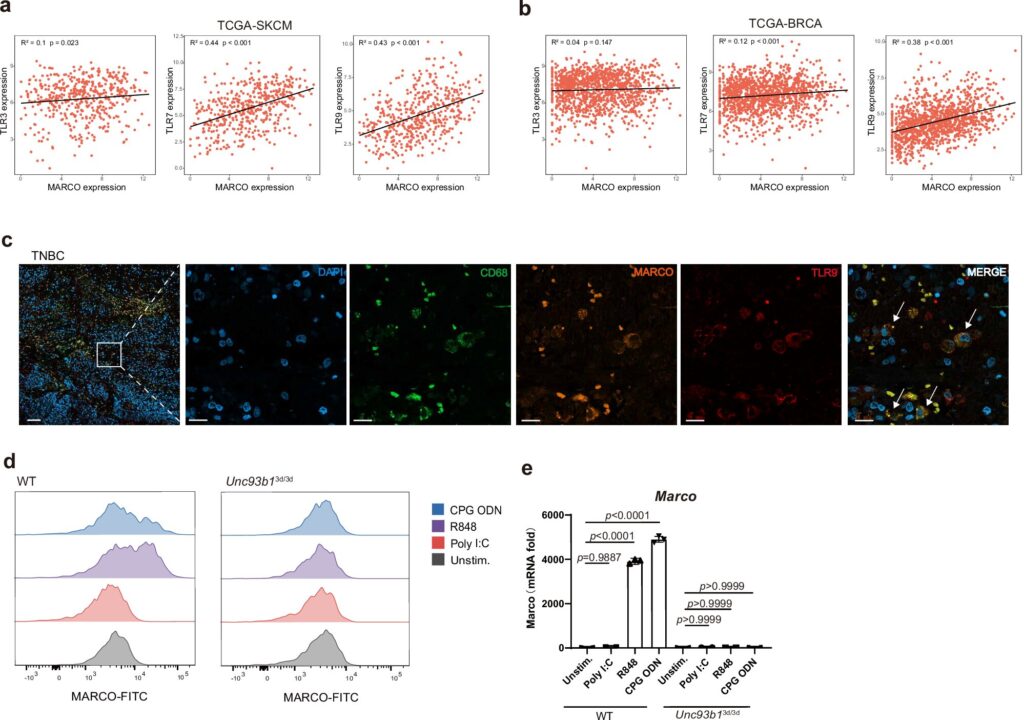
The researchers also analyzed data from human tumor samples and observed links between the expression of the treatment target MARCO and TLR9 in breast cancer, among other cancers. This suggests that the mechanisms may also be relevant in humans.
The study was conducted at Karolinska Institutet in collaboration with the University of Toronto, Rockefeller University and clinical departments at the university hospital. The researchers mainly used mouse models to investigate how different immunotherapies are affected by the receptors in question.
The next step is to use the new knowledge to develop and test new treatment strategies for cancer, including combinations of immunotherapies that could increase effectiveness in patients whose tumors are currently difficult to treat.
Publication details
Yueyun Pan et al, Cancer immunotherapy targeting murine myeloid cells requires endosomal pattern recognition, Nature Communications (2026). DOI: 10.1038/s41467-026-75543-2
Journal information:
Nature Communications
Clinical categories


Citation:
New mechanism may help predict and improve macrophage-targeted cancer immunotherapy (2026, August 14)
retrieved 14 August 2026
from https://medicalxpress.com/news/2026-08-mechanism-macrophage-cancer-immunotherapy.html
This document is subject to copyright. Apart from any fair dealing for the purpose of private study or research, no
part may be reproduced without the written permission. The content is provided for information purposes only.

Khamrah by Lattafa for Men - 3.4 oz EDP Spray
4% Off
Ghost Sweetheart Eau de Toilette | Pineapple, Jasmine and Sandalwood | Perfume for Women 50 ml
50% Off
Marc Jacobs Dot Eau De Parfum for Women, 100 ml
42% Off
Ted Baker W Eau de Toilette for Her, Fig Leaf, White Peony and Violet Top Notes, Pink Orchid and Raspberry Middle Notes, 75ml
£11.77 (£15.69 / 100 ml) (as of 03/10/2026 05:09 GMT +01:00 - More infoProduct prices and availability are accurate as of the date/time indicated and are subject to change. Any price and availability information displayed on [relevant Amazon Site(s), as applicable] at the time of purchase will apply to the purchase of this product.)
Ted Baker Woman Pink Eau de Toilette Spray Floral Green Feminine Fragrance, Opening Notes are Fresh Peach, Bergamot and Tangerine with Warm Musk, Vanilla and Vetiver Base, 100ml
11% Off
Vera Wang Princess Eau de Toilette - 30 ml

Choco Musk 50ml Eau De Parfum for men and women | Chocolate Musk by Jannat Aromas
17% Off
Christina Aguilera Signature Eau de Parfum (50ml) Floral, Fruity & Exotic Scent, Luxury Fragrance for Women
9% Off
Calvin Klein - Eau De Toilette CKIN2U - Calvin Klein Women, Ladies Perfume, Women's Perfume, Calvin Klein Perfume, Calvin Klein One - 150 ml
5% Off
Jimmy Choo Flash Eau de Parfum, 60 ml (Pack of 1)
3% Off
Fruit of the Loom Men's Heavy T Shirt, White, XL UK
28% Off
ATNKE LED Lighted Beanie Cap,USB Rechargeable Running Hat Ultra Bright 4 LED Waterproof Light Winter Warm Gifts for Men and Women/Pink
17% Off
Men's 1/4 Zip Pullover UK Sale Clearance, Fleece Sweatshirt Casual Jumper Long Sleeve T-shirt Top Stand Collar Sweater Plain Pullover Sports Leisure Workwear Quarter Zip Sweater Lightweight Jumpers
£5.88 (as of 12/11/2025 00:52 GMT +01:00 - More infoProduct prices and availability are accurate as of the date/time indicated and are subject to change. Any price and availability information displayed on [relevant Amazon Site(s), as applicable] at the time of purchase will apply to the purchase of this product.)
Crevice Cleaning Brush, Bathroom Tile Groove Gap Cleaning Brush,Premium Crevice Cleaning Tool Aluminum Support with 15° Angle Magic Brush, Thin Brush for Home Kitchen
19% Off
Wireless Earbuds, Bluetooth 5.3 Headphones in Ear with HiFi Stereo Deep Bass, 4 ENC Noise Cancelling Mic Wireless Earphones 40H Playtime, Bluetooth Earbuds Dual LED Display, IP7 Waterproof, USB-C
42% Off