
 [
[


Keloids are abnormal fibroproliferative scars that form when overactive fibroblasts produce excessive collagen after skin injury. Unlike ordinary scars, they can extend beyond the original wound and cause itching, pain and tenderness.
Current treatments, including surgery, corticosteroid injections, lasers and radiotherapy, may require prolonged treatment and can be associated with recurrence. Although radiotherapy can suppress keloid growth, conventional external-beam approaches struggle to precisely target small, irregular lesions while sparing surrounding healthy tissue.
To address this challenge, researchers from Pusan National University, led by Seung Yun Yang, who also serves as CEO of SNVIA Co., Ltd., developed an injectable system designed to deliver radiation directly within keloid tissue.
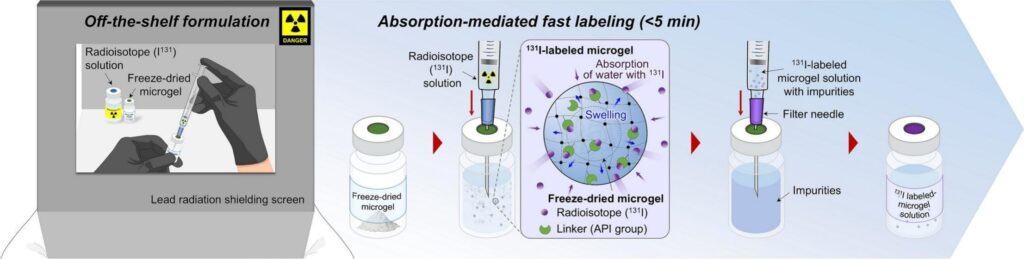
Yang explains, “We developed an ‘off-the-shelf’ microbrachytherapy approach using injectable, biodegradable hyaluronic acid (HA) microgels for keloid treatment.” The researchers investigated whether freeze-dried HA microgels could provide rapid and sustained local delivery of radioactive iodine-131 (¹³¹I) while minimizing systemic exposure.
This paper was published in Journal of Controlled Release.
The researchers fabricated uniform, biodegradable HA microgels using microfluidic technology and freeze-drying, creating a porous structure that could rapidly absorb radioactive solution. The microgels were then labeled with ¹³¹I and evaluated using patient-derived keloid fibroblasts to assess cytotoxicity and apoptosis. Their therapeutic efficacy, radioactive retention, biodistribution and safety were subsequently evaluated in mice carrying patient-derived keloid tissue.

The microgels enabled rapid and efficient radiolabeling. “Through absorption-mediated rapid radiolabeling, our freeze-dried microgels achieve high labeling efficiency (>90%) of iodine-131 in less than 10 minutes,” Yang said. Following injection, the microgels remained localized within keloid tissue for up to 14 days. In vitro, ¹³¹I-HA microgels at doses of ≥10 MBq induced more than 80% keloid fibroblast death within 48 hours, primarily through apoptosis.
Intralesional injection also reduced keloid size by about 70% after two weeks in a xenograft model, without off-target biodistribution or damage to surrounding healthy tissues. No significant abnormalities were observed in thyroid function, blood parameters or major organs.
The team believes the platform could simplify the preparation and delivery of localized brachytherapy. On-site radiolabeling may reduce radioactive waste and logistical demands while allowing treatment to be tailored to individual lesions. The approach could potentially be adapted for other localized tumors, although further studies are needed to assess its broader applications.
Yang concludes, “This technology provides a minimally invasive approach to deliver precise local radiotherapy, overcoming the targeting limitations of conventional external-beam radiation for small, irregular lesions.” Overall, the findings provide a promising preclinical foundation for targeted microbrachytherapy for keloids. Longer-term studies are still needed to evaluate recurrence, immune responses, dose distribution and clinical safety.
Publication details
Sodam Kim et al, Off-the-shelf microbrachytherapy using on-site fast radiolabeling for keloid treatment, Journal of Controlled Release (2026). DOI: 10.1016/j.jconrel.2026.115239
Journal information:
Journal of Controlled Release
Key medical concepts
Clinical categories


Citation:
Injectable microgels for targeted keloid radiotherapy (2026, August 27)
retrieved 27 August 2026
from https://medicalxpress.com/news/2026-08-microgels-keloid-radiotherapy.html
This document is subject to copyright. Apart from any fair dealing for the purpose of private study or research, no
part may be reproduced without the written permission. The content is provided for information purposes only.

Khamrah by Lattafa for Men - 3.4 oz EDP Spray
4% Off
Ghost Sweetheart Eau de Toilette | Pineapple, Jasmine and Sandalwood | Perfume for Women 50 ml
50% Off
Marc Jacobs Dot Eau De Parfum for Women, 100 ml
42% Off
Ted Baker W Eau de Toilette for Her, Fig Leaf, White Peony and Violet Top Notes, Pink Orchid and Raspberry Middle Notes, 75ml
£11.77 (£15.69 / 100 ml) (as of 02/10/2026 05:09 GMT +01:00 - More infoProduct prices and availability are accurate as of the date/time indicated and are subject to change. Any price and availability information displayed on [relevant Amazon Site(s), as applicable] at the time of purchase will apply to the purchase of this product.)
Ted Baker Woman Pink Eau de Toilette Spray Floral Green Feminine Fragrance, Opening Notes are Fresh Peach, Bergamot and Tangerine with Warm Musk, Vanilla and Vetiver Base, 100ml
11% Off
Vera Wang Princess Eau de Toilette - 30 ml

Choco Musk 50ml Eau De Parfum for men and women | Chocolate Musk by Jannat Aromas
17% Off
Christina Aguilera Signature Eau de Parfum (50ml) Floral, Fruity & Exotic Scent, Luxury Fragrance for Women
9% Off
Calvin Klein - Eau De Toilette CKIN2U - Calvin Klein Women, Ladies Perfume, Women's Perfume, Calvin Klein Perfume, Calvin Klein One - 150 ml
5% Off
Jimmy Choo Flash Eau de Parfum, 60 ml (Pack of 1)
3% Off
Fruit of the Loom Men's Heavy T Shirt, White, XL UK
28% Off
ATNKE LED Lighted Beanie Cap,USB Rechargeable Running Hat Ultra Bright 4 LED Waterproof Light Winter Warm Gifts for Men and Women/Pink
17% Off
Men's 1/4 Zip Pullover UK Sale Clearance, Fleece Sweatshirt Casual Jumper Long Sleeve T-shirt Top Stand Collar Sweater Plain Pullover Sports Leisure Workwear Quarter Zip Sweater Lightweight Jumpers
£5.88 (as of 12/11/2025 00:52 GMT +01:00 - More infoProduct prices and availability are accurate as of the date/time indicated and are subject to change. Any price and availability information displayed on [relevant Amazon Site(s), as applicable] at the time of purchase will apply to the purchase of this product.)
Crevice Cleaning Brush, Bathroom Tile Groove Gap Cleaning Brush,Premium Crevice Cleaning Tool Aluminum Support with 15° Angle Magic Brush, Thin Brush for Home Kitchen
19% Off
Wireless Earbuds, Bluetooth 5.3 Headphones in Ear with HiFi Stereo Deep Bass, 4 ENC Noise Cancelling Mic Wireless Earphones 40H Playtime, Bluetooth Earbuds Dual LED Display, IP7 Waterproof, USB-C
42% Off


