A NASA spacecraft has launched from Florida on a mission to establish whether Jupiter’s icy moon Europa could support life.
The craft, called Europa Clipper, was on a SpaceX Falcon Heavy rocket which blasted off from Kennedy Space Center in Cape Canaveral.
Its launch had been delayed by the deadly Hurricane Milton that struck the US state last week.
The mission’s main scientific goal is to establish whether there are places below the surface of the moon that can harbour life.
Scientists are interested in the salty liquid water ocean that previous observations have shown is under Europa’s icy shell.
The craft will carry out 49 close flybys of Europa over three years, gathering detailed measurements to investigate the moon.
It will fly as low as 16 miles above the surface, soaring over a different location during each flyby to scan nearly the entire moon.
Europa Clipper, which is about 30m long, 17m wide and weighs six tonnes, is the largest spacecraft the US space agency has ever built for a planetary mission.
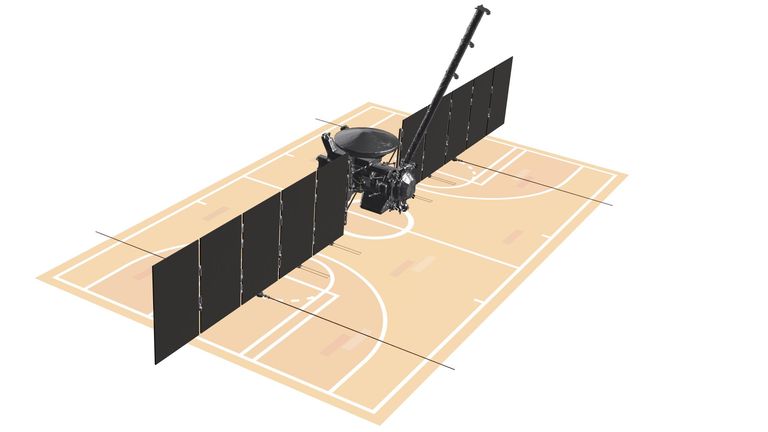
Europa Clipper is as big as a basketball court. Pic: Artist’s illustration/NASA
The solar-powered spacecraft, that is carrying nine scientific instruments, will travel 1.8 billion miles in a trip lasting about five and a half years and is due to enter orbit around Jupiter in 2030.
Its solar panels will gather sunlight for powering scientific instruments, electronics and its other subsystems.
NASA said: “The mission’s three main science objectives are to understand the nature of the ice shell and the ocean beneath it, along with the moon’s composition and geology.
“The mission’s detailed exploration of Europa will help scientists better understand the astrobiological potential for habitable worlds beyond our planet,” the agency added.
The mission’s deputy project scientist Bonnie Buratti, of NASA’s Jet Propulsion Laboratory, said: “There is very strong evidence that the ingredients for life exist on Europa. But we have to go there to find out.”

Keep up with all the latest news from the UK and around the world by following Sky News
The planetary scientist added: “Just to emphasise: we’re not a life-detection mission. We’re just looking for the conditions for life.”
Source link

Khamrah by Lattafa for Men - 3.4 oz EDP Spray
4% Off
Ghost Sweetheart Eau de Toilette | Pineapple, Jasmine and Sandalwood | Perfume for Women 50 ml
50% Off
Marc Jacobs Dot Eau De Parfum for Women, 100 ml
42% Off
Ted Baker W Eau de Toilette for Her, Fig Leaf, White Peony and Violet Top Notes, Pink Orchid and Raspberry Middle Notes, 75ml
£11.77 (£15.69 / 100 ml) (as of 06/08/2026 04:06 GMT +01:00 - More infoProduct prices and availability are accurate as of the date/time indicated and are subject to change. Any price and availability information displayed on [relevant Amazon Site(s), as applicable] at the time of purchase will apply to the purchase of this product.)
Ted Baker Woman Pink Eau de Toilette Spray Floral Green Feminine Fragrance, Opening Notes are Fresh Peach, Bergamot and Tangerine with Warm Musk, Vanilla and Vetiver Base, 100ml
11% Off
Vera Wang Princess Eau de Toilette - 30 ml

Choco Musk 50ml Eau De Parfum for men and women | Chocolate Musk by Jannat Aromas
17% Off
Christina Aguilera Signature Eau de Parfum (50ml) Floral, Fruity & Exotic Scent, Luxury Fragrance for Women
9% Off
Calvin Klein - Eau De Toilette CKIN2U - Calvin Klein Women, Ladies Perfume, Women's Perfume, Calvin Klein Perfume, Calvin Klein One - 150 ml
5% Off
Jimmy Choo Flash Eau de Parfum, 60 ml (Pack of 1)
3% Off
Fruit of the Loom Men's Heavy T Shirt, White, XL UK
28% Off
ATNKE LED Lighted Beanie Cap,USB Rechargeable Running Hat Ultra Bright 4 LED Waterproof Light Winter Warm Gifts for Men and Women/Pink
17% Off
Men's 1/4 Zip Pullover UK Sale Clearance, Fleece Sweatshirt Casual Jumper Long Sleeve T-shirt Top Stand Collar Sweater Plain Pullover Sports Leisure Workwear Quarter Zip Sweater Lightweight Jumpers
£5.88 (as of 12/11/2025 00:52 GMT +01:00 - More infoProduct prices and availability are accurate as of the date/time indicated and are subject to change. Any price and availability information displayed on [relevant Amazon Site(s), as applicable] at the time of purchase will apply to the purchase of this product.)
Crevice Cleaning Brush, Bathroom Tile Groove Gap Cleaning Brush,Premium Crevice Cleaning Tool Aluminum Support with 15° Angle Magic Brush, Thin Brush for Home Kitchen
19% Off
Wireless Earbuds, Bluetooth 5.3 Headphones in Ear with HiFi Stereo Deep Bass, 4 ENC Noise Cancelling Mic Wireless Earphones 40H Playtime, Bluetooth Earbuds Dual LED Display, IP7 Waterproof, USB-C
42% Off