
 City of Edinburgh Council
Pupils at two high schools in Edinburgh will have to lock their mobile phones in magnetically-sealed pouches during the day under new rules.
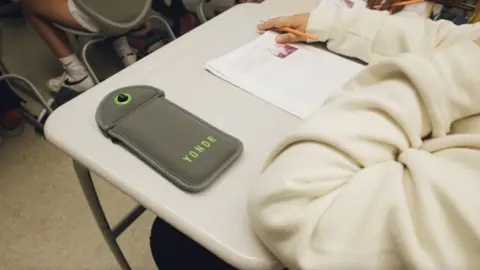
Students at Portobello High School and Queensferry High School will be issued with Yondr pouches over the next week as part of an effort to crack down on the use of devices in class.
Under the policy, pupils will keep phones in their possession throughout the day, but will be expected to keep them in the wallets until the bell rings at the end of their final lesson.
Edinburgh Council’s education convener said the move would end the “competition” between phones and teachers for pupils’ attention.
The local authority said the phone-free policy had been supported by about 86% of pupils and parents at Portobello High School during a survey.
It cited research which suggested pupils accessing social media on mobile phones had an “adverse effect on learning ability”.
 Google
Education convener councillor Joan Griffiths said: “Mobile phones in classroom settings are increasingly competing with the teachers for learners’ attention and limiting access to mobile phones during the school day is only a positive thing for our young people.
“I know that schools across Edinburgh, and indeed the country, are exploring ways to manage mobile phone use, including restricting phone use during the school day.
“The new pouches provide an innovative way for our young people to have distance from their devices while having the reassurance that they are still in their possession.
She added: “We hope that this new policy will increase focus on learning, reduce classroom distractions and help improve wellbeing.”
What is a Yondr pouch?
Fans of singer Bob Dylan had to keep their phones in Yondr pouches during his UK tour last year, which included a date at Edinburgh’s Usher Hall.
The legendary performer followed in the footsteps of Jack White, Alicia Keys and Childish Gambino, among others, to ban phones from his gigs.
They are also used widely in theatre and art galleries to stop alerts from disrupting performances.
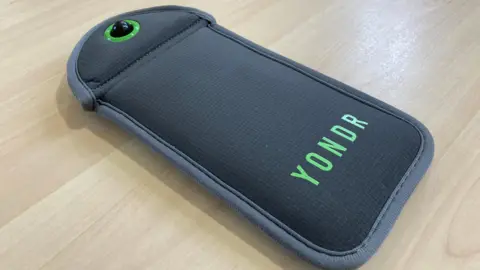
The wallets work in a similar way to anti-theft tags seen on clothes or alcohol bottles in shops.
A device is placed inside and closed with a powerful magnet, which snaps it shut until it is tapped on an unlocking base.
But it does not function in the same way as a Faraday Cage, meaning electronic transmissions such as texts or calls are not blocked.
What is happening elsewhere?
Several other Scottish councils have taken steps to regulate the use of phones in classrooms.
Most leave the enforcement to schools themselves.
At Inverness Royal Academy in the Highlands, phone signals are blocked inside the building, while only staff are given access to password-protected wi-fi.
Pupils can still access a signal in the school grounds.
Perth and Kinross Council said it “strictly prohibits” the use of phones during lesson time unless permitted by a teacher for educational purposes.
They said devices must be “turned off or on silent mode and stored in a manner that does not disturb the learning environment”.
Scottish government advice has been issued to schools in Glasgow, but the local authority said it would be up to individual schools to implement the policy.
East Dunbartonshire, Moray and Shetland give schools autonomy to create their own rules, but have consulted with parents and carers on their future use.
East Lothian is also consulting on a future policy, but all of their secondary schools have rules stating phones must be kept in bags, lockers or appropriate storage while in classrooms.
Midlothian Council said schools would contact parents or carers if a pupil fails to comply with expectations that phones are switched off and out of sight during class time.
Meanwhile, Argyll and Bute Council said it would not be appropriate to ban phones in schools outright.
BBC News

Khamrah by Lattafa for Men - 3.4 oz EDP Spray
4% Off
Ghost Sweetheart Eau de Toilette | Pineapple, Jasmine and Sandalwood | Perfume for Women 50 ml
50% Off
Marc Jacobs Dot Eau De Parfum for Women, 100 ml
42% Off
Ted Baker W Eau de Toilette for Her, Fig Leaf, White Peony and Violet Top Notes, Pink Orchid and Raspberry Middle Notes, 75ml
£11.77 (£15.69 / 100 ml) (as of 22/06/2026 03:34 GMT +01:00 - More infoProduct prices and availability are accurate as of the date/time indicated and are subject to change. Any price and availability information displayed on [relevant Amazon Site(s), as applicable] at the time of purchase will apply to the purchase of this product.)
Ted Baker Woman Pink Eau de Toilette Spray Floral Green Feminine Fragrance, Opening Notes are Fresh Peach, Bergamot and Tangerine with Warm Musk, Vanilla and Vetiver Base, 100ml
11% Off
Vera Wang Princess Eau de Toilette - 30 ml

Choco Musk 50ml Eau De Parfum for men and women | Chocolate Musk by Jannat Aromas
17% Off
Christina Aguilera Signature Eau de Parfum (50ml) Floral, Fruity & Exotic Scent, Luxury Fragrance for Women
9% Off
Calvin Klein - Eau De Toilette CKIN2U - Calvin Klein Women, Ladies Perfume, Women's Perfume, Calvin Klein Perfume, Calvin Klein One - 150 ml
5% Off
Jimmy Choo Flash Eau de Parfum, 60 ml (Pack of 1)
3% Off
Fruit of the Loom Men's Heavy T Shirt, White, XL UK
28% Off
ATNKE LED Lighted Beanie Cap,USB Rechargeable Running Hat Ultra Bright 4 LED Waterproof Light Winter Warm Gifts for Men and Women/Pink
17% Off
Men's 1/4 Zip Pullover UK Sale Clearance, Fleece Sweatshirt Casual Jumper Long Sleeve T-shirt Top Stand Collar Sweater Plain Pullover Sports Leisure Workwear Quarter Zip Sweater Lightweight Jumpers
£5.88 (as of 12/11/2025 00:52 GMT +01:00 - More infoProduct prices and availability are accurate as of the date/time indicated and are subject to change. Any price and availability information displayed on [relevant Amazon Site(s), as applicable] at the time of purchase will apply to the purchase of this product.)
Crevice Cleaning Brush, Bathroom Tile Groove Gap Cleaning Brush,Premium Crevice Cleaning Tool Aluminum Support with 15° Angle Magic Brush, Thin Brush for Home Kitchen
19% Off
Wireless Earbuds, Bluetooth 5.3 Headphones in Ear with HiFi Stereo Deep Bass, 4 ENC Noise Cancelling Mic Wireless Earphones 40H Playtime, Bluetooth Earbuds Dual LED Display, IP7 Waterproof, USB-C
42% Off