 [
[

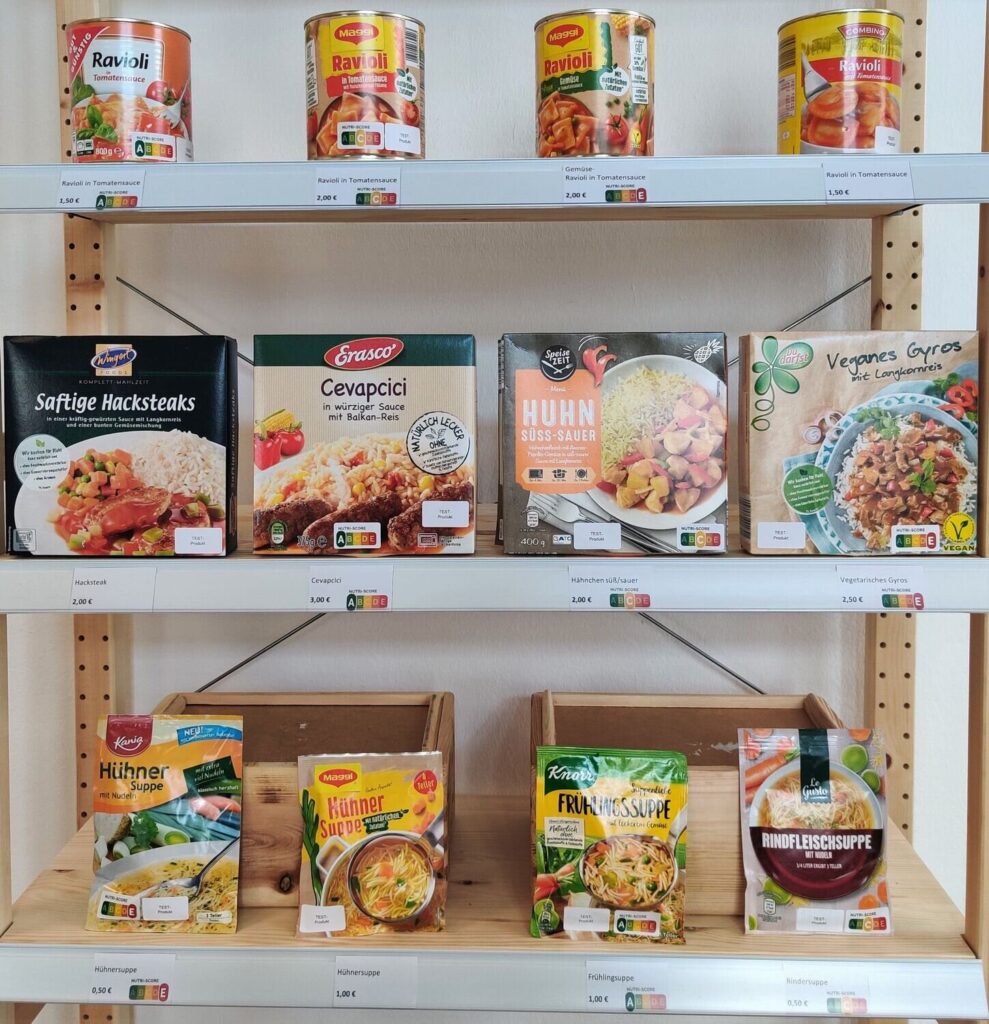
Anyone seeking to purchase healthy products at the supermarket needs clear guidance. Nutritional labeling schemes, such as Nutri-Score labels, are designed to help with that. The Nutri-Score front-of-pack label shows a five-color system from favorable nutritional composition in green (A) through to unfavorable in red (E). The scheme is optional on products across the EU but has been adopted by companies in several countries, for instance, Germany and the Netherlands. Some supermarkets also print a gray version on the price tag, but the colorful version on the shelf also attracts more attention here.
Researchers at Göttingen University—in collaboration with Osnabrück University of Applied Sciences, the German Institute of Food Technology and Giessen University—studied consumers’ visual attention on these label formats. Their research showed colorful labeling catches the eye more frequently and for longer than monochrome. Particularly frequent and prolonged glances at the dark green A or the yellow C were usually accompanied by choosing this particular product. The red E, on the other hand, did not have the desired warning effect: even when this unfavorable rating was viewed frequently, the products still ended up in shopping baskets. The study was published in the journal Food Quality and Preference.
The researchers used eye-tracking data to analyze the behavior of 199 participants in Germany, investigating where consumers looked and which product they ultimately chose to buy. The participants were placed in a simulation of a supermarket and divided into four groups. Each group was presented with a different labeling option: multi-colored Nutri-Score labels on the front package and shelf price tag; grayscale Nutri-Score labels on the front package and shelf price tag; the current supermarket standard—a single multi-colored label on the front package; or no label at all.
“Our findings show that the five-colored, traffic-light Nutri-Score label is clearly more noticeable on price labels than when displayed in gray,” says lead author Isabelle Weiß, Ph.D. researcher at Göttingen University. “The greater visibility of the labels can make it easier to compare products and support people in making more health-conscious choices. The more companies display the Nutri-Score on their products, the sounder the comparison will be for consumers.”

Study leader Dr. Clara Mehlhose adds, “The Nutri-Score is intended to provide simple guidance in the supermarket. It is crucial that shoppers can recognize and understand the information at a glance. A multi-colored label can be helpful here.”
The study highlights just how crucial the color scheme and placement of nutritional labels are for grabbing attention and, consequently, for influencing decisions about what to buy. Policymakers and retailers need to prioritize the use of traffic-light-colored Nutri-Score labels on the front package as well as shelf price tags, in order to increase their effectiveness in everyday life.
Publication details
Isabelle Weiß et al, Polychrome versus monochrome Nutri-Score shelf labels: An eye-tracking study of consumer attention and choice, Food Quality and Preference (2026). DOI: 10.1016/j.foodqual.2026.105933
Journal information:
Food Quality and Preference
Key medical concepts
Clinical categories


Citation:
Eye-catching for shoppers: Colorful Nutri-Score labels more effective than gray (2026, May 26)
retrieved 26 May 2026
from https://medicalxpress.com/news/2026-05-eye-shoppers-nutri-score-effective.html
This document is subject to copyright. Apart from any fair dealing for the purpose of private study or research, no
part may be reproduced without the written permission. The content is provided for information purposes only.

Khamrah by Lattafa for Men - 3.4 oz EDP Spray
4% Off
Ghost Sweetheart Eau de Toilette | Pineapple, Jasmine and Sandalwood | Perfume for Women 50 ml
50% Off
Marc Jacobs Dot Eau De Parfum for Women, 100 ml
42% Off
Ted Baker W Eau de Toilette for Her, Fig Leaf, White Peony and Violet Top Notes, Pink Orchid and Raspberry Middle Notes, 75ml
£11.77 (£15.69 / 100 ml) (as of 23/06/2026 03:34 GMT +01:00 - More infoProduct prices and availability are accurate as of the date/time indicated and are subject to change. Any price and availability information displayed on [relevant Amazon Site(s), as applicable] at the time of purchase will apply to the purchase of this product.)
Ted Baker Woman Pink Eau de Toilette Spray Floral Green Feminine Fragrance, Opening Notes are Fresh Peach, Bergamot and Tangerine with Warm Musk, Vanilla and Vetiver Base, 100ml
11% Off
Vera Wang Princess Eau de Toilette - 30 ml

Choco Musk 50ml Eau De Parfum for men and women | Chocolate Musk by Jannat Aromas
17% Off
Christina Aguilera Signature Eau de Parfum (50ml) Floral, Fruity & Exotic Scent, Luxury Fragrance for Women
9% Off
Calvin Klein - Eau De Toilette CKIN2U - Calvin Klein Women, Ladies Perfume, Women's Perfume, Calvin Klein Perfume, Calvin Klein One - 150 ml
5% Off
Jimmy Choo Flash Eau de Parfum, 60 ml (Pack of 1)
3% Off
Fruit of the Loom Men's Heavy T Shirt, White, XL UK
28% Off
ATNKE LED Lighted Beanie Cap,USB Rechargeable Running Hat Ultra Bright 4 LED Waterproof Light Winter Warm Gifts for Men and Women/Pink
17% Off
Men's 1/4 Zip Pullover UK Sale Clearance, Fleece Sweatshirt Casual Jumper Long Sleeve T-shirt Top Stand Collar Sweater Plain Pullover Sports Leisure Workwear Quarter Zip Sweater Lightweight Jumpers
£5.88 (as of 12/11/2025 00:52 GMT +01:00 - More infoProduct prices and availability are accurate as of the date/time indicated and are subject to change. Any price and availability information displayed on [relevant Amazon Site(s), as applicable] at the time of purchase will apply to the purchase of this product.)
Crevice Cleaning Brush, Bathroom Tile Groove Gap Cleaning Brush,Premium Crevice Cleaning Tool Aluminum Support with 15° Angle Magic Brush, Thin Brush for Home Kitchen
19% Off
Wireless Earbuds, Bluetooth 5.3 Headphones in Ear with HiFi Stereo Deep Bass, 4 ENC Noise Cancelling Mic Wireless Earphones 40H Playtime, Bluetooth Earbuds Dual LED Display, IP7 Waterproof, USB-C
42% Off