 [
[

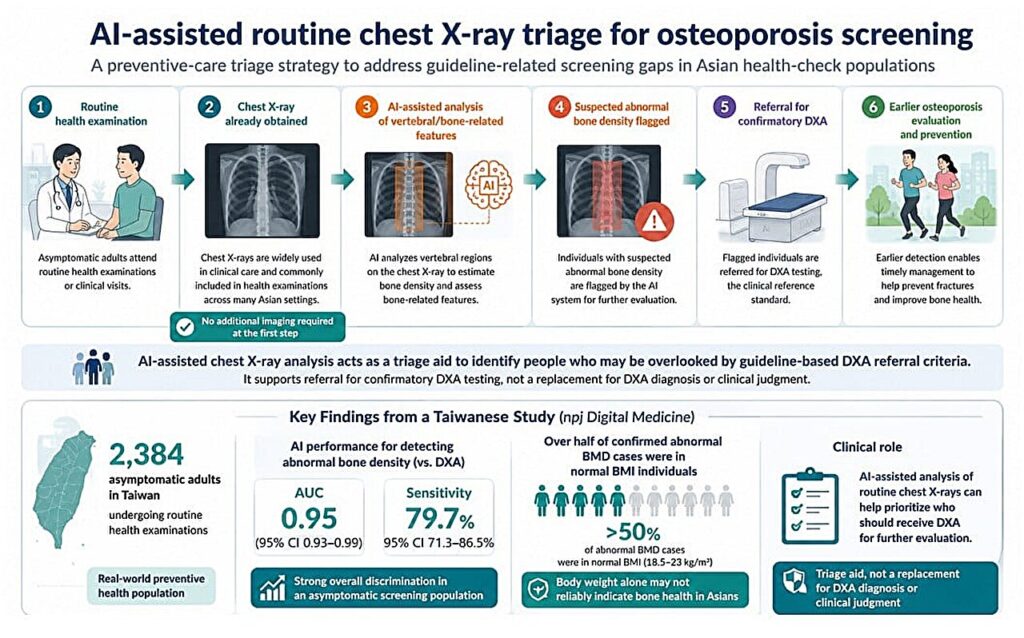
Osteoporosis is a silent disease where bone loss develops gradually before fractures occur. Current clinical screening recommendations mainly focus on older women and selected high-risk groups, leaving some men, younger adults, and individuals with normal body weight completely outside routine screening pathways.
To close this care gap, researchers from St. Paul’s Hospital and National Taiwan University have demonstrated how AI can leverage routine chest X-rays to detect asymptomatic bone loss, closing critical gaps in screening healthy Asian populations. Their paper is published in the journal npj Digital Medicine.
Strikingly, the study found that more than half of the confirmed abnormal bone-density cases occurred in people with a normal body mass index (BMI). This reveals a severe diagnostic blind spot in conventional, guideline-based screening. By relying strictly on traditional criteria, health care systems routinely overlook healthy-weight individuals, younger adults, and men who are secretly losing bone density but remain completely off the clinical radar.
Since chest X-rays are already universally performed during routine health examinations across Asia, this AI approach provides a practical, infrastructure-light strategy to expand opportunistic screening. It actively flags at-risk men and younger individuals outside standard guidelines without adding patient burden or cost.
“Under Taiwan’s National Health Insurance system, we often rely on strict guideline-based criteria to decide who qualifies for DXA testing,” said Shu-Han Chen, MD, first author of the study, a family medicine physician, leader of the Health Management Center at St. Paul’s Hospital, and an alumnus of the Graduate Institute of Health Policy and Management at National Taiwan University.
“Our findings suggest that AI-assisted chest X-ray analysis could help identify individuals who may otherwise be overlooked and who may benefit from confirmatory DXA testing.”
“This study demonstrates how artificial intelligence can transform existing health care workflows into scalable preventive-health strategies while supporting more equitable access to osteoporosis screening,” said co-corresponding author Prof. Ray-E Chang at the Institute of Health Policy and Management at National Taiwan University.
Publication details
Shu-Han Chen et al, Advancing diagnostic equity through artificial intelligence chest radiograph screening for osteoporosis in Asian populations, npj Digital Medicine (2026). DOI: 10.1038/s41746-026-02484-x
Journal information:
npj Digital Medicine


Citation:
AI repurposes routine chest X-rays to catch silent bone loss before fracture (2026, May 30)
retrieved 30 May 2026
from https://medicalxpress.com/news/2026-05-ai-repurposes-routine-chest-rays.html
This document is subject to copyright. Apart from any fair dealing for the purpose of private study or research, no
part may be reproduced without the written permission. The content is provided for information purposes only.

Khamrah by Lattafa for Men - 3.4 oz EDP Spray
4% Off
Ghost Sweetheart Eau de Toilette | Pineapple, Jasmine and Sandalwood | Perfume for Women 50 ml
50% Off
Marc Jacobs Dot Eau De Parfum for Women, 100 ml
42% Off
Ted Baker W Eau de Toilette for Her, Fig Leaf, White Peony and Violet Top Notes, Pink Orchid and Raspberry Middle Notes, 75ml
£11.77 (£15.69 / 100 ml) (as of 23/06/2026 03:34 GMT +01:00 - More infoProduct prices and availability are accurate as of the date/time indicated and are subject to change. Any price and availability information displayed on [relevant Amazon Site(s), as applicable] at the time of purchase will apply to the purchase of this product.)
Ted Baker Woman Pink Eau de Toilette Spray Floral Green Feminine Fragrance, Opening Notes are Fresh Peach, Bergamot and Tangerine with Warm Musk, Vanilla and Vetiver Base, 100ml
11% Off
Vera Wang Princess Eau de Toilette - 30 ml

Choco Musk 50ml Eau De Parfum for men and women | Chocolate Musk by Jannat Aromas
17% Off
Christina Aguilera Signature Eau de Parfum (50ml) Floral, Fruity & Exotic Scent, Luxury Fragrance for Women
9% Off
Calvin Klein - Eau De Toilette CKIN2U - Calvin Klein Women, Ladies Perfume, Women's Perfume, Calvin Klein Perfume, Calvin Klein One - 150 ml
5% Off
Jimmy Choo Flash Eau de Parfum, 60 ml (Pack of 1)
3% Off
Fruit of the Loom Men's Heavy T Shirt, White, XL UK
28% Off
ATNKE LED Lighted Beanie Cap,USB Rechargeable Running Hat Ultra Bright 4 LED Waterproof Light Winter Warm Gifts for Men and Women/Pink
17% Off
Men's 1/4 Zip Pullover UK Sale Clearance, Fleece Sweatshirt Casual Jumper Long Sleeve T-shirt Top Stand Collar Sweater Plain Pullover Sports Leisure Workwear Quarter Zip Sweater Lightweight Jumpers
£5.88 (as of 12/11/2025 00:52 GMT +01:00 - More infoProduct prices and availability are accurate as of the date/time indicated and are subject to change. Any price and availability information displayed on [relevant Amazon Site(s), as applicable] at the time of purchase will apply to the purchase of this product.)
Crevice Cleaning Brush, Bathroom Tile Groove Gap Cleaning Brush,Premium Crevice Cleaning Tool Aluminum Support with 15° Angle Magic Brush, Thin Brush for Home Kitchen
19% Off
Wireless Earbuds, Bluetooth 5.3 Headphones in Ear with HiFi Stereo Deep Bass, 4 ENC Noise Cancelling Mic Wireless Earphones 40H Playtime, Bluetooth Earbuds Dual LED Display, IP7 Waterproof, USB-C
42% Off