 [
[

Researchers at Ben-Gurion University of the Negev (BGU) have discovered that a gene long known for shaping the skin’s physical barrier also plays a crucial role in building and maintaining the skin’s immune defense. The findings, published in Cell Reports, reveal a previously unknown mechanism linking skin development to immune protection—and offer new insights into inflammatory skin diseases such as psoriasis and atopic dermatitis.
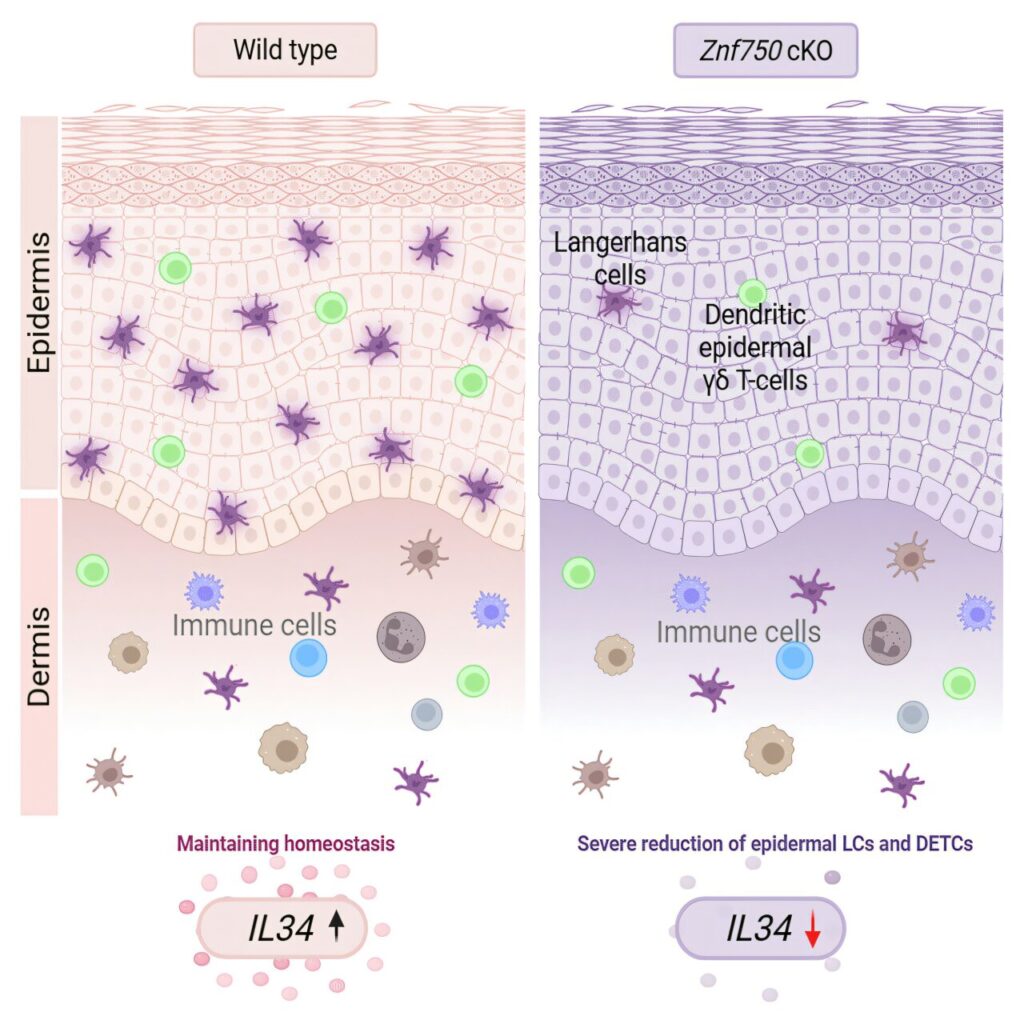
The study shows that a gene called ZNF750, active in skin cells (keratinocytes), is essential not only for forming healthy skin but also for supporting Langerhans cells—specialized immune cells that live in the outer layer of the skin and function as frontline sentinels against infection.
Skin cells don’t work alone
The skin is often thought of as a passive shield, but it is also a highly active immune organ. For the skin to function properly, skin cells and immune cells must develop together.
Until now, scientists have not fully understood how this coordination happens.
“Our study shows that skin cells themselves actively support immune cells,” said Prof. Idan Cohen of BGU’s Faculty of Health Sciences, one of the study’s senior authors. “They don’t just build a wall—they create an environment that allows immune cells to survive and thrive.”
Using genetically engineered mice, the researchers removed ZNF750 specifically from skin cells while leaving immune cells untouched. The result was striking:
- Immune cells nearly vanished from the outer skin layer
- The loss was especially severe for Langerhans cells, which play a key role in immune surveillance
- Immune cells in deeper skin layers remained normal
Importantly, the immune cells that did remain were fully formed and functional—they simply could not survive long-term in the skin.
“This told us the problem wasn’t the immune cells themselves,” explained Prof. Roi Gazit, co-senior author of the study. “The problem was that the skin was no longer providing what they needed to stay alive.”
The missing signal: IL-34
The team discovered that ZNF750 controls the production of IL-34, a molecule released by skin cells that acts as a survival signal for Langerhans cells.
Without ZNF750:
- IL-34 levels dropped sharply
- Langerhans cells lost their support system and gradually disappeared
In effect, ZNF750 acts as a primary coordinator, ensuring that as the skin barrier forms, immune protection forms alongside it.
Immunological implications for human health
Mutations in ZNF750 are already known to cause rare inherited skin disorders and to be linked to psoriasis, a chronic inflammatory disease. Langerhans cells are also reduced in psoriasis and atopic dermatitis, conditions marked by disrupted skin immunity.
“These findings help explain why defects in skin structure are often accompanied by immune dysfunction,” said Prof. Cohen. “They also point to new therapeutic directions—perhaps restoring key support signals like IL-34 could help rebalance skin immunity.”
Beyond skin disease, the study highlights a broader biological principle: tissues are built through constant dialogue between structural cells and immune cells. When that dialogue breaks down, disease can follow.
A new way of thinking about barriers and immunity
The research challenges the traditional view that physical barriers and immune defenses are built separately.
“Our work shows that a single gene can coordinate both,” said Prof. Gazit. “It’s a powerful example of how the body integrates form and function—and why disrupting one part of the system can have far-reaching consequences.”
Publication details
Lotem Adar et al, Keratinocyte differentiation transcription factor ZNF750 coordinates the development of epidermal immunocytes, Cell Reports (2025). DOI: 10.1016/j.celrep.2025.116648
Journal information:
Cell Reports
Key medical concepts
Citation:
A single skin gene helps build the body’s first line of immune defense (2026, February 3)
retrieved 3 February 2026
from https://medicalxpress.com/news/2026-02-skin-gene-body-line-immune.html
This document is subject to copyright. Apart from any fair dealing for the purpose of private study or research, no
part may be reproduced without the written permission. The content is provided for information purposes only.

Khamrah by Lattafa for Men - 3.4 oz EDP Spray
4% Off
Ghost Sweetheart Eau de Toilette | Pineapple, Jasmine and Sandalwood | Perfume for Women 50 ml
50% Off
Marc Jacobs Dot Eau De Parfum for Women, 100 ml
42% Off
Ted Baker W Eau de Toilette for Her, Fig Leaf, White Peony and Violet Top Notes, Pink Orchid and Raspberry Middle Notes, 75ml
£11.77 (£15.69 / 100 ml) (as of 12/05/2026 03:13 GMT +01:00 - More infoProduct prices and availability are accurate as of the date/time indicated and are subject to change. Any price and availability information displayed on [relevant Amazon Site(s), as applicable] at the time of purchase will apply to the purchase of this product.)
Ted Baker Woman Pink Eau de Toilette Spray Floral Green Feminine Fragrance, Opening Notes are Fresh Peach, Bergamot and Tangerine with Warm Musk, Vanilla and Vetiver Base, 100ml
11% Off
Vera Wang Princess Eau de Toilette - 30 ml

Choco Musk 50ml Eau De Parfum for men and women | Chocolate Musk by Jannat Aromas
17% Off
Christina Aguilera Signature Eau de Parfum (50ml) Floral, Fruity & Exotic Scent, Luxury Fragrance for Women
9% Off
Calvin Klein - Eau De Toilette CKIN2U - Calvin Klein Women, Ladies Perfume, Women's Perfume, Calvin Klein Perfume, Calvin Klein One - 150 ml
5% Off
Jimmy Choo Flash Eau de Parfum, 60 ml (Pack of 1)
3% Off
Fruit of the Loom Men's Heavy T Shirt, White, XL UK
28% Off
ATNKE LED Lighted Beanie Cap,USB Rechargeable Running Hat Ultra Bright 4 LED Waterproof Light Winter Warm Gifts for Men and Women/Pink
17% Off
Men's 1/4 Zip Pullover UK Sale Clearance, Fleece Sweatshirt Casual Jumper Long Sleeve T-shirt Top Stand Collar Sweater Plain Pullover Sports Leisure Workwear Quarter Zip Sweater Lightweight Jumpers
£5.88 (as of 12/11/2025 00:52 GMT +01:00 - More infoProduct prices and availability are accurate as of the date/time indicated and are subject to change. Any price and availability information displayed on [relevant Amazon Site(s), as applicable] at the time of purchase will apply to the purchase of this product.)
Crevice Cleaning Brush, Bathroom Tile Groove Gap Cleaning Brush,Premium Crevice Cleaning Tool Aluminum Support with 15° Angle Magic Brush, Thin Brush for Home Kitchen
19% Off
Wireless Earbuds, Bluetooth 5.3 Headphones in Ear with HiFi Stereo Deep Bass, 4 ENC Noise Cancelling Mic Wireless Earphones 40H Playtime, Bluetooth Earbuds Dual LED Display, IP7 Waterproof, USB-C
42% Off