A new research paper was published in Aging titled, “A novel deep proteomic approach in human skeletal muscle unveils distinct molecular signatures affected by aging and resistance training.”
The skeletal muscle proteome alterations to aging and resistance training have been reported in prior studies. However, conventional proteomics in skeletal muscle typically yields wide protein abundance ranges that mask the detection of lowly expressed proteins.
In this new study, researchers from Auburn University, Seer, Inc., and The Center for Applied Health Sciences adopted a novel deep proteomics approach whereby myofibril (MyoF) and non-MyoF fractions were separately subjected to protein corona nanoparticle complex formation prior to digestion and Liquid Chromatography Mass Spectrometry (LC-MS).
“Specifically, we investigated MyoF and non-MyoF proteomic profiles of the vastus lateralis muscle of younger (Y, 22±2 years old; n=5) and middle-aged participants (MA, 56±8 years old; n=6). Additionally, MA muscle was analyzed following eight weeks of resistance training (RT, 2d/week),” the researchers write.
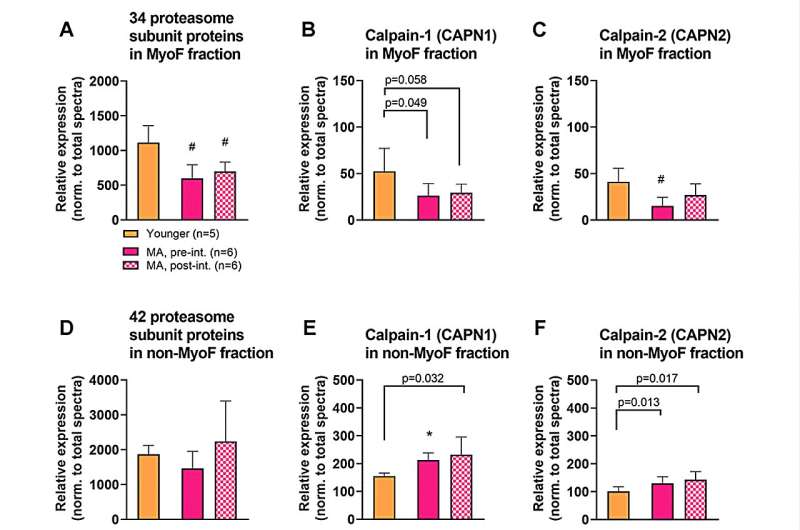
Across all participants, the number of non-MyoF proteins detected averaged to be 5,645±266 (range: 4,888–5,987) and the number of MyoF proteins detected averaged to be 2,611±326 (range: 1,944–3,101). Differences in the non-MyoF (8.4%) and MyoF (2.5%) proteomes were evident between age cohorts, and most differentially expressed non-MyoF proteins (447/543) were more enriched in MA versus Y.
Biological processes in the non-MyoF fraction were predicted to be operative in MA versus Y including increased cellular stress, mRNA splicing, translation elongation, and ubiquitin-mediated proteolysis. RT in MA participants only altered ~0.3% of MyoF and ~1.0% of non-MyoF proteomes.
“In summary, aging and RT predominantly affect non-contractile proteins in skeletal muscle. Additionally, marginal proteome adaptations with RT suggest more rigorous training may stimulate more robust effects or that RT, regardless of age, subtly alters basal state skeletal muscle protein abundances,” the authors conclude.
More information:
Michael D. Roberts et al, A novel deep proteomic approach in human skeletal muscle unveils distinct molecular signatures affected by aging and resistance training, Aging (2024). DOI: 10.18632/aging.205751
Provided by
Impact Journals LLC
Citation:
A novel deep proteomic approach unveils molecular signatures affected by aging and resistance training (2024, May 1)
retrieved 1 May 2024
from https://medicalxpress.com/news/2024-05-deep-proteomic-approach-unveils-molecular.html
This document is subject to copyright. Apart from any fair dealing for the purpose of private study or research, no
part may be reproduced without the written permission. The content is provided for information purposes only.

Khamrah by Lattafa for Men - 3.4 oz EDP Spray
4% Off
Ghost Sweetheart Eau de Toilette | Pineapple, Jasmine and Sandalwood | Perfume for Women 50 ml
50% Off
Marc Jacobs Dot Eau De Parfum for Women, 100 ml
42% Off
Ted Baker W Eau de Toilette for Her, Fig Leaf, White Peony and Violet Top Notes, Pink Orchid and Raspberry Middle Notes, 75ml
£11.77 (£15.69 / 100 ml) (as of 01/05/2026 03:09 GMT +01:00 - More infoProduct prices and availability are accurate as of the date/time indicated and are subject to change. Any price and availability information displayed on [relevant Amazon Site(s), as applicable] at the time of purchase will apply to the purchase of this product.)
Ted Baker Woman Pink Eau de Toilette Spray Floral Green Feminine Fragrance, Opening Notes are Fresh Peach, Bergamot and Tangerine with Warm Musk, Vanilla and Vetiver Base, 100ml
11% Off
Vera Wang Princess Eau de Toilette - 30 ml

Choco Musk 50ml Eau De Parfum for men and women | Chocolate Musk by Jannat Aromas
17% Off
Christina Aguilera Signature Eau de Parfum (50ml) Floral, Fruity & Exotic Scent, Luxury Fragrance for Women
9% Off
Calvin Klein - Eau De Toilette CKIN2U - Calvin Klein Women, Ladies Perfume, Women's Perfume, Calvin Klein Perfume, Calvin Klein One - 150 ml
5% Off
Jimmy Choo Flash Eau de Parfum, 60 ml (Pack of 1)
3% Off
Fruit of the Loom Men's Heavy T Shirt, White, XL UK
28% Off
ATNKE LED Lighted Beanie Cap,USB Rechargeable Running Hat Ultra Bright 4 LED Waterproof Light Winter Warm Gifts for Men and Women/Pink
17% Off
Men's 1/4 Zip Pullover UK Sale Clearance, Fleece Sweatshirt Casual Jumper Long Sleeve T-shirt Top Stand Collar Sweater Plain Pullover Sports Leisure Workwear Quarter Zip Sweater Lightweight Jumpers
£5.88 (as of 12/11/2025 00:52 GMT +01:00 - More infoProduct prices and availability are accurate as of the date/time indicated and are subject to change. Any price and availability information displayed on [relevant Amazon Site(s), as applicable] at the time of purchase will apply to the purchase of this product.)
Crevice Cleaning Brush, Bathroom Tile Groove Gap Cleaning Brush,Premium Crevice Cleaning Tool Aluminum Support with 15° Angle Magic Brush, Thin Brush for Home Kitchen
19% Off
Wireless Earbuds, Bluetooth 5.3 Headphones in Ear with HiFi Stereo Deep Bass, 4 ENC Noise Cancelling Mic Wireless Earphones 40H Playtime, Bluetooth Earbuds Dual LED Display, IP7 Waterproof, USB-C
42% Off