 [
[

Pancreatic cancer can remain quiet for years, developing undetected before causing symptoms that lead to a diagnosis. Even after a surgeon removes a pancreas tumor, other cells often hide and erupt later. But University of Rochester Medicine researchers made an important laboratory discovery about why and how this happens—with the goal of targeting pancreas cancer with newer immunotherapy drugs.
“Pancreatic cancer is an urgent problem, with a five-year survival rate of only 13%,” said Darren Carpizo, MD, Ph.D., a surgeon-scientist and member of the Wilmot Cancer Institute, who led the study now published in Developmental Cell.
“I routinely see patients who undergo surgery and experience a recurrence despite our best efforts, and that is disappointing. Our new study brings us another step closer to understanding how these pancreas tumor cells can hide out for long periods of time, and how to target them.”
Pancreatic cancer challenges
Evasion of the immune system is a unique feature of pancreatic cancer. This means that some of the most successful immunotherapies developed in recent years, which rally the immune system to attack cancer, are not effective in pancreatic cancer.
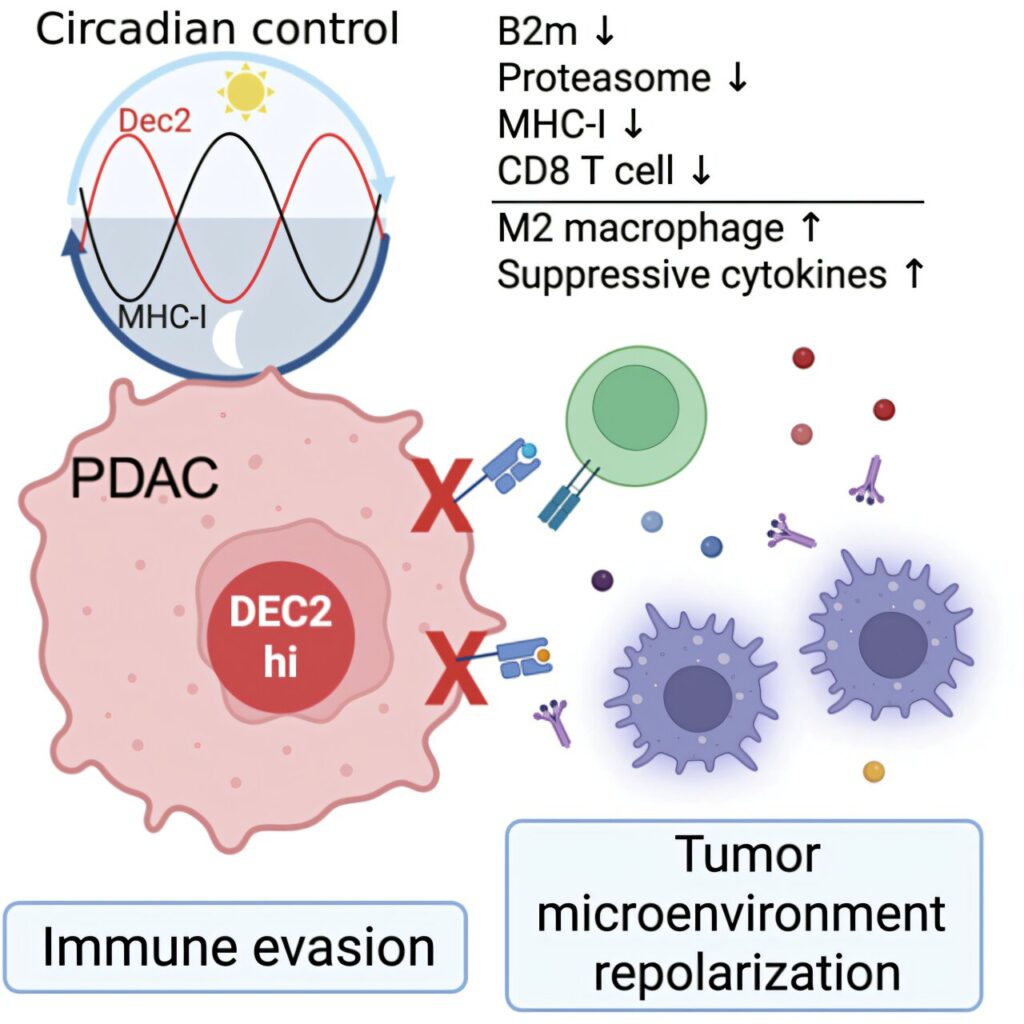
Carpizo’s team discovered key molecular activities that may explain why. A gene with previously unknown activities, Dec2, can disguise pancreatic cancer cells when the immune system’s killer T cells are trying to seek and destroy them. Dec2 does this by regulating a molecule on the surface of tumor cells. But when researchers knocked out Dec2 in the lab, the immune cells were able to find the pancreas cancer cells—boosting the potential that Dec2 could be a new target for therapy in the future.
The gene Dec2 also has its own “sleep-wake” cycle, an internal clock known as circadian rhythm. Dec2’s levels go up and down within pancreas cancer cells throughout the day. Thus, researchers were able to show that the time of day mattered when T cells tried to kill pancreas cancer cells—a highly novel finding, Carpizo said.
The circadian rhythm discovery provides a biological explanation for why some cancer immunotherapies are more effective if they are given to patients at certain times of the day. For example, clinicians have observed that immunotherapy given in the morning seems to work better than in the evening, he said.
Pancreatic cancer vaccine
An experimental mRNA vaccine for pancreatic cancer has been in the news lately. The vaccine, tested in a small clinical trial at Memorial Sloan Kettering with 16 patients, boosted survivorship for half of the participants. The eight patients who were able to generate an immune response to kill the disease remained alive for several years.
Although this development is exciting, Carpizo said he is concerned with finding a solution for the eight people who did not respond to the vaccine.
“Vaccines like this one depend on T cells being able to seek out and destroy cancer cells,” he said. “Our research has important implications for this, because if the actions of Dec2 will not allow the vaccine to work properly, it may explain why 50% of the patients didn’t do well. Targeting Dec2 may be an alternative solution.”
Carpizo is a professor of Surgery and of Biomedical Genetics at URochester Medicine, and co-leader of Wilmot’s Genetics, Epigenetics, and Metabolism (GEM) basic research program.
Carpizo’s team designed a special laboratory model using mice to mirror how pancreatic cancer progresses in humans. The model enables them to examine the cancer microenvironment—the interplay of tissues and cells in the area surrounding tumors that makes it favorable for cancer.
The project began in 2023, when Carpizo and Wilmot co-investigators Paula Vertino, Ph.D., Senior Associate Dean for Basic Research at URochester Medicine, and Brian Altman, Ph.D., associate professor of Biomedical Genetics, won a pilot grant from Wilmot. That project led to the discovery of a separate circadian gene, BMAL1, which also regulates pancreatic cancer progression and metastasis through immune evasion.
Publication details
Lan Wang et al, The circadian gene Dec2 promotes pancreatic cancer progression and dormancy through immune evasion, Developmental Cell (2026). DOI: 10.1016/j.devcel.2026.04.001. www.cell.com/developmental-cel … 1534-5807(26)00124-3
Journal information:
Developmental Cell
Clinical categories
Citation:
Genetic discovery may explain why pancreatic cancer is so difficult to treat (2026, April 30)
retrieved 30 April 2026
from https://medicalxpress.com/news/2026-04-genetic-discovery-pancreatic-cancer-difficult.html
This document is subject to copyright. Apart from any fair dealing for the purpose of private study or research, no
part may be reproduced without the written permission. The content is provided for information purposes only.

Khamrah by Lattafa for Men - 3.4 oz EDP Spray
4% Off
Ghost Sweetheart Eau de Toilette | Pineapple, Jasmine and Sandalwood | Perfume for Women 50 ml
50% Off
Marc Jacobs Dot Eau De Parfum for Women, 100 ml
42% Off
Ted Baker W Eau de Toilette for Her, Fig Leaf, White Peony and Violet Top Notes, Pink Orchid and Raspberry Middle Notes, 75ml
£11.77 (£15.69 / 100 ml) (as of 27/07/2026 04:03 GMT +01:00 - More infoProduct prices and availability are accurate as of the date/time indicated and are subject to change. Any price and availability information displayed on [relevant Amazon Site(s), as applicable] at the time of purchase will apply to the purchase of this product.)
Ted Baker Woman Pink Eau de Toilette Spray Floral Green Feminine Fragrance, Opening Notes are Fresh Peach, Bergamot and Tangerine with Warm Musk, Vanilla and Vetiver Base, 100ml
11% Off
Vera Wang Princess Eau de Toilette - 30 ml

Choco Musk 50ml Eau De Parfum for men and women | Chocolate Musk by Jannat Aromas
17% Off
Christina Aguilera Signature Eau de Parfum (50ml) Floral, Fruity & Exotic Scent, Luxury Fragrance for Women
9% Off
Calvin Klein - Eau De Toilette CKIN2U - Calvin Klein Women, Ladies Perfume, Women's Perfume, Calvin Klein Perfume, Calvin Klein One - 150 ml
5% Off
Jimmy Choo Flash Eau de Parfum, 60 ml (Pack of 1)
3% Off
Fruit of the Loom Men's Heavy T Shirt, White, XL UK
28% Off
ATNKE LED Lighted Beanie Cap,USB Rechargeable Running Hat Ultra Bright 4 LED Waterproof Light Winter Warm Gifts for Men and Women/Pink
17% Off
Men's 1/4 Zip Pullover UK Sale Clearance, Fleece Sweatshirt Casual Jumper Long Sleeve T-shirt Top Stand Collar Sweater Plain Pullover Sports Leisure Workwear Quarter Zip Sweater Lightweight Jumpers
£5.88 (as of 12/11/2025 00:52 GMT +01:00 - More infoProduct prices and availability are accurate as of the date/time indicated and are subject to change. Any price and availability information displayed on [relevant Amazon Site(s), as applicable] at the time of purchase will apply to the purchase of this product.)
Crevice Cleaning Brush, Bathroom Tile Groove Gap Cleaning Brush,Premium Crevice Cleaning Tool Aluminum Support with 15° Angle Magic Brush, Thin Brush for Home Kitchen
19% Off
Wireless Earbuds, Bluetooth 5.3 Headphones in Ear with HiFi Stereo Deep Bass, 4 ENC Noise Cancelling Mic Wireless Earphones 40H Playtime, Bluetooth Earbuds Dual LED Display, IP7 Waterproof, USB-C
42% Off