A new study of prion diseases, using a human cerebral organoid model, suggests there is a substantial species barrier preventing transmission of chronic wasting disease (CWD) from cervids—deer, elk and moose—to people. The findings, from National Institutes of Health scientists and published in Emerging Infectious Diseases, are consistent with decades of similar research in animal models at the NIH’s National Institute of Allergy and Infectious Diseases (NIAID).
Prion diseases are degenerative diseases found in some mammals. These diseases primarily involve deterioration of the brain but can also affect the eyes and other organs. Disease and death occur when abnormal proteins fold, clump together, recruit other prion proteins to do the same, and eventually destroy the central nervous system. Currently, there are no preventive or therapeutic treatments for prion diseases.
CWD is a type of prion disease found in cervids, which are popular game animals. While CWD has never been found in people, a question about its transmission potential has lingered for decades: Can people who eat meat from CWD-infected cervids develop prion disease? The question is important because during the mid-1980s and mid-1990s a different prion disease—bovine spongiform encephalopathy (BSE), or mad cow disease—emerged in cattle in the United Kingdom (U.K.) and cases also were detected in cattle in other countries, including the United States.
Over the next decade, 178 people in the U.K. who were thought to have eaten BSE-infected beef developed a new form of a human prion disease, variant Creutzfeldt-Jakob Disease, and died. Researchers later determined that the disease had spread among cattle through feed tainted with infectious prion protein.
The disease transmission path from feed to cattle to people terrified U.K. residents and put the world on alert for other prion diseases transmitted from animals to people, including CWD. CWD is the most transmissible of the prion disease family, showing highly efficient transmission between cervids.
Historically, scientists have used mice, hamsters, squirrel monkeys and cynomolgus macaques to mimic prion diseases in people, sometimes monitoring animals for signs of CWD for more than a decade. In 2019, NIAID scientists at Rocky Mountain Laboratories in Hamilton, Montana, developed a human cerebral organoid model of Creutzfeldt-Jakob Disease to evaluate potential treatments and to study specific human prion diseases.
Human cerebral organoids are small spheres of human brain cells ranging in size from a poppy seed to a pea. Scientists grow organoids in dishes from human skin cells. The organization, structure, and electrical signaling of cerebral organoids are similar to brain tissue. They are currently the closest available laboratory model to the human brain.
Because organoids can survive in a controlled environment for months, scientists use them to study nervous system diseases over time. Cerebral organoids have been used as models to study other diseases, such as Zika virus infection, Alzheimer’s disease, and Down syndrome.
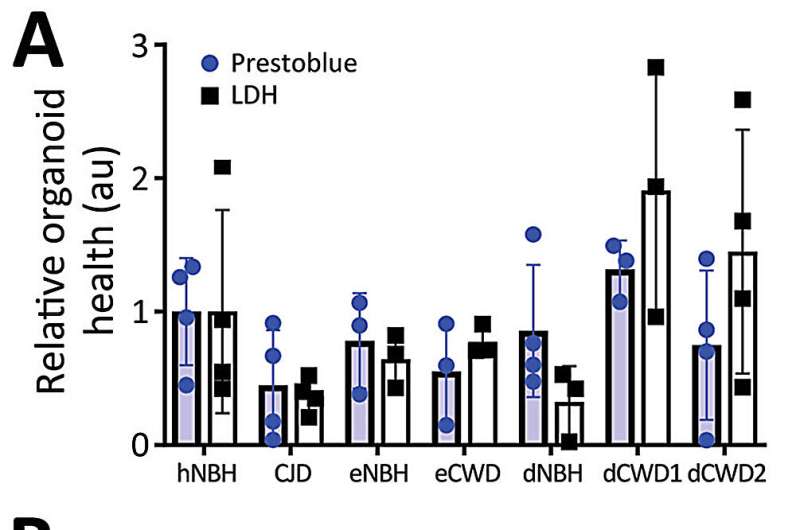
In the new CWD study, the bulk of which was done in 2022 and 2023, the research team validated the study model by successfully infecting human cerebral organoids with human CJD prions (positive control). Then, using the same laboratory conditions, they directly exposed healthy human cerebral organoids for seven days with high concentrations of CWD prions from white-tailed deer, mule deer, elk, and normal brain matter (negative control). The researchers then observed the organoids for up to six months, and none became infected with CWD.
This indicates that even following direct exposure of human central nervous system tissues to CWD prions there is a substantial resistance or barrier to the propagation of infection, according to researchers. The authors acknowledge the limitations of their research, including the possibility that a small number of people may have genetic susceptibility that was not accounted for, and that emergence of new strains with a lesser barrier to infection remains possible.
They are optimistic that the inference of these current data is that humans are extremely unlikely to contract a prion disease because of inadvertently eating CWD-infected cervid meat.
More information:
B Groveman and K Williams et al. (2024). Lack of Transmission of Chronic Wasting Disease Prions to Human Cerebral Organoids. Emerging Infectious Diseases DOI: 10.3201/eid3006.231568, wwwnc.cdc.gov/eid/article/30/6/23-1568_article
Citation:
Study suggests chronic wasting disease unlikely to move from animals to people (2024, May 17)
retrieved 17 May 2024
from https://medicalxpress.com/news/2024-05-chronic-disease-animals-people.html
This document is subject to copyright. Apart from any fair dealing for the purpose of private study or research, no
part may be reproduced without the written permission. The content is provided for information purposes only.

Khamrah by Lattafa for Men - 3.4 oz EDP Spray
4% Off
Ghost Sweetheart Eau de Toilette | Pineapple, Jasmine and Sandalwood | Perfume for Women 50 ml
50% Off
Marc Jacobs Dot Eau De Parfum for Women, 100 ml
42% Off
Ted Baker W Eau de Toilette for Her, Fig Leaf, White Peony and Violet Top Notes, Pink Orchid and Raspberry Middle Notes, 75ml
£11.77 (£15.69 / 100 ml) (as of 16/07/2026 03:58 GMT +01:00 - More infoProduct prices and availability are accurate as of the date/time indicated and are subject to change. Any price and availability information displayed on [relevant Amazon Site(s), as applicable] at the time of purchase will apply to the purchase of this product.)
Ted Baker Woman Pink Eau de Toilette Spray Floral Green Feminine Fragrance, Opening Notes are Fresh Peach, Bergamot and Tangerine with Warm Musk, Vanilla and Vetiver Base, 100ml
11% Off
Vera Wang Princess Eau de Toilette - 30 ml

Choco Musk 50ml Eau De Parfum for men and women | Chocolate Musk by Jannat Aromas
17% Off
Christina Aguilera Signature Eau de Parfum (50ml) Floral, Fruity & Exotic Scent, Luxury Fragrance for Women
9% Off
Calvin Klein - Eau De Toilette CKIN2U - Calvin Klein Women, Ladies Perfume, Women's Perfume, Calvin Klein Perfume, Calvin Klein One - 150 ml
5% Off
Jimmy Choo Flash Eau de Parfum, 60 ml (Pack of 1)
3% Off
Fruit of the Loom Men's Heavy T Shirt, White, XL UK
28% Off
ATNKE LED Lighted Beanie Cap,USB Rechargeable Running Hat Ultra Bright 4 LED Waterproof Light Winter Warm Gifts for Men and Women/Pink
17% Off
Men's 1/4 Zip Pullover UK Sale Clearance, Fleece Sweatshirt Casual Jumper Long Sleeve T-shirt Top Stand Collar Sweater Plain Pullover Sports Leisure Workwear Quarter Zip Sweater Lightweight Jumpers
£5.88 (as of 12/11/2025 00:52 GMT +01:00 - More infoProduct prices and availability are accurate as of the date/time indicated and are subject to change. Any price and availability information displayed on [relevant Amazon Site(s), as applicable] at the time of purchase will apply to the purchase of this product.)
Crevice Cleaning Brush, Bathroom Tile Groove Gap Cleaning Brush,Premium Crevice Cleaning Tool Aluminum Support with 15° Angle Magic Brush, Thin Brush for Home Kitchen
19% Off
Wireless Earbuds, Bluetooth 5.3 Headphones in Ear with HiFi Stereo Deep Bass, 4 ENC Noise Cancelling Mic Wireless Earphones 40H Playtime, Bluetooth Earbuds Dual LED Display, IP7 Waterproof, USB-C
42% Off