 [
[

A new study from Karolinska Institutet shows that an enzyme in the liver may partly explain sex differences in the body’s handling of cholesterol and the risk of developing atherosclerosis. The research, published in Nature Communications, is based on experiments conducted in mice and human liver cells.
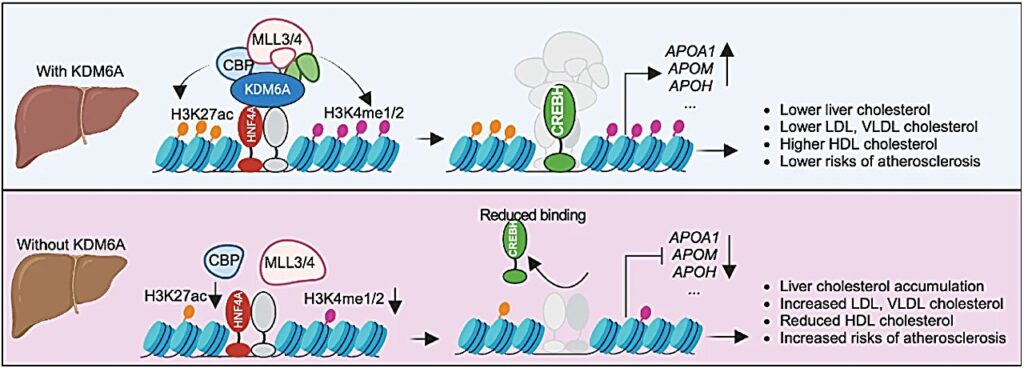
The study investigates how the enzyme KDM6A affects the liver’s regulation of cholesterol. The gene encoding this enzyme is located on the X chromosome and is therefore expressed at higher levels in females. By combining experiments in human liver cell lines and genetically modified mice, the researchers demonstrate that KDM6A is required to maintain the activity of key genes that regulate the metabolism of lipoproteins, i.e., the particles that transport cholesterol in the blood.
Counteracting the formation of harmful blood lipids
When KDM6A was specifically knocked out in the livers of female mice, their blood lipid profile changed markedly, while cholesterol accumulated in the liver and levels of conjugated bile acids rose sharply. In male mice, however, no major changes were observed. The female mice also developed more extensive atherosclerosis when exposed to a diet rich in fat and cholesterol.
“The sex differences in cellular metabolism caused by key enzymes in the sex chromosomes are largely overlooked,” says Rongrong Fan, group leader at the Department of Medicine Huddinge, Karolinska Institutet.
“Our results show that KDM6A plays a particularly important role in cholesterol metabolism in the liver cells of females but not males, where the enzyme helps activate genes that counteract the formation of harmful blood lipids.”
Cholesterol metabolism differs between the sexes
To understand the mechanism, the researchers mapped the proteins that interact with KDM6A. They found that the enzyme needs to bind to the transcription factor HNF4A to activate genes controlling lipoproteins. This, in turn, influences how another factor, CREBH, binds to DNA and initiates gene activity.
“Taken together, our data show that an entire network of proteins in the liver regulates cholesterol metabolism in a way that differs between the sexes.” says Lin Chen, the first author and Ph.D. candidate at Department of Medicine Huddinge at Karolinska Institutet.
Publication details
Lin Chen et al, Sex-specific KDM6A-HNF4A-CREBH network controls lipoprotein cholesterol metabolism and atherosclerosis via epigenetic reprograming of hepatocytes, Nature Communications (2026). DOI: 10.1038/s41467-026-70846-w
Journal information:
Nature Communications
Clinical categories
Citation:
X-linked liver enzyme may explain why women and men process cholesterol differently (2026, May 4)
retrieved 4 May 2026
from https://medicalxpress.com/news/2026-05-linked-liver-enzyme-women-men.html
This document is subject to copyright. Apart from any fair dealing for the purpose of private study or research, no
part may be reproduced without the written permission. The content is provided for information purposes only.

Khamrah by Lattafa for Men - 3.4 oz EDP Spray
4% Off
Ghost Sweetheart Eau de Toilette | Pineapple, Jasmine and Sandalwood | Perfume for Women 50 ml
50% Off
Marc Jacobs Dot Eau De Parfum for Women, 100 ml
42% Off
Ted Baker W Eau de Toilette for Her, Fig Leaf, White Peony and Violet Top Notes, Pink Orchid and Raspberry Middle Notes, 75ml
£11.77 (£15.69 / 100 ml) (as of 16/07/2026 03:58 GMT +01:00 - More infoProduct prices and availability are accurate as of the date/time indicated and are subject to change. Any price and availability information displayed on [relevant Amazon Site(s), as applicable] at the time of purchase will apply to the purchase of this product.)
Ted Baker Woman Pink Eau de Toilette Spray Floral Green Feminine Fragrance, Opening Notes are Fresh Peach, Bergamot and Tangerine with Warm Musk, Vanilla and Vetiver Base, 100ml
11% Off
Vera Wang Princess Eau de Toilette - 30 ml

Choco Musk 50ml Eau De Parfum for men and women | Chocolate Musk by Jannat Aromas
17% Off
Christina Aguilera Signature Eau de Parfum (50ml) Floral, Fruity & Exotic Scent, Luxury Fragrance for Women
9% Off
Calvin Klein - Eau De Toilette CKIN2U - Calvin Klein Women, Ladies Perfume, Women's Perfume, Calvin Klein Perfume, Calvin Klein One - 150 ml
5% Off
Jimmy Choo Flash Eau de Parfum, 60 ml (Pack of 1)
3% Off
Fruit of the Loom Men's Heavy T Shirt, White, XL UK
28% Off
ATNKE LED Lighted Beanie Cap,USB Rechargeable Running Hat Ultra Bright 4 LED Waterproof Light Winter Warm Gifts for Men and Women/Pink

Men's 1/4 Zip Pullover UK Sale Clearance, Fleece Sweatshirt Casual Jumper Long Sleeve T-shirt Top Stand Collar Sweater Plain Pullover Sports Leisure Workwear Quarter Zip Sweater Lightweight Jumpers
£5.88 (as of 12/11/2025 00:52 GMT +01:00 - More infoProduct prices and availability are accurate as of the date/time indicated and are subject to change. Any price and availability information displayed on [relevant Amazon Site(s), as applicable] at the time of purchase will apply to the purchase of this product.)
Crevice Cleaning Brush, Bathroom Tile Groove Gap Cleaning Brush,Premium Crevice Cleaning Tool Aluminum Support with 15° Angle Magic Brush, Thin Brush for Home Kitchen
19% Off
Wireless Earbuds, Bluetooth 5.3 Headphones in Ear with HiFi Stereo Deep Bass, 4 ENC Noise Cancelling Mic Wireless Earphones 40H Playtime, Bluetooth Earbuds Dual LED Display, IP7 Waterproof, USB-C
42% Off