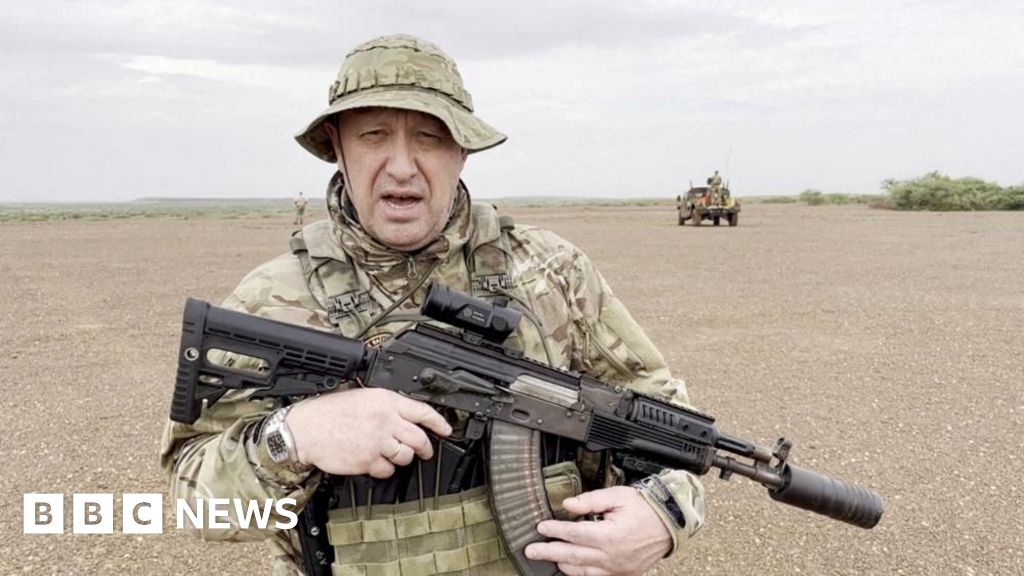
In the days after the mutiny, Prigozhin was said to have cut a deal with Mr Putin to focus his group’s operations in Africa, propping up regimes and securing resources for Russia. Following his death, deputy Defence Minister Yunus-Bek Yevkurov reportedly toured African capitals, assuring officials that the services provided by the group would not dissipate.
Earlier this month the Polish Institute of International Affairs (PISM) think tank observed that in the wake of Prigozhin’s death “the Russian state’s attention in [Africa] not only did not weaken, but strengthened”.
In February, the BBC obtained documents revealing that Moscow was offering a “regime survival package” in exchange for access to strategically important natural resources – an approach previously favoured by the Wagner Group.
The plan was being offered by a so-called Russian “expeditionary group” – nicknamed the Africa Corps – and commanded by former GRU Gen Andrey Averyanov. He previously oversaw secretive operations specialising in targeting killings and destabilising foreign governments.
Experts told the BBC that the Africa Corps has effectively replaced Wagner in West Africa. On Telegram, the unit boasted of offering recruits salaries of up to 110,000 roubles per year and service “under the leadership of competent commanders with extensive combat experience”.
In January, it announced its first deployment of 100 troops to Burkina Faso. Another 100 reportedly arrived in Niger in April.
Ruslan Trad, a security analyst with the Atlantic Council, told the BBC that, in effect, Wagner “became the Africa Corps and now serves the full purposes of military intelligence” and the ministry of defence.
“In Africa, these soldiers are doing much the same thing – guarding trade routes, securing resources that Moscow uses to circumvent sanctions, and more – serving local juntas and directing the flow of migrants,” he observed.
The PISM noted that the Africa Corps is intended to be used “more openly” than Wagner was on the continent with the intention of replacing Western – and particularly French – influence in Africa.
BBC Russian reported that only in the Central African Republic (CAR) is Wagner still operating in any shadow of its former shape, allegedly controlled by Prigozhin’s son Pavel.
“Moscow has given the heir the go-ahead to continue doing what his father did in Africa, on condition that it does not contradict Russia’s interests,” a source who used to work with Yevgeny Prigozhin told BBC Russian.
Source link

Khamrah by Lattafa for Men - 3.4 oz EDP Spray
4% Off
Ghost Sweetheart Eau de Toilette | Pineapple, Jasmine and Sandalwood | Perfume for Women 50 ml
50% Off
Marc Jacobs Dot Eau De Parfum for Women, 100 ml
42% Off
Ted Baker W Eau de Toilette for Her, Fig Leaf, White Peony and Violet Top Notes, Pink Orchid and Raspberry Middle Notes, 75ml
£11.77 (£15.69 / 100 ml) (as of 10/07/2026 03:55 GMT +01:00 - More infoProduct prices and availability are accurate as of the date/time indicated and are subject to change. Any price and availability information displayed on [relevant Amazon Site(s), as applicable] at the time of purchase will apply to the purchase of this product.)
Ted Baker Woman Pink Eau de Toilette Spray Floral Green Feminine Fragrance, Opening Notes are Fresh Peach, Bergamot and Tangerine with Warm Musk, Vanilla and Vetiver Base, 100ml
11% Off
Vera Wang Princess Eau de Toilette - 30 ml

Choco Musk 50ml Eau De Parfum for men and women | Chocolate Musk by Jannat Aromas
17% Off
Christina Aguilera Signature Eau de Parfum (50ml) Floral, Fruity & Exotic Scent, Luxury Fragrance for Women
9% Off
Calvin Klein - Eau De Toilette CKIN2U - Calvin Klein Women, Ladies Perfume, Women's Perfume, Calvin Klein Perfume, Calvin Klein One - 150 ml
5% Off
Jimmy Choo Flash Eau de Parfum, 60 ml (Pack of 1)
3% Off
Fruit of the Loom Men's Heavy T Shirt, White, XL UK
28% Off
ATNKE LED Lighted Beanie Cap,USB Rechargeable Running Hat Ultra Bright 4 LED Waterproof Light Winter Warm Gifts for Men and Women/Pink
17% Off
Men's 1/4 Zip Pullover UK Sale Clearance, Fleece Sweatshirt Casual Jumper Long Sleeve T-shirt Top Stand Collar Sweater Plain Pullover Sports Leisure Workwear Quarter Zip Sweater Lightweight Jumpers

Crevice Cleaning Brush, Bathroom Tile Groove Gap Cleaning Brush,Premium Crevice Cleaning Tool Aluminum Support with 15° Angle Magic Brush, Thin Brush for Home Kitchen
19% Off
Wireless Earbuds, Bluetooth 5.3 Headphones in Ear with HiFi Stereo Deep Bass, 4 ENC Noise Cancelling Mic Wireless Earphones 40H Playtime, Bluetooth Earbuds Dual LED Display, IP7 Waterproof, USB-C
42% Off