



 PA Media
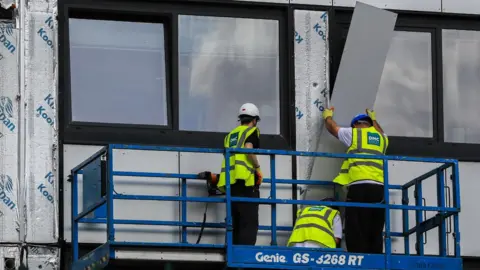
Up to £3bn of public money may have to be spent assessing and removing potentially flammable cladding from buildings in Scotland.
New estimates from the Scottish government suggest up to 1,450 residential buildings may need remediation work, including about 250 high-rises.
It was previously estimated about 900 buildings were affected.
However, full surveys will be needed to establish what needs to be done on a case-by-case basis, with 107 buildings being examined as part of a pilot phase.
The Building Safety Levy (Scotland) Bill will see a tax charged on the construction of certain new residential properties, in line with equivalent legislation in England.
The bill seeks to raise about £30m a year to help fund work to fix residential buildings with unsafe cladding which have no linked developer.
Public Finance Minister Ivan McKee said: “The Scottish government is committed to doing what is right and necessary to address the challenge of fixing buildings affected by unsafe cladding.
“That includes putting the appropriate funding arrangements in place to ensure that the associated costs of cladding remediation do not fall directly onto affected homeowners.
“I know that developers share our determination to keep people safe and this levy will ensure they make a fair contribution to these costs, just as they will be doing in England.”
He added: “I also welcome the continued co-operation of developers who have accepted responsibility for the assessments and any required mitigation and remediation of their buildings.”
Grenfell Tower fire
The UK government agreed in principle to devolve the powers needed for a Scottish Building Safety Levy last year.
Last month ministers announced plans to speed up efforts to inspect and repair buildings in response to the 2017 Grenfell Tower fire in London that killed 72 people.
The 23-storey tower’s cladding is believed to have contributed to the rapid spread of the fire.
It broke out in the kitchen of a fourth-floor flat at the tower block in North Kensington, just before 01:00 on 14 June 2017.
Within minutes, the fire had rapidly spread up the exterior of the building and moved across all four sides. By 03:00, most of the upper floors were well alight.
As well as those killed, more than 70 people were injured.
The Cladding Remediation Programme was set up in the aftermath of the disaster but Scottish ministers have been criticised for its slow progress.
BBC News

Khamrah by Lattafa for Men - 3.4 oz EDP Spray
4% Off
Ghost Sweetheart Eau de Toilette | Pineapple, Jasmine and Sandalwood | Perfume for Women 50 ml
50% Off
Marc Jacobs Dot Eau De Parfum for Women, 100 ml
42% Off
Ted Baker W Eau de Toilette for Her, Fig Leaf, White Peony and Violet Top Notes, Pink Orchid and Raspberry Middle Notes, 75ml
£11.77 (£15.69 / 100 ml) (as of 20/10/2026 06:36 GMT +01:00 - More infoProduct prices and availability are accurate as of the date/time indicated and are subject to change. Any price and availability information displayed on [relevant Amazon Site(s), as applicable] at the time of purchase will apply to the purchase of this product.)
Ted Baker Woman Pink Eau de Toilette Spray Floral Green Feminine Fragrance, Opening Notes are Fresh Peach, Bergamot and Tangerine with Warm Musk, Vanilla and Vetiver Base, 100ml
11% Off
Vera Wang Princess Eau de Toilette - 30 ml

Choco Musk 50ml Eau De Parfum for men and women | Chocolate Musk by Jannat Aromas
17% Off
Christina Aguilera Signature Eau de Parfum (50ml) Floral, Fruity & Exotic Scent, Luxury Fragrance for Women
9% Off
Calvin Klein - Eau De Toilette CKIN2U - Calvin Klein Women, Ladies Perfume, Women's Perfume, Calvin Klein Perfume, Calvin Klein One - 150 ml
5% Off
Jimmy Choo Flash Eau de Parfum, 60 ml (Pack of 1)
3% Off
Fruit of the Loom Men's Heavy T Shirt, White, XL UK
28% Off
ATNKE LED Lighted Beanie Cap,USB Rechargeable Running Hat Ultra Bright 4 LED Waterproof Light Winter Warm Gifts for Men and Women/Pink
17% Off
Men's 1/4 Zip Pullover UK Sale Clearance, Fleece Sweatshirt Casual Jumper Long Sleeve T-shirt Top Stand Collar Sweater Plain Pullover Sports Leisure Workwear Quarter Zip Sweater Lightweight Jumpers
£5.88 (as of 12/11/2025 00:52 GMT +01:00 - More infoProduct prices and availability are accurate as of the date/time indicated and are subject to change. Any price and availability information displayed on [relevant Amazon Site(s), as applicable] at the time of purchase will apply to the purchase of this product.)
Crevice Cleaning Brush, Bathroom Tile Groove Gap Cleaning Brush,Premium Crevice Cleaning Tool Aluminum Support with 15° Angle Magic Brush, Thin Brush for Home Kitchen
19% Off
Wireless Earbuds, Bluetooth 5.3 Headphones in Ear with HiFi Stereo Deep Bass, 4 ENC Noise Cancelling Mic Wireless Earphones 40H Playtime, Bluetooth Earbuds Dual LED Display, IP7 Waterproof, USB-C
42% Off