 [
[

Education, intellectually stimulating work and an active lifestyle help preserve cognitive abilities in adults over 65 and lead to more effective verbal expression and stronger cognitive performance. But there is another important factor: emotions. The way we recognize and interpret them can significantly influence the efficiency of cognitive processes as we age.
These findings emerge from two new studies conducted by the laboratory of Raffaella Rumiati at the Scuola Internazionale Superiore di Studi Avanzati (SISSA) in Trieste, Italy, recently published in Neuropsychology and Brain Sciences. The researchers examined how a group of adults over age 65 performed on various tasks to identify factors that help preserve cognitive function later in life.
The first authors of the two studies, Elisabetta Pisanu and Stefania Lucia, focused in particular on the role of cognitive reserve—the set of mental resources accumulated throughout life through education, professional experience and intellectually engaging leisure activities. The first study found that individuals with greater cognitive reserve performed better in language tasks, showing a greater ability to express themselves and retrieve the right words. Positive emotions also contributed to better language performance.
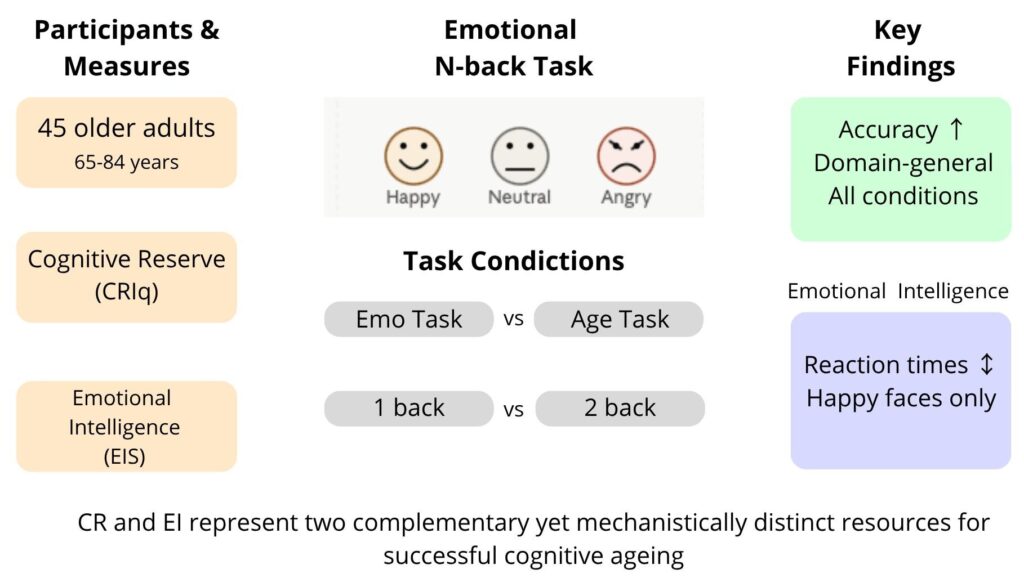
The second study showed that cognitive reserve also plays a key role in supporting working memory—the ability to temporarily retain, process and use information to complete a task. Emotions also influence these cognitive processes: They not only improve performance but also shape the way we respond to different stimuli. In particular, higher emotional intelligence, i.e., the ability to recognize, understand and use emotions to guide thinking, behavior and relationships, was found to significantly influence participants’ responses to emotional stimuli.
Overall, the findings confirm that an intellectually stimulating life helps preserve cognitive function as we grow older. They also suggest that cognitive and emotional resources do not operate independently but work together to support healthier and more efficient cognitive aging. Both studies were carried out as part of Age-It: Ageing Well in an Ageing Society, a major Italian research program investigating the challenges and opportunities associated with population aging.
Finding the right words: Cognitive reserve and emotions shape language in later life
Cognitive reserve helps preserve language abilities as we age. The study published in Neuropsychology found that older adults with greater cognitive reserve maintained better language performance than their peers.
“Our findings show that older adults with higher cognitive reserve achieve language performance comparable to that of younger adults,” explains Pisanu, first author of the study. “In our experiments, we focused on what happens during the first 10 seconds of a verbal fluency task, when people search for the right words to express their thoughts. This brief time window captures the fastest and most automatic processes involved in word retrieval, without the need for the traditional one-minute test. We found that these first 10 seconds are already sufficient to reveal the effects of both aging and cognitive reserve on language performance.”
The researchers observed that a decline in performance is already detectable during these initial moments in adults over 65. However, this decline is greatly reduced and may even disappear in individuals with high cognitive reserve. “In other words,” the researchers explain, “cognitive reserve helps keep the brain ‘young,’ at least when it comes to language and word retrieval.”
The study also found that not all words are equally easy to retrieve. According to Pisanu: “Older adults retrieve words associated with positive emotions more easily than those linked to negative emotions. These findings suggest that, alongside the protective role of cognitive reserve, the emotional valence of words also contributes to language performance.”
Aging and working memory: Experience and emotions support cognition in different ways
As we grow older, working memory—the ability to temporarily hold, process and use information to complete a task—also tends to become less efficient. The study published in Brain Sciences investigated how cognitive reserve and emotional intelligence contribute to working memory, particularly when emotions are relevant to the task at hand.
To address this question, the researchers asked a group of adults over age 65 to complete a working memory task in which, depending on the condition, they had to focus either on the emotional expression or on the age of the faces presented to them. “We wanted to understand whether cognitive reserve and emotional intelligence play different roles depending on whether emotions are relevant—or irrelevant—to a working memory task,” explains Lucia, first author of the study.
The findings showed that cognitive reserve improves performance regardless of the type of task. “Our results indicate that cognitive reserve enhances performance accuracy independently of the experimental condition,” says Lucia. “This suggests that it plays a fundamental role in supporting the ability to maintain and manipulate the information needed to carry out a task.”
The role of emotions also emerged clearly. “When the task involves emotional content, older adults perform better: They appear to become more efficient,” Lucia observes. Emotional intelligence, in turn, influences the way people process information and respond to the task.
“It affects how individuals process information and generate a response, ultimately shaping their performance. For example, people with higher emotional intelligence take longer to respond to emotional stimuli, probably because they devote greater attentional and cognitive resources to processing them. This does not reflect greater difficulty, but rather deeper and more thorough processing of emotional information.”
Rumiati: Understanding cognitive aging is a scientific and societal challenge
“Both of these studies were carried out as part of Age-It: Ageing Well in an Ageing Society, an ambitious national research program that has laid the foundations for a research and data infrastructure dedicated to the study of aging from multiple perspectives, including socioeconomic, biomedical and technological dimensions,” says Rumiati, neuroscientist at SISSA and principal investigator of both studies.
“Italy is one of the world’s longest-lived countries, together with Japan. While this is an extraordinary achievement, it also brings new challenges. As the older population continues to grow, so does the demand for health care and long-term care services. Understanding how to preserve cognitive abilities for as long as possible is therefore essential—not only to improve people’s quality of life but also to help ensure the sustainability of health care and social welfare systems.”
According to Rumiati, cognitive decline and the strategies to counteract it are among the major challenges of an aging society. “Our research can contribute in two important ways: by improving the methodological tools used to study cognitive aging and by identifying the factors that help protect cognitive functions as people grow older.”
She concludes, “Our findings show that an intellectually stimulating life helps preserve a wide range of cognitive functions, from language to working memory. They also highlight the important role of emotions, which, as our studies suggest, make a significant contribution to the efficiency of cognitive processes. Taken together, these findings indicate that cognitive reserve and emotional skills contribute to healthier and more efficient cognitive aging. These are promising results that we intend to explore further in future studies.”
Publication details
Elisabetta Pisanu et al, Verbal fluency across the lifespan: The role of cognitive reserve and expression suppression in the first 10-s performance., Neuropsychology (2026). DOI: 10.1037/neu0001114
Stefania Lucia et al, Emotional Modulation of Working Memory in Older Adults: Dissociable Contributions of Cognitive Reserve and Emotional Intelligence, Brain Sciences (2026). DOI: 10.3390/brainsci16070725
Journal information:
Neuropsychology
,
Brain
Key medical concepts


Citation:
Training the mind and emotional skills may support brain health after 65 (2026, September 1)
retrieved 2 September 2026
from https://medicalxpress.com/news/2026-09-mind-emotional-skills-brain-health.html
This document is subject to copyright. Apart from any fair dealing for the purpose of private study or research, no
part may be reproduced without the written permission. The content is provided for information purposes only.

Khamrah by Lattafa for Men - 3.4 oz EDP Spray
4% Off
Ghost Sweetheart Eau de Toilette | Pineapple, Jasmine and Sandalwood | Perfume for Women 50 ml
50% Off
Marc Jacobs Dot Eau De Parfum for Women, 100 ml
42% Off
Ted Baker W Eau de Toilette for Her, Fig Leaf, White Peony and Violet Top Notes, Pink Orchid and Raspberry Middle Notes, 75ml
£11.77 (£15.69 / 100 ml) (as of 02/09/2026 04:57 GMT +01:00 - More infoProduct prices and availability are accurate as of the date/time indicated and are subject to change. Any price and availability information displayed on [relevant Amazon Site(s), as applicable] at the time of purchase will apply to the purchase of this product.)
Ted Baker Woman Pink Eau de Toilette Spray Floral Green Feminine Fragrance, Opening Notes are Fresh Peach, Bergamot and Tangerine with Warm Musk, Vanilla and Vetiver Base, 100ml
11% Off
Vera Wang Princess Eau de Toilette - 30 ml

Choco Musk 50ml Eau De Parfum for men and women | Chocolate Musk by Jannat Aromas
17% Off
Christina Aguilera Signature Eau de Parfum (50ml) Floral, Fruity & Exotic Scent, Luxury Fragrance for Women
9% Off
Calvin Klein - Eau De Toilette CKIN2U - Calvin Klein Women, Ladies Perfume, Women's Perfume, Calvin Klein Perfume, Calvin Klein One - 150 ml
5% Off
Jimmy Choo Flash Eau de Parfum, 60 ml (Pack of 1)
3% Off
Fruit of the Loom Men's Heavy T Shirt, White, XL UK
28% Off
ATNKE LED Lighted Beanie Cap,USB Rechargeable Running Hat Ultra Bright 4 LED Waterproof Light Winter Warm Gifts for Men and Women/Pink
17% Off
Men's 1/4 Zip Pullover UK Sale Clearance, Fleece Sweatshirt Casual Jumper Long Sleeve T-shirt Top Stand Collar Sweater Plain Pullover Sports Leisure Workwear Quarter Zip Sweater Lightweight Jumpers
£5.88 (as of 12/11/2025 00:52 GMT +01:00 - More infoProduct prices and availability are accurate as of the date/time indicated and are subject to change. Any price and availability information displayed on [relevant Amazon Site(s), as applicable] at the time of purchase will apply to the purchase of this product.)
Crevice Cleaning Brush, Bathroom Tile Groove Gap Cleaning Brush,Premium Crevice Cleaning Tool Aluminum Support with 15° Angle Magic Brush, Thin Brush for Home Kitchen
19% Off
Wireless Earbuds, Bluetooth 5.3 Headphones in Ear with HiFi Stereo Deep Bass, 4 ENC Noise Cancelling Mic Wireless Earphones 40H Playtime, Bluetooth Earbuds Dual LED Display, IP7 Waterproof, USB-C
42% Off