Scientists have discovered key differences under the moon’s surface that may explain why its two hemispheres look so different.
The moon’s near side, the side visible to Earth, is dark and covered in the remnants of ancient lava flows.
Its far side, which we can’t see from Earth, is rugged and rocky.
Scientists have long suspected the differences could be explained by what’s inside the moon but until now, couldn’t prove it.
“We found that the moon’s near side is flexing more than the far side, meaning there’s something fundamentally different about the internal structure of the moon’s near side compared to its far side,” said Ryan Park, who led the team from NASA’s Jet Propulsion Laboratory.
“When we first analysed the data, we were so surprised by the result we didn’t believe it. So we ran the calculations many times to verify the findings.
“In all, this is a decade of work.”
The team studied data gathered by the Gravity Recovery and Interior Laboratory (GRAIL) mission.
Read more from climate, science and technology:
M&S says customers’ personal data taken by hackers
AIs can make collective decisions and influence each other
Warning of heat impact on pregnant women and newborns
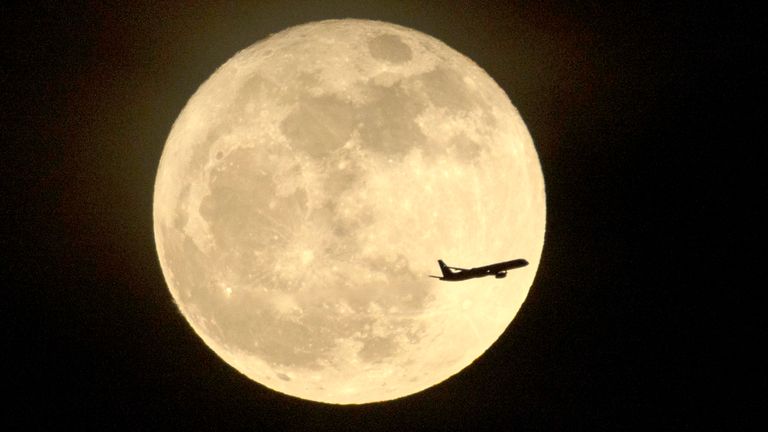
File pic: AP
For that mission, two spacecraft, Ebb and Flow, were sent to orbit the moon for a year between 2011 and 2012.
They used that data to map how the moon responds to Earth’s gravitational pull as it orbits.
The moon’s gravity slightly fluctuates as it circles the Earth which causes it to flex.
That movement helped the scientists to understand the moon’s deep internal structure and discovered that the moon’s near side is internally warmer than its far side.
Although this helps with crucial understanding of the moon, it may also help us understand other planets.
In fact, the team have already used their technique to map the internal structures of planets like Jupiter and the Vesta asteroid.
“There are many opportunities in the future to apply our technique for studying the interiors of intriguing planetary bodies throughout the solar system,” said Mr Park.
Source link

Khamrah by Lattafa for Men - 3.4 oz EDP Spray
4% Off
Ghost Sweetheart Eau de Toilette | Pineapple, Jasmine and Sandalwood | Perfume for Women 50 ml
50% Off
Marc Jacobs Dot Eau De Parfum for Women, 100 ml
42% Off
Ted Baker W Eau de Toilette for Her, Fig Leaf, White Peony and Violet Top Notes, Pink Orchid and Raspberry Middle Notes, 75ml
£11.77 (£15.69 / 100 ml) (as of 17/07/2026 03:58 GMT +01:00 - More infoProduct prices and availability are accurate as of the date/time indicated and are subject to change. Any price and availability information displayed on [relevant Amazon Site(s), as applicable] at the time of purchase will apply to the purchase of this product.)
Ted Baker Woman Pink Eau de Toilette Spray Floral Green Feminine Fragrance, Opening Notes are Fresh Peach, Bergamot and Tangerine with Warm Musk, Vanilla and Vetiver Base, 100ml
11% Off
Vera Wang Princess Eau de Toilette - 30 ml

Choco Musk 50ml Eau De Parfum for men and women | Chocolate Musk by Jannat Aromas
17% Off
Christina Aguilera Signature Eau de Parfum (50ml) Floral, Fruity & Exotic Scent, Luxury Fragrance for Women
9% Off
Calvin Klein - Eau De Toilette CKIN2U - Calvin Klein Women, Ladies Perfume, Women's Perfume, Calvin Klein Perfume, Calvin Klein One - 150 ml
5% Off
Jimmy Choo Flash Eau de Parfum, 60 ml (Pack of 1)
3% Off
Fruit of the Loom Men's Heavy T Shirt, White, XL UK
28% Off
ATNKE LED Lighted Beanie Cap,USB Rechargeable Running Hat Ultra Bright 4 LED Waterproof Light Winter Warm Gifts for Men and Women/Pink

Men's 1/4 Zip Pullover UK Sale Clearance, Fleece Sweatshirt Casual Jumper Long Sleeve T-shirt Top Stand Collar Sweater Plain Pullover Sports Leisure Workwear Quarter Zip Sweater Lightweight Jumpers
£5.88 (as of 12/11/2025 00:52 GMT +01:00 - More infoProduct prices and availability are accurate as of the date/time indicated and are subject to change. Any price and availability information displayed on [relevant Amazon Site(s), as applicable] at the time of purchase will apply to the purchase of this product.)
Crevice Cleaning Brush, Bathroom Tile Groove Gap Cleaning Brush,Premium Crevice Cleaning Tool Aluminum Support with 15° Angle Magic Brush, Thin Brush for Home Kitchen
19% Off
Wireless Earbuds, Bluetooth 5.3 Headphones in Ear with HiFi Stereo Deep Bass, 4 ENC Noise Cancelling Mic Wireless Earphones 40H Playtime, Bluetooth Earbuds Dual LED Display, IP7 Waterproof, USB-C
42% Off