 [
[

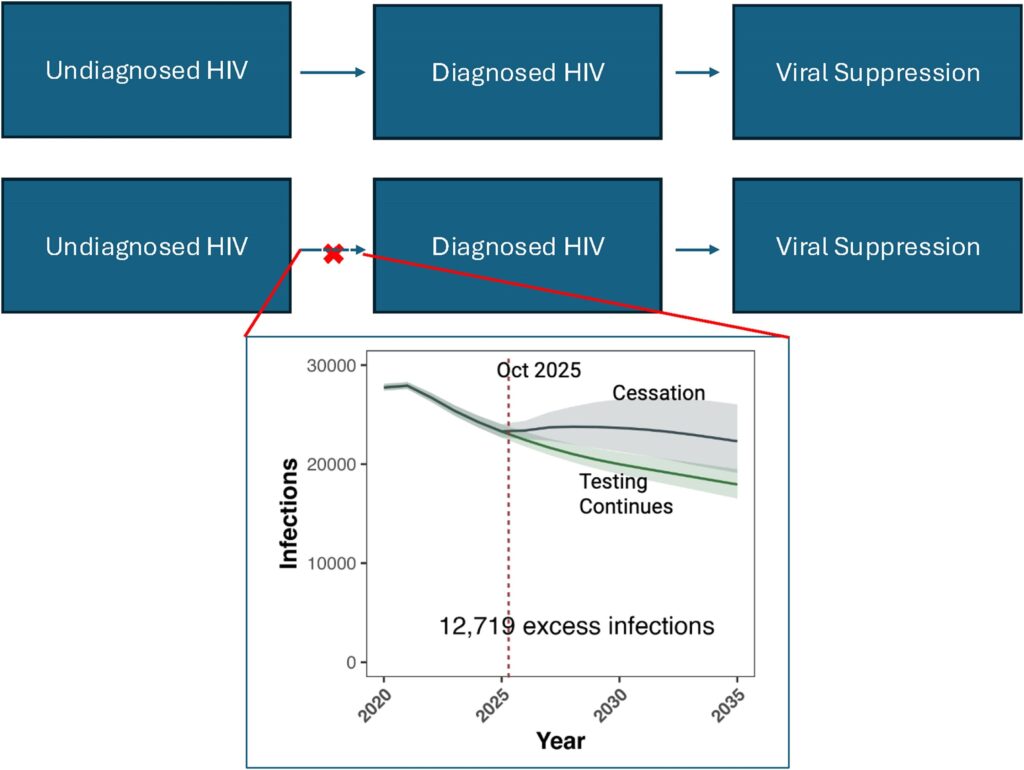
Timely HIV diagnosis and treatment are critical to preventing transmission. To help make this happen, the U.S. Centers for Disease Control and Prevention (CDC) provides funding for HIV testing to local health departments and community organizations. In a new NIH-funded Johns Hopkins Medicine study, researchers used a computer model to quantify the effect of funding cuts for HIV testing. They estimate that HIV infections could increase an average of 10% in 18 U.S. states if this funding is interrupted or ended.
“The HIV epidemic has been going on for 40 years,” says study lead researcher Todd T. Fojo, M.D., M.H.S., associate professor of medicine at the Johns Hopkins University School of Medicine. “The United States has made tremendous progress over the years, with fewer people getting infected and better treatments for those who are infected. To enter a world where that suddenly reverses would be a big deal. Treating someone with HIV over a lifetime is expensive, so any HIV infection you can prevent saves a lot of money.”
The study was published February 4 in the journal Clinical Infectious Diseases.
“Once you are diagnosed with HIV, you get treated, and in turn, you can’t transmit it,” Fojo says. “If more people are unaware they have HIV because effective testing isn’t available, it is more likely that they will transmit the virus to someone else.”
The simulation model examined HIV infections across 18 states, with populations representing different groups of age, race and sex. The model estimates how frequently populations are being tested and how many of those tests are being done using CDC funding.
“Looking across the 18 states in total, you would have 12,751 more infections over the next five years,” Fojo says. “That’s 10% more infections than you would have if CDC-funded tests continued at their current pace.”
Fojo says that the number varies widely across states.
“The biggest driver is how much testing is already going on in the state and how much testing is done through CDC funding,” Fojo explained. “For example, in Washington state, our model predicts that the number of infections increases by 2.7% without CDC-funded tests, but in Louisiana, infections would increase by almost 30%. We know that CDC-funded tests are diagnosing more infections in Louisiana than in Washington state, so the model’s prediction makes sense.”
“In general,” he adds, “If you look at states that have more of a rural HIV epidemic, those states tend to be more impacted when you take away funding for HIV testing.”
Fojo says the next steps in this research are to get a more comprehensive idea of what loss of CDC funding for other prevention activities may look like, and what would be the effect of those cuts on HIV infections in the United States.
Publication details
The Potential Effect of Ending Centers for Disease Control and Prevention Funding for HIV Tests: A Modeling Study in 18 States, Clinical Infectious Diseases (2026). doi.org/10.1093/cid/ciag038
Journal information:
Clinical Infectious Diseases
Citation:
Study predicts HIV infections could rise 10% if CDC testing funds end (2026, April 7)
retrieved 7 April 2026
from https://medicalxpress.com/news/2026-04-hiv-infections-cdc-funds.html
This document is subject to copyright. Apart from any fair dealing for the purpose of private study or research, no
part may be reproduced without the written permission. The content is provided for information purposes only.

Khamrah by Lattafa for Men - 3.4 oz EDP Spray
4% Off
Ghost Sweetheart Eau de Toilette | Pineapple, Jasmine and Sandalwood | Perfume for Women 50 ml
50% Off
Marc Jacobs Dot Eau De Parfum for Women, 100 ml
42% Off
Ted Baker W Eau de Toilette for Her, Fig Leaf, White Peony and Violet Top Notes, Pink Orchid and Raspberry Middle Notes, 75ml
£11.77 (£15.69 / 100 ml) (as of 16/05/2026 03:14 GMT +01:00 - More infoProduct prices and availability are accurate as of the date/time indicated and are subject to change. Any price and availability information displayed on [relevant Amazon Site(s), as applicable] at the time of purchase will apply to the purchase of this product.)
Ted Baker Woman Pink Eau de Toilette Spray Floral Green Feminine Fragrance, Opening Notes are Fresh Peach, Bergamot and Tangerine with Warm Musk, Vanilla and Vetiver Base, 100ml
11% Off
Vera Wang Princess Eau de Toilette - 30 ml

Choco Musk 50ml Eau De Parfum for men and women | Chocolate Musk by Jannat Aromas
17% Off
Christina Aguilera Signature Eau de Parfum (50ml) Floral, Fruity & Exotic Scent, Luxury Fragrance for Women
9% Off
Calvin Klein - Eau De Toilette CKIN2U - Calvin Klein Women, Ladies Perfume, Women's Perfume, Calvin Klein Perfume, Calvin Klein One - 150 ml
5% Off
Jimmy Choo Flash Eau de Parfum, 60 ml (Pack of 1)
3% Off
Fruit of the Loom Men's Heavy T Shirt, White, XL UK
28% Off
ATNKE LED Lighted Beanie Cap,USB Rechargeable Running Hat Ultra Bright 4 LED Waterproof Light Winter Warm Gifts for Men and Women/Pink
17% Off
Men's 1/4 Zip Pullover UK Sale Clearance, Fleece Sweatshirt Casual Jumper Long Sleeve T-shirt Top Stand Collar Sweater Plain Pullover Sports Leisure Workwear Quarter Zip Sweater Lightweight Jumpers
£5.88 (as of 12/11/2025 00:52 GMT +01:00 - More infoProduct prices and availability are accurate as of the date/time indicated and are subject to change. Any price and availability information displayed on [relevant Amazon Site(s), as applicable] at the time of purchase will apply to the purchase of this product.)
Crevice Cleaning Brush, Bathroom Tile Groove Gap Cleaning Brush,Premium Crevice Cleaning Tool Aluminum Support with 15° Angle Magic Brush, Thin Brush for Home Kitchen
19% Off
Wireless Earbuds, Bluetooth 5.3 Headphones in Ear with HiFi Stereo Deep Bass, 4 ENC Noise Cancelling Mic Wireless Earphones 40H Playtime, Bluetooth Earbuds Dual LED Display, IP7 Waterproof, USB-C
42% Off