 [
[


Barrier organs that form boundaries between the body and the outside environment, such as the lungs, skin, and intestines, face a difficult balancing act. They must respond quickly to threats such as infection, but they also need to avoid triggering unnecessary inflammation that can damage the tissue. A new study led by Whitehead Institute member Pulin Li and graduate student in her lab Diep Nguyen reveals one way the lung manages that tradeoff.
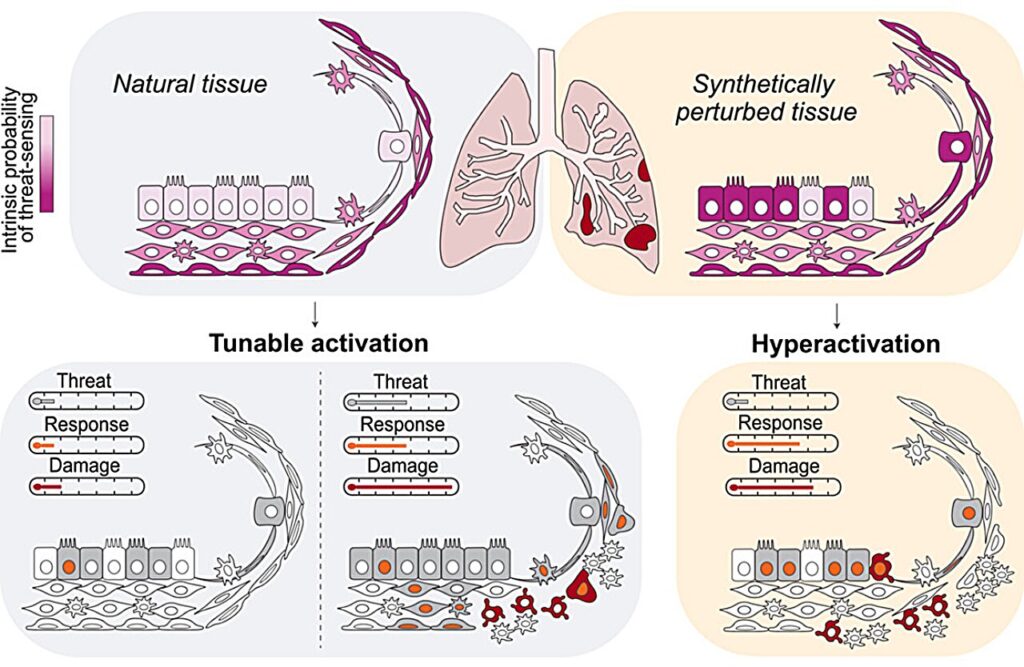
Published in Cell Systems, the research found that immune sensitivity is not evenly distributed across the lung. Instead, it arranges in tiers: cells at the outer surface respond cautiously, while cells deeper in the tissue are more likely to sound the alarm when a threat breaks through.
“The central question was how tissues balance the benefits and harmful effects of immune activation when they face different degrees of danger or stress,” says Li, who is also a professor of biology at MIT. “Too little immune activation leaves the tissue unprotected, but too much can create inflammation and damage.”
The team focused on the lung, where epithelial cells line the airways and air sacs and form a physical barrier between the body and the outside world. These cells sit at the point of first contact with inhaled viruses, microbes, allergens, and other particles. For that reason, they are often thought of as front-line defenders.
But the new study suggests that the lung’s outermost defenders are deliberately cautious.
Using mouse models of influenza infection and imaging methods that allowed them to measure infection and immune responses in individual cells, the researchers found that epithelial cells were the least likely to respond to infection by producing interferons, signaling proteins that help alert the immune system. Cells deeper in the tissue, especially endothelial cells that line blood vessels, were much more likely to respond.
This arrangement suggests that the lung uses location as a clue to the seriousness of a threat. A stimulus that remains at the surface may not require a large immune response. But when infection breaches the epithelial barrier and reaches deeper tissue, the lung treats that as a more dangerous threat and activates a stronger defense.
“A less severe threat only requires a lower level of immune response,” says Nguyen. “As a threat goes deeper into the tissue, the inner cell types can encode that information and indicate that the threat has invaded further.”
The researchers traced these differences in sensitivity, in part, to immune-sensing proteins called pattern recognition receptors. These receptors detect molecular signs of infection or damage. One receptor, RIG-I, helps cells recognize viral RNA. Epithelial cells had relatively low levels of RIG-I and related sensors, while deeper stromal cells had higher levels.
That lower sensitivity appears to protect the lung from unnecessary damage. When the researchers increased RIG-I levels in lung epithelial cells in mice, the animals mounted a stronger immune response to a non-infectious inflammatory trigger. But the heightened response caused more tissue damage and interfered with repair.
The finding helps explain why the lung’s surface cells may be tuned not to overreact. The lung constantly encounters harmless or low-level irritants. If epithelial cells respond too readily, they could turn minor disturbances into damaging false alarms.
The researchers also found evidence that similar patterns may exist in other barrier organs, including the intestine and trachea. That raises the possibility that spatially tiered immune sensing is a broader strategy for protecting organs that face the outside world.
“One impact of this work is that it helps us look at an old question in a new way: how do tissues balance protection with tissue damage?” says Nguyen. “We can start to understand that when we look at the building blocks of the tissue and how they work together.”
Li says the work also reflects the value of studying tissues as communities of cells rather than collections of identical responders.
“To understand physiology, you have to take a multicellular approach,” she says. “Thinking about tissues as communities of cells can reveal new insights into how they function.”
Publication details
Diep H. Nguyen et al, A tissue-scale strategy for sensing threats in barrier organs, Cell Systems (2026). DOI: 10.1016/j.cels.2026.101611. www.cell.com/cell-systems/full … 2405-4712(26)00093-1
Journal information:
Cell Systems
Clinical categories


Citation:
How lungs balance defense and damage by tuning responses to deeper threats (2026, May 16)
retrieved 16 May 2026
from https://medicalxpress.com/news/2026-05-lungs-defense-tuning-responses-deeper.html
This document is subject to copyright. Apart from any fair dealing for the purpose of private study or research, no
part may be reproduced without the written permission. The content is provided for information purposes only.

Khamrah by Lattafa for Men - 3.4 oz EDP Spray
4% Off
Ghost Sweetheart Eau de Toilette | Pineapple, Jasmine and Sandalwood | Perfume for Women 50 ml
50% Off
Marc Jacobs Dot Eau De Parfum for Women, 100 ml
42% Off
Ted Baker W Eau de Toilette for Her, Fig Leaf, White Peony and Violet Top Notes, Pink Orchid and Raspberry Middle Notes, 75ml
£11.77 (£15.69 / 100 ml) (as of 14/10/2026 06:35 GMT +01:00 - More infoProduct prices and availability are accurate as of the date/time indicated and are subject to change. Any price and availability information displayed on [relevant Amazon Site(s), as applicable] at the time of purchase will apply to the purchase of this product.)
Ted Baker Woman Pink Eau de Toilette Spray Floral Green Feminine Fragrance, Opening Notes are Fresh Peach, Bergamot and Tangerine with Warm Musk, Vanilla and Vetiver Base, 100ml
11% Off
Vera Wang Princess Eau de Toilette - 30 ml

Choco Musk 50ml Eau De Parfum for men and women | Chocolate Musk by Jannat Aromas
17% Off
Christina Aguilera Signature Eau de Parfum (50ml) Floral, Fruity & Exotic Scent, Luxury Fragrance for Women
9% Off
Calvin Klein - Eau De Toilette CKIN2U - Calvin Klein Women, Ladies Perfume, Women's Perfume, Calvin Klein Perfume, Calvin Klein One - 150 ml
5% Off
Jimmy Choo Flash Eau de Parfum, 60 ml (Pack of 1)
3% Off
Fruit of the Loom Men's Heavy T Shirt, White, XL UK
28% Off
ATNKE LED Lighted Beanie Cap,USB Rechargeable Running Hat Ultra Bright 4 LED Waterproof Light Winter Warm Gifts for Men and Women/Pink
17% Off
Men's 1/4 Zip Pullover UK Sale Clearance, Fleece Sweatshirt Casual Jumper Long Sleeve T-shirt Top Stand Collar Sweater Plain Pullover Sports Leisure Workwear Quarter Zip Sweater Lightweight Jumpers
£5.88 (as of 12/11/2025 00:52 GMT +01:00 - More infoProduct prices and availability are accurate as of the date/time indicated and are subject to change. Any price and availability information displayed on [relevant Amazon Site(s), as applicable] at the time of purchase will apply to the purchase of this product.)
Crevice Cleaning Brush, Bathroom Tile Groove Gap Cleaning Brush,Premium Crevice Cleaning Tool Aluminum Support with 15° Angle Magic Brush, Thin Brush for Home Kitchen
19% Off
Wireless Earbuds, Bluetooth 5.3 Headphones in Ear with HiFi Stereo Deep Bass, 4 ENC Noise Cancelling Mic Wireless Earphones 40H Playtime, Bluetooth Earbuds Dual LED Display, IP7 Waterproof, USB-C
42% Off