Stressful experiences in midlife or during childhood may be associated with a higher risk of developing Alzheimer’s disease and neuroinflammation, respectively. This is one of the conclusions of a study published in Annals of Neurology and led by the Barcelona Institute for Global Health (ISGlobal), a center supported by the “la Caixa” Foundation, in collaboration with the Barcelonaβeta Brain Research Center (BBRC), research center of the Pasqual Maragall Foundation.
Stressful Life Events are those in which objective external threats activate behavioral and psychological responses in us, for example, the death of a loved one, unemployment, or illness. Mounting evidence suggests that stress could be associated with an increased risk of dementia and cognitive decline.
The purpose of this research was to assess whether the accumulation of stressful life events throughout life could influence the development of Alzheimer’s-related pathologies in older ages. To do so, the research team counted on 1,290 volunteers from the ALFA cohort in Barcelona, also supported by the “la Caixa” Foundation, all of them cognitively unimpaired at the time of the study but with a direct family history of Alzheimer’s disease.
Participants went through interviews to assess the number of Stressful Life Events. Lumbar punctures and magnetic resonance imaging (MRI) were performed to test different biomarkers related to Alzheimer’s disease.
Midlife as a vulnerable period
The statistical analyses revealed that the accumulation of stressful events during midlife was associated with higher levels of β-amyloid (Aβ) protein, a key player in the development of Alzheimer’s disease.
“We know midlife is a period when Alzheimer’s disease pathologies start to build up. It is possible that these years represent a vulnerable period where experiencing psychological stress may have a long-lasting impact on brain health,” says Eleni Palpatzis, ISGlobal researcher and first author of the study.
The research team also found that higher levels of stressful experiences in childhood were associated with higher risk of developing neuroinflammation in older ages. Inflammation has been recognized as a key molecular response in neurodegenerative diseases, and these results are in line with emerging evidence suggesting childhood trauma to be linked with increased adulthood inflammation.
Sex differences on the impact of stressors
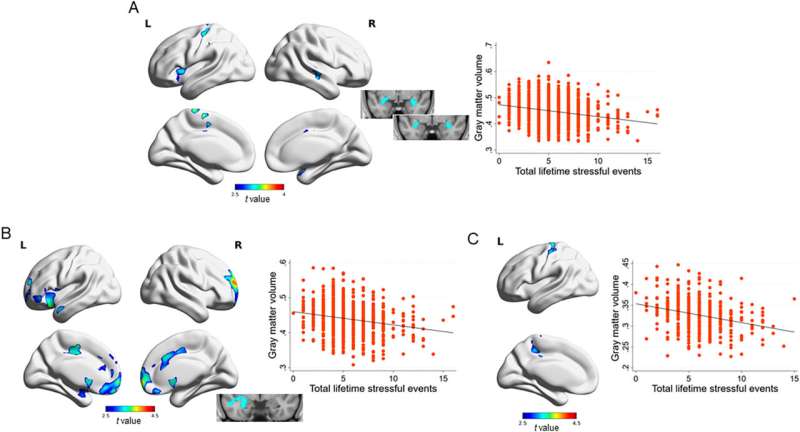
Accumulation of stressful life events over the course of life were associated with higher levels of β-amyloid (Aβ) protein only in men. In women, however, the researchers observed that more stressful experiences over the course of life were associated with lower volumes of gray matter, implying that stress may have sex-specific effects.
“Our results suggest that the mechanisms through which life stressors affect brain health in men and women are different: amyloid protein accumulation in men and brain atrophy in women,” says Eider Arenaza-Urquijo, ISGlobal researcher and last author of the study.
Lastly, the authors found that stressful life events in people with a history of psychiatric disease were associated with higher levels of Aβ and tau proteins, neuroinflammation, and lower gray matter volume, suggesting that this population could be more susceptible to the effects of stressful life events, for example, due to impaired stress-coping abilities which could make them more vulnerable.
“Our study reinforces the idea that stress could play a significant role in the development of Alzheimer’s disease and provides initial evidence regarding the mechanisms behind this effect, but additional research is needed to replicate and validate our initial findings,” says Eider Arenaza-Urquijo.
More information:
Eleni Palpatzis et al, Lifetime Stressful Events Associated with Alzheimer’s Pathologies, Neuroinflammation and Brain Structure in a Risk Enriched Cohort, Annals of Neurology (2024). DOI: 10.1002/ana.26881
Citation:
Stressful events in midlife might be a risk factor for Alzheimer’s disease in older ages (2024, April 2)
retrieved 3 April 2024
from https://medicalxpress.com/news/2024-04-stressful-events-midlife-factor-alzheimer.html
This document is subject to copyright. Apart from any fair dealing for the purpose of private study or research, no
part may be reproduced without the written permission. The content is provided for information purposes only.

Khamrah by Lattafa for Men - 3.4 oz EDP Spray
4% Off
Ghost Sweetheart Eau de Toilette | Pineapple, Jasmine and Sandalwood | Perfume for Women 50 ml
50% Off
Marc Jacobs Dot Eau De Parfum for Women, 100 ml
42% Off
Ted Baker W Eau de Toilette for Her, Fig Leaf, White Peony and Violet Top Notes, Pink Orchid and Raspberry Middle Notes, 75ml
£11.77 (£15.69 / 100 ml) (as of 05/09/2026 04:58 GMT +01:00 - More infoProduct prices and availability are accurate as of the date/time indicated and are subject to change. Any price and availability information displayed on [relevant Amazon Site(s), as applicable] at the time of purchase will apply to the purchase of this product.)
Ted Baker Woman Pink Eau de Toilette Spray Floral Green Feminine Fragrance, Opening Notes are Fresh Peach, Bergamot and Tangerine with Warm Musk, Vanilla and Vetiver Base, 100ml
11% Off
Vera Wang Princess Eau de Toilette - 30 ml

Choco Musk 50ml Eau De Parfum for men and women | Chocolate Musk by Jannat Aromas
17% Off
Christina Aguilera Signature Eau de Parfum (50ml) Floral, Fruity & Exotic Scent, Luxury Fragrance for Women
9% Off
Calvin Klein - Eau De Toilette CKIN2U - Calvin Klein Women, Ladies Perfume, Women's Perfume, Calvin Klein Perfume, Calvin Klein One - 150 ml
5% Off
Jimmy Choo Flash Eau de Parfum, 60 ml (Pack of 1)
3% Off
Fruit of the Loom Men's Heavy T Shirt, White, XL UK
28% Off
ATNKE LED Lighted Beanie Cap,USB Rechargeable Running Hat Ultra Bright 4 LED Waterproof Light Winter Warm Gifts for Men and Women/Pink
17% Off
Men's 1/4 Zip Pullover UK Sale Clearance, Fleece Sweatshirt Casual Jumper Long Sleeve T-shirt Top Stand Collar Sweater Plain Pullover Sports Leisure Workwear Quarter Zip Sweater Lightweight Jumpers
£5.88 (as of 12/11/2025 00:52 GMT +01:00 - More infoProduct prices and availability are accurate as of the date/time indicated and are subject to change. Any price and availability information displayed on [relevant Amazon Site(s), as applicable] at the time of purchase will apply to the purchase of this product.)
Crevice Cleaning Brush, Bathroom Tile Groove Gap Cleaning Brush,Premium Crevice Cleaning Tool Aluminum Support with 15° Angle Magic Brush, Thin Brush for Home Kitchen
19% Off
Wireless Earbuds, Bluetooth 5.3 Headphones in Ear with HiFi Stereo Deep Bass, 4 ENC Noise Cancelling Mic Wireless Earphones 40H Playtime, Bluetooth Earbuds Dual LED Display, IP7 Waterproof, USB-C
42% Off