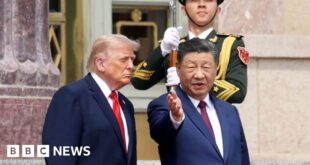
Most of his meetings are at a ministerial level and audiences with President Xi are reserved for when senior US officials, such as Secretary of State Antony Blinken, visit.
Both sides have also vowed to work towards more “people-to-people” exchanges. This comes as the number of US students studying in China has fallen from around 15,000 in 2011 to 800.
Mr Xi hopes to open the door for 50,000 American students to come to China in the next five years. He said on a visit to San Francisco last November that it was the “ultimate wish of our two peoples for exchanges and cooperation”.
But Ambassador Burns accused parts of the Chinese government of not taking these warm words seriously: “Since the San Francisco summit, there have been 61 separate incidents when the security forces or a government ministry have prevented Chinese citizens from participating in public diplomacy programmes at this house, at our embassy or they have prevented people from travelling to the US to participate in joint trips – so it has been very difficult for us to bring people together.”
On the other side, Chinese students and academics have reported being unfairly targeted by US border officials. Beijing’s embassy in Washington lodged a formal protest and accused US authorities of “unwarrantedly” interrogating, harassing, cancelling the visas of and even deporting several students from China with valid travel permits upon their arrival in the US.
Washington has also placed a “level 3” travel advisory on China urging visitors to “reconsider” their travel. Mr Burns denied this alert was contradictory to a US plea to “bring people together,” but was rather a precaution.
“There are Americans imprisoned here who we believe are wrongfully detained, wrongfully prosecuted, I’ve been visiting these prisoners and we want them released.” He said several Americans had been subjected to “exit bans” by China and had their passports taken at the airport and could not leave.
China, in turn, has left the US off a list of countries that are exempt from visas for up to 15 days of travel – Australia is on the list after Beijing recently mended ties with Canberra.
That “people-to-people” contact – a relatively easy goal in an otherwise thorny relationship – is proving to be so difficult is perhaps a sign of the continuing lack of trust on both sides.
But the biggest fault line for now may well be the war in Ukraine.
The US seems to believe China could hold the key to halting Russia’s progress on the battlefield. And Ambassador Burns reiterated Washington’s message that Beijing’s support for Moscow’s invasion will not be tolerated.
“China is not neutral in this war,” he said. “China is showing its true colours. It’s supporting Russia, supporting Putin as he unleashes this barbaric war on Ukrainian civilians. We know what is being shipped by Chinese companies and we know the impact it is having on Russia’s ability to conduct this war.”
He said there were “tens of thousands” of Chinese companies supporting Moscow. “We have sanctioned a great number and we are prepared to do more if the government here does not pull back.”
Source link

Khamrah by Lattafa for Men - 3.4 oz EDP Spray
4% Off
Ghost Sweetheart Eau de Toilette | Pineapple, Jasmine and Sandalwood | Perfume for Women 50 ml
50% Off
Marc Jacobs Dot Eau De Parfum for Women, 100 ml
42% Off
Ted Baker W Eau de Toilette for Her, Fig Leaf, White Peony and Violet Top Notes, Pink Orchid and Raspberry Middle Notes, 75ml
£11.77 (£15.69 / 100 ml) (as of 14/05/2026 03:13 GMT +01:00 - More infoProduct prices and availability are accurate as of the date/time indicated and are subject to change. Any price and availability information displayed on [relevant Amazon Site(s), as applicable] at the time of purchase will apply to the purchase of this product.)
Ted Baker Woman Pink Eau de Toilette Spray Floral Green Feminine Fragrance, Opening Notes are Fresh Peach, Bergamot and Tangerine with Warm Musk, Vanilla and Vetiver Base, 100ml
11% Off
Vera Wang Princess Eau de Toilette - 30 ml

Choco Musk 50ml Eau De Parfum for men and women | Chocolate Musk by Jannat Aromas
17% Off
Christina Aguilera Signature Eau de Parfum (50ml) Floral, Fruity & Exotic Scent, Luxury Fragrance for Women
9% Off
Calvin Klein - Eau De Toilette CKIN2U - Calvin Klein Women, Ladies Perfume, Women's Perfume, Calvin Klein Perfume, Calvin Klein One - 150 ml
5% Off
Jimmy Choo Flash Eau de Parfum, 60 ml (Pack of 1)
3% Off
Fruit of the Loom Men's Heavy T Shirt, White, XL UK
28% Off
ATNKE LED Lighted Beanie Cap,USB Rechargeable Running Hat Ultra Bright 4 LED Waterproof Light Winter Warm Gifts for Men and Women/Pink
17% Off
Men's 1/4 Zip Pullover UK Sale Clearance, Fleece Sweatshirt Casual Jumper Long Sleeve T-shirt Top Stand Collar Sweater Plain Pullover Sports Leisure Workwear Quarter Zip Sweater Lightweight Jumpers

Crevice Cleaning Brush, Bathroom Tile Groove Gap Cleaning Brush,Premium Crevice Cleaning Tool Aluminum Support with 15° Angle Magic Brush, Thin Brush for Home Kitchen
19% Off
Wireless Earbuds, Bluetooth 5.3 Headphones in Ear with HiFi Stereo Deep Bass, 4 ENC Noise Cancelling Mic Wireless Earphones 40H Playtime, Bluetooth Earbuds Dual LED Display, IP7 Waterproof, USB-C
42% Off