Promoting healthy diets for the entire family can better improve health outcomes for people with chronic illnesses, according to a new Cornell study.
“Families are an essential social unit, and food is a social medium: families pool and negotiate food choices, and it’s also the way we pass on dietary preferences, traditions and build kinship,” said Ramya Ambikapthi, senior research associate in the Food Systems & Global Change program in the Department of Global Development, in the College of Agriculture and Life Sciences.
“If you can change food behaviors at the family level, you have the opportunity to achieve healthier diets for all, now and for the next generation.”
Ambikapthi is the co-first author of the paper, published Aug. 7 in Global Food Security and co-written with colleagues from Purdue University, University of South Carolina, Harvard University, Muhimbili University of Health and Allied Sciences in Tanzania, Tanzania Food and Nutrition Center, London School of Hygiene and Tropical Medicine, and the University of Illinois.
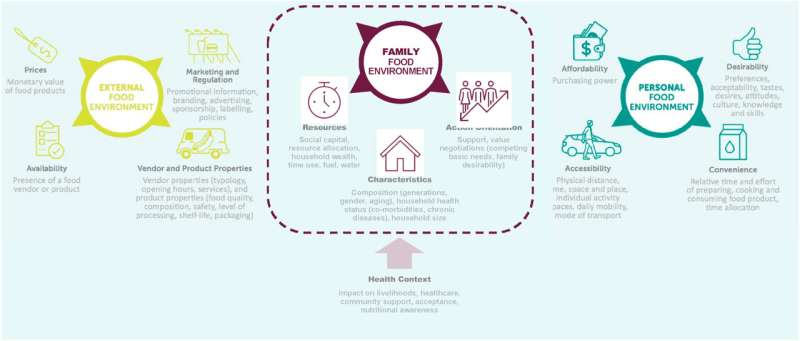
Research and policy on nutrition support have historically focused on external factors, such as market prices and availability, and individual factors, including affordability and physical distance from food resources. In the last few years, researchers have begun emphasizing the importance of family food dynamics as both a factor influencing individual food choices and as a policy lever to improve healthy, sustainable diets for all, Ambikapthi said.
In the current study, researchers used HIV as a case study to understand family food dynamics, reviewing almost 7,000 relevant articles. Then they developed a Family Dynamics Food Environment Framework (FDF), which they hope will inform research and policy on an array of chronic illnesses, especially as diet-related illnesses such as diabetes and heart disease grow across the globe.
Because of improvements in disease management, HIV has become a chronic illness that many people can live with for decades; however, such a diagnosis can have devastating economic impacts for individuals and families, especially those already living in poverty in the Global South. HIV-positive individuals may lack energy to perform farm labor or be denied employment because of social stigma.
“If your family supports you, that determines how well you survive, and food is an important part of family support,” Ambikapthi said. Food security is particularly important for HIV patients prescribed antiretroviral therapy (ART) drugs, which require a full meal to be absorbed. “When people who have HIV and are food insecure are told to take ART, they don’t take it, because if they don’t have enough food, ART just makes them throw up.”
In low-income households, families also have to cope with the constant pressure of competing basic needs, such as allocating scarce resources to fuel or schooling, or choosing which family members will receive sufficient nutritious food: children, elderly family members, those performing the most manual labor or individuals with HIV.
“Nutrition programs generally focus on pregnant women and small children, due to their critical nutrition needs. But what we want is healthy diets for all,” Ambikapthi said. “Understanding how family dynamics impact food choices can help people who implement nutrition policies to structure intervention messages in ways that enable healthy diets for the entire family.”
The researchers plan for future work on this topic to explore how family food dynamics can be applied in other contexts; for example, achieving sustainable, healthy diets in urban areas.
More information:
Ramya Ambikapathi et al, Expanding the food environment framework to include family dynamics: A systematic synthesis of qualitative evidence using HIV as a case study, Global Food Security (2024). DOI: 10.1016/j.gfs.2024.100788
Citation:
Smart food choices at family level can ease chronic illness (2024, August 12)
retrieved 12 August 2024
from https://medicalxpress.com/news/2024-08-smart-food-choices-family-ease.html
This document is subject to copyright. Apart from any fair dealing for the purpose of private study or research, no
part may be reproduced without the written permission. The content is provided for information purposes only.

Khamrah by Lattafa for Men - 3.4 oz EDP Spray
4% Off
Ghost Sweetheart Eau de Toilette | Pineapple, Jasmine and Sandalwood | Perfume for Women 50 ml
50% Off
Marc Jacobs Dot Eau De Parfum for Women, 100 ml
42% Off
Ted Baker W Eau de Toilette for Her, Fig Leaf, White Peony and Violet Top Notes, Pink Orchid and Raspberry Middle Notes, 75ml
£11.77 (£15.69 / 100 ml) (as of 25/06/2026 03:50 GMT +01:00 - More infoProduct prices and availability are accurate as of the date/time indicated and are subject to change. Any price and availability information displayed on [relevant Amazon Site(s), as applicable] at the time of purchase will apply to the purchase of this product.)
Ted Baker Woman Pink Eau de Toilette Spray Floral Green Feminine Fragrance, Opening Notes are Fresh Peach, Bergamot and Tangerine with Warm Musk, Vanilla and Vetiver Base, 100ml
11% Off
Vera Wang Princess Eau de Toilette - 30 ml

Choco Musk 50ml Eau De Parfum for men and women | Chocolate Musk by Jannat Aromas
17% Off
Christina Aguilera Signature Eau de Parfum (50ml) Floral, Fruity & Exotic Scent, Luxury Fragrance for Women
9% Off
Calvin Klein - Eau De Toilette CKIN2U - Calvin Klein Women, Ladies Perfume, Women's Perfume, Calvin Klein Perfume, Calvin Klein One - 150 ml
5% Off
Jimmy Choo Flash Eau de Parfum, 60 ml (Pack of 1)
3% Off
Fruit of the Loom Men's Heavy T Shirt, White, XL UK
28% Off
ATNKE LED Lighted Beanie Cap,USB Rechargeable Running Hat Ultra Bright 4 LED Waterproof Light Winter Warm Gifts for Men and Women/Pink
17% Off
Men's 1/4 Zip Pullover UK Sale Clearance, Fleece Sweatshirt Casual Jumper Long Sleeve T-shirt Top Stand Collar Sweater Plain Pullover Sports Leisure Workwear Quarter Zip Sweater Lightweight Jumpers
£5.88 (as of 12/11/2025 00:52 GMT +01:00 - More infoProduct prices and availability are accurate as of the date/time indicated and are subject to change. Any price and availability information displayed on [relevant Amazon Site(s), as applicable] at the time of purchase will apply to the purchase of this product.)
Crevice Cleaning Brush, Bathroom Tile Groove Gap Cleaning Brush,Premium Crevice Cleaning Tool Aluminum Support with 15° Angle Magic Brush, Thin Brush for Home Kitchen
19% Off
Wireless Earbuds, Bluetooth 5.3 Headphones in Ear with HiFi Stereo Deep Bass, 4 ENC Noise Cancelling Mic Wireless Earphones 40H Playtime, Bluetooth Earbuds Dual LED Display, IP7 Waterproof, USB-C
42% Off