 [
[

Regan Odysseus was scared. She’d tried Prozac before, but the medication made her mental health worse, leaving her unsure whether further treatment would help or hurt. But between her full-time job as an ICU nurse, her full-time job as a mom, and the hormone shifts from her second pregnancy, the pressure on her mental health was becoming unsustainable.
When perinatal psychiatrist Rana Jawish, MD, started a conversation about how Odysseus was doing, she broke down. “It was very enlightening,” Odysseus says. “I didn’t realize I was not in a good place until someone else asked me.”
Jawish was leading a clinical trial to help treat depression and anxiety in pregnant people. When Odysseus learned of the opportunity to participate, she was nervous but determined to try again. “If any time, now is the time,” she recalls thinking, “and I owe it to my children to try to be better for them and feel my best so I can be my best. It was kind of a sense of relief, like, ‘OK, I’m finally going to get this addressed, not just feel like I have to cope with it on my own all the time.'”
An unorthodox strategy
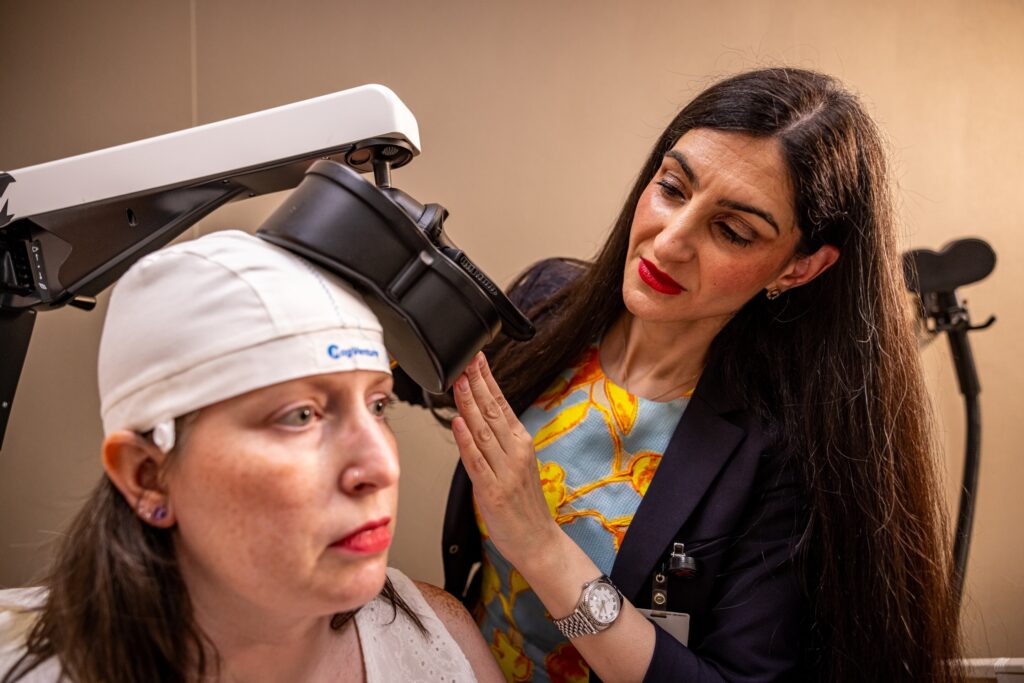
Unlike Odysseus’s previous negative experiences, the clinical trial involved no medication. Instead, the trial used a combination of two strategies: a kind of talk therapy called cognitive behavioral therapy (CBT), combined with regular sessions of transcranial magnetic stimulation (TMS), in which powerful magnetic fields stimulate regions of the brain involved in mood control.
The FDA approved TMS for treatment-resistant depression in nonpregnant populations in 2009. While small pilot studies suggest that TMS could work as a nonpharmacological intervention for depression during pregnancy, it’s still understudied in this population.
Despite being in use for more than a decade, the therapy is still off-label for pregnant people—a population for which nonpharmaceutical mental health treatments are urgently needed, Jawish says.
“According to the Centers for Disease Control and Prevention in 2023, maternal mental health conditions, including depression and substance use disorder, are the most common cause of maternal mortality,” Jawish says. And despite the severity of this issue, treatment options for pregnant people are limited. “A lot of antidepressants have very limited safety data for use while pregnant or breastfeeding,” Jawish adds.
TMS could be an alternative option that wouldn’t involve introducing medications into a pregnant person’s body.
Buzzing your brain
Odysseus’s first TMS appointment was “a little scary,” she recalls. “The magnetic pulse feels like a buzzing sensation in your brain. It’s really weird.” But she says that the comprehensive support of the research team made a big difference. “I felt very supported. They had a whole team there with me, talking me through everything, and I felt really well informed about what to expect from the treatment.”
Odysseus received TMS multiple times a week for six weeks, and she says she noticed real improvements to her mental health. By the end of the trial, “everything became a lot lighter and more tolerable and manageable,” she says. “I felt like a better employee, a better nurse, a better leader, and a better mother.”
While TMS appeared to help Odysseus, the overall efficacy of the therapy for pregnant populations is still unknown. Jawish’s study was designed to test whether TMS combined with CBT is doable for patients and to identify any barriers to completing treatment; with 20 patients, it’s too early to say whether TMS works for most pregnant people. Jawish hopes to start larger clinical studies soon to determine whether the treatment is effective.
From the clinic to communities
Clinical trials like this one are crucial to improving health care for the women she works with every day, Jawish says. “I see my research and clinical practice as synergistic with each other,” she explains. “My clinical practice informs my research question, and my research work advances and improves my clinical practice and the care for my patient.”
She adds that maternal mental health isn’t a niche issue. “This is not women’s mental health. This is community mental health. Because if a mom is not doing well, everyone else in the family is affected.”
Odysseus says that participating in the study felt significant as a means to help develop treatments for pregnant people, regardless of the benefits she personally experienced. “I had better outcomes myself, but then to be able to maybe contribute to other women having better access to better support and better outcomes was meaningful to me. It felt like an important study to participate in.”
To anyone else who may be pregnant and dealing with anxiety or depression, Odysseus adds, “You’re not alone, even if it feels that way. There’s somebody somewhere who’s going through something very similar. It’s OK to ask for help, and it’s really brave. You don’t have to be suffering.”


Citation:
Seeking new solutions for perinatal mental health (2026, August 4)
retrieved 4 August 2026
from https://medicalxpress.com/news/2026-08-solutions-perinatal-mental-health.html
This document is subject to copyright. Apart from any fair dealing for the purpose of private study or research, no
part may be reproduced without the written permission. The content is provided for information purposes only.

Khamrah by Lattafa for Men - 3.4 oz EDP Spray
4% Off
Ghost Sweetheart Eau de Toilette | Pineapple, Jasmine and Sandalwood | Perfume for Women 50 ml
50% Off
Marc Jacobs Dot Eau De Parfum for Women, 100 ml
42% Off
Ted Baker W Eau de Toilette for Her, Fig Leaf, White Peony and Violet Top Notes, Pink Orchid and Raspberry Middle Notes, 75ml
£11.77 (£15.69 / 100 ml) (as of 05/08/2026 04:06 GMT +01:00 - More infoProduct prices and availability are accurate as of the date/time indicated and are subject to change. Any price and availability information displayed on [relevant Amazon Site(s), as applicable] at the time of purchase will apply to the purchase of this product.)
Ted Baker Woman Pink Eau de Toilette Spray Floral Green Feminine Fragrance, Opening Notes are Fresh Peach, Bergamot and Tangerine with Warm Musk, Vanilla and Vetiver Base, 100ml
11% Off
Vera Wang Princess Eau de Toilette - 30 ml

Choco Musk 50ml Eau De Parfum for men and women | Chocolate Musk by Jannat Aromas
17% Off
Christina Aguilera Signature Eau de Parfum (50ml) Floral, Fruity & Exotic Scent, Luxury Fragrance for Women
9% Off
Calvin Klein - Eau De Toilette CKIN2U - Calvin Klein Women, Ladies Perfume, Women's Perfume, Calvin Klein Perfume, Calvin Klein One - 150 ml
5% Off
Jimmy Choo Flash Eau de Parfum, 60 ml (Pack of 1)
3% Off
Fruit of the Loom Men's Heavy T Shirt, White, XL UK
28% Off
ATNKE LED Lighted Beanie Cap,USB Rechargeable Running Hat Ultra Bright 4 LED Waterproof Light Winter Warm Gifts for Men and Women/Pink
17% Off
Men's 1/4 Zip Pullover UK Sale Clearance, Fleece Sweatshirt Casual Jumper Long Sleeve T-shirt Top Stand Collar Sweater Plain Pullover Sports Leisure Workwear Quarter Zip Sweater Lightweight Jumpers
£5.88 (as of 12/11/2025 00:52 GMT +01:00 - More infoProduct prices and availability are accurate as of the date/time indicated and are subject to change. Any price and availability information displayed on [relevant Amazon Site(s), as applicable] at the time of purchase will apply to the purchase of this product.)
Crevice Cleaning Brush, Bathroom Tile Groove Gap Cleaning Brush,Premium Crevice Cleaning Tool Aluminum Support with 15° Angle Magic Brush, Thin Brush for Home Kitchen
19% Off
Wireless Earbuds, Bluetooth 5.3 Headphones in Ear with HiFi Stereo Deep Bass, 4 ENC Noise Cancelling Mic Wireless Earphones 40H Playtime, Bluetooth Earbuds Dual LED Display, IP7 Waterproof, USB-C
42% Off