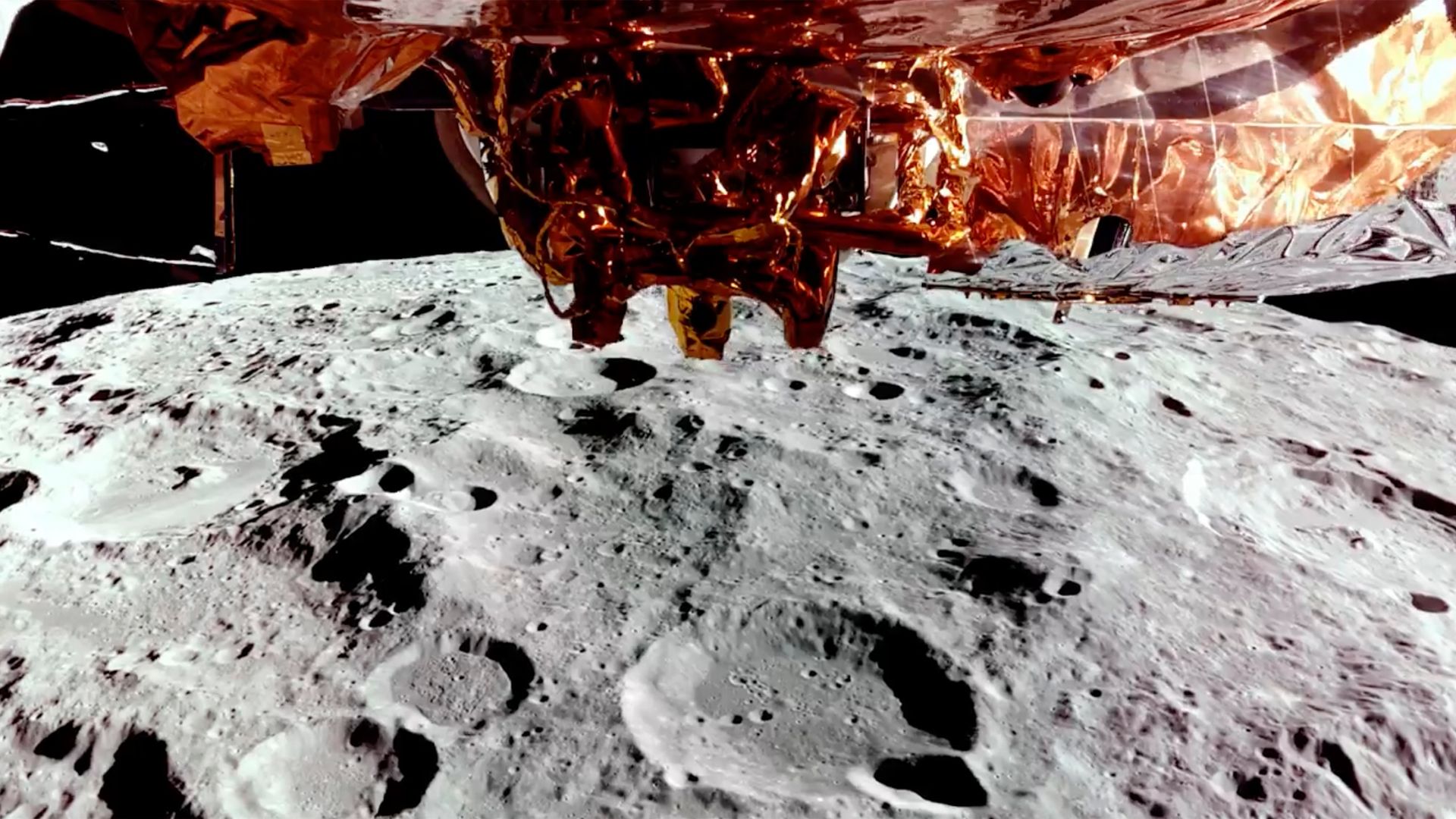
Firefly Aerospace’s Blue Ghost lander has successfully touched down on the moon, in a pivotal moment for private space travel.
The size of a compact car, the four-legged lander is carrying 10 scientific payloads and used 21 thrusters to guide itself to touchdown near an ancient volcanic vent on Mare Crisium, a large basin in the northeast corner of the moon’s Earth-facing side.
A smooth upright landing makes Firefly – a decade old startup – the first private company to put a spacecraft on the moon without it crashing or falling over. The lander was launched in mid January.
Dr Joel Kearns, deputy associate administrator at NASA, said this area was of “great scientific interest” but also “a very achievable place to land”.
This moment, he said, was “one for the history books”.
Firefly becomes the second private firm to score a soft moon landing, after Houston-based Intuitive Machines’ Odysseus lander made a lopsided soft touchdown last year.
A “soft” moon landing refers to a controlled landing on the moon, where it touches down at a low speed and causes minimal damage to the vehicle. A “hard landing” would be a crash landing.
Only five nations have been successful in soft-landings in the past: the then-Soviet Union, the US, China, India and Japan.
Dr Nicola Fox, from NASA’s Science Mission Directorate, said: “We choose our landing sites very carefully.
“This one in this really perfect location, we want to study the geological features on the moon. We want to study the interaction with the solar wind.”
She said part of this mission will be to help “prepare for future astronauts” who will go to the moon.
‘A sustainable commercial lunar economy’
Backed by NASA and its flagship Artemis moon program, private companies have played a significant role in the modern moon race. The moonshot by Firefly, an upstart primarily building rockets, is one of three lunar missions actively in progress.
The space agency paid $101m (£80.3m) for the delivery, plus $44m (£35m) for the science and tech on board.
Dr Fox said one of the hopes from this was to generate “a sustainable commercial lunar economy and have it led by American companies”.
Two other companies’ landers are hot on Blue Ghost’s heels, with the next one expected to join it on the moon later this week.
Elon Musk’s SpaceX and Jeff Bezos’ Blue Origin are building landers to put US astronauts on the moon as soon as 2027 – this would be for the first time since 1972.
Source link

Khamrah by Lattafa for Men - 3.4 oz EDP Spray
4% Off
Ghost Sweetheart Eau de Toilette | Pineapple, Jasmine and Sandalwood | Perfume for Women 50 ml
50% Off
Marc Jacobs Dot Eau De Parfum for Women, 100 ml
42% Off
Ted Baker W Eau de Toilette for Her, Fig Leaf, White Peony and Violet Top Notes, Pink Orchid and Raspberry Middle Notes, 75ml
£11.77 (£15.69 / 100 ml) (as of 05/09/2026 04:58 GMT +01:00 - More infoProduct prices and availability are accurate as of the date/time indicated and are subject to change. Any price and availability information displayed on [relevant Amazon Site(s), as applicable] at the time of purchase will apply to the purchase of this product.)
Ted Baker Woman Pink Eau de Toilette Spray Floral Green Feminine Fragrance, Opening Notes are Fresh Peach, Bergamot and Tangerine with Warm Musk, Vanilla and Vetiver Base, 100ml
11% Off
Vera Wang Princess Eau de Toilette - 30 ml

Choco Musk 50ml Eau De Parfum for men and women | Chocolate Musk by Jannat Aromas
17% Off
Christina Aguilera Signature Eau de Parfum (50ml) Floral, Fruity & Exotic Scent, Luxury Fragrance for Women
9% Off
Calvin Klein - Eau De Toilette CKIN2U - Calvin Klein Women, Ladies Perfume, Women's Perfume, Calvin Klein Perfume, Calvin Klein One - 150 ml
5% Off
Jimmy Choo Flash Eau de Parfum, 60 ml (Pack of 1)
3% Off
Fruit of the Loom Men's Heavy T Shirt, White, XL UK
28% Off
ATNKE LED Lighted Beanie Cap,USB Rechargeable Running Hat Ultra Bright 4 LED Waterproof Light Winter Warm Gifts for Men and Women/Pink

Men's 1/4 Zip Pullover UK Sale Clearance, Fleece Sweatshirt Casual Jumper Long Sleeve T-shirt Top Stand Collar Sweater Plain Pullover Sports Leisure Workwear Quarter Zip Sweater Lightweight Jumpers
£5.88 (as of 12/11/2025 00:52 GMT +01:00 - More infoProduct prices and availability are accurate as of the date/time indicated and are subject to change. Any price and availability information displayed on [relevant Amazon Site(s), as applicable] at the time of purchase will apply to the purchase of this product.)
Crevice Cleaning Brush, Bathroom Tile Groove Gap Cleaning Brush,Premium Crevice Cleaning Tool Aluminum Support with 15° Angle Magic Brush, Thin Brush for Home Kitchen
19% Off
Wireless Earbuds, Bluetooth 5.3 Headphones in Ear with HiFi Stereo Deep Bass, 4 ENC Noise Cancelling Mic Wireless Earphones 40H Playtime, Bluetooth Earbuds Dual LED Display, IP7 Waterproof, USB-C
42% Off