A research team led by the University of California, Irvine has revealed the link between the frequency of sleep apnea events during the rapid-eye-movement stage and the severity of verbal memory impairment in older adults at risk for Alzheimer’s disease. Verbal memory refers to the cognitive ability to retain and recall information presented through spoken words or written text and is particularly vulnerable to Alzheimer’s.
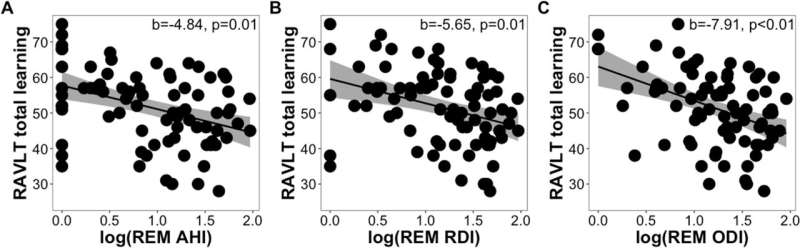
The study, recently published in Alzheimer’s Research & Therapy, discovered a specific correlation between the severity of sleep apnea—when breathing pauses while an individual is sleeping—and diminished cognition. Higher ratios during REM compared to non-REM stages were associated with worse memory performance.
“Our findings identified the specific features of sleep apnea that are associated with memory, which is important because clinically, events occurring during REM sleep are often overlooked or minimized,” said co-corresponding author Bryce Mander, UC Irvine associate professor of psychiatry & human behavior.
“Most hours of sleep are non-REM, so the overall averages of apnea severity can look much lower than what is typically observed during REM sleep. This means that someone at risk can be misdiagnosed and undertreated because current evaluation standards are not focused on sleep-stage-specific apnea severity.”
“Furthermore,” said co-corresponding author Ruth Benca, professor and chair of psychiatry and behavioral medicine at Wake Forest University School of Medicine, “we found that women are more likely to have a greater proportion of their apneic events in REM sleep in comparison to men, which could potentially be contributing to their greater risk for Alzheimer’s disease.”
The study involved 81 middle-aged and older adults from the Wisconsin Alzheimer’s Disease Research Center with heightened risk factors, of whom 62% were female. Participants underwent polysomnography—a comprehensive test that records brain waves, eye movements, muscle activity, blood oxygen levels, heart rate and breathing during sleep—and verbal memory assessments. Results showed apnea events during REM to be a critical factor contributing to verbal memory decline, especially among individuals with a genetic predisposition to Alzheimer’s and those with a parental history of the disease.
“Our findings highlight the intricate relationship among sleep apnea, memory function and Alzheimer’s risk,” Mander said. “Identifying and addressing REM-specific events are crucial for developing proactive, personalized approaches to assessment and treatment that are tailored to individual sleep patterns.”
The team also included lead author Kitty K. Lui, a graduate student in the San Diego State University/University of California, San Diego joint doctoral program in clinical psychology, and faculty and graduate students from UC Irvine, UC San Diego, the Wisconsin Alzheimer’s Disease Research Center and the University of Kentucky.
More information:
Kitty K. Lui et al, Older adults at greater risk for Alzheimer’s disease show stronger associations between sleep apnea severity in REM sleep and verbal memory, Alzheimer’s Research & Therapy (2024). DOI: 10.1186/s13195-024-01446-3
Citation:
Research links sleep apnea severity during REM stage to verbal memory decline (2024, May 14)
retrieved 15 May 2024
from https://medicalxpress.com/news/2024-05-links-apnea-severity-rem-stage.html
This document is subject to copyright. Apart from any fair dealing for the purpose of private study or research, no
part may be reproduced without the written permission. The content is provided for information purposes only.

Khamrah by Lattafa for Men - 3.4 oz EDP Spray
4% Off
Ghost Sweetheart Eau de Toilette | Pineapple, Jasmine and Sandalwood | Perfume for Women 50 ml
50% Off
Marc Jacobs Dot Eau De Parfum for Women, 100 ml
42% Off
Ted Baker W Eau de Toilette for Her, Fig Leaf, White Peony and Violet Top Notes, Pink Orchid and Raspberry Middle Notes, 75ml
£11.77 (£15.69 / 100 ml) (as of 31/05/2026 03:24 GMT +01:00 - More infoProduct prices and availability are accurate as of the date/time indicated and are subject to change. Any price and availability information displayed on [relevant Amazon Site(s), as applicable] at the time of purchase will apply to the purchase of this product.)
Ted Baker Woman Pink Eau de Toilette Spray Floral Green Feminine Fragrance, Opening Notes are Fresh Peach, Bergamot and Tangerine with Warm Musk, Vanilla and Vetiver Base, 100ml
11% Off
Vera Wang Princess Eau de Toilette - 30 ml

Choco Musk 50ml Eau De Parfum for men and women | Chocolate Musk by Jannat Aromas
17% Off
Christina Aguilera Signature Eau de Parfum (50ml) Floral, Fruity & Exotic Scent, Luxury Fragrance for Women
9% Off
Calvin Klein - Eau De Toilette CKIN2U - Calvin Klein Women, Ladies Perfume, Women's Perfume, Calvin Klein Perfume, Calvin Klein One - 150 ml
5% Off
Jimmy Choo Flash Eau de Parfum, 60 ml (Pack of 1)
3% Off
Fruit of the Loom Men's Heavy T Shirt, White, XL UK
28% Off
ATNKE LED Lighted Beanie Cap,USB Rechargeable Running Hat Ultra Bright 4 LED Waterproof Light Winter Warm Gifts for Men and Women/Pink
17% Off
Men's 1/4 Zip Pullover UK Sale Clearance, Fleece Sweatshirt Casual Jumper Long Sleeve T-shirt Top Stand Collar Sweater Plain Pullover Sports Leisure Workwear Quarter Zip Sweater Lightweight Jumpers
£5.88 (as of 12/11/2025 00:52 GMT +01:00 - More infoProduct prices and availability are accurate as of the date/time indicated and are subject to change. Any price and availability information displayed on [relevant Amazon Site(s), as applicable] at the time of purchase will apply to the purchase of this product.)
Crevice Cleaning Brush, Bathroom Tile Groove Gap Cleaning Brush,Premium Crevice Cleaning Tool Aluminum Support with 15° Angle Magic Brush, Thin Brush for Home Kitchen
19% Off
Wireless Earbuds, Bluetooth 5.3 Headphones in Ear with HiFi Stereo Deep Bass, 4 ENC Noise Cancelling Mic Wireless Earphones 40H Playtime, Bluetooth Earbuds Dual LED Display, IP7 Waterproof, USB-C
42% Off