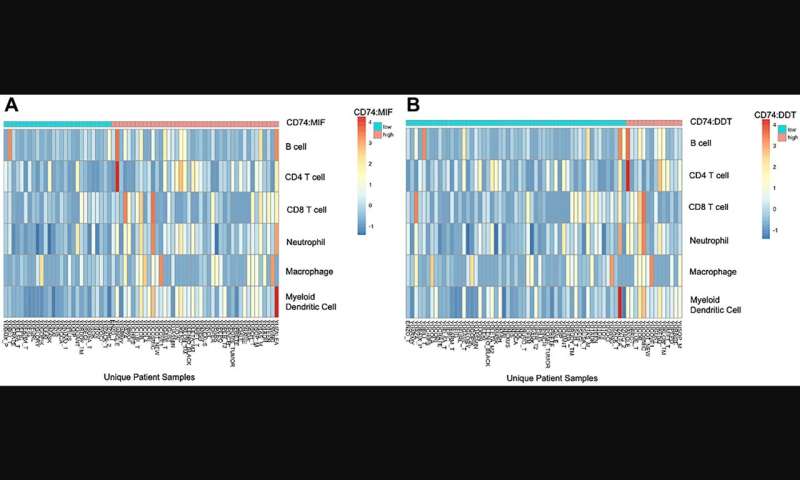
A new research paper was published in Oncotarget entitled, “Prognostic and therapeutic insights into MIF, DDT, and CD74 in melanoma.”
Macrophage Migration Inhibitory Factor (MIF) and its homolog D-dopachrome Tautomerase (DDT) have been implicated as drivers of tumor progression across a variety of cancers. Recent evidence suggests MIF as a therapeutic target in immune checkpoint inhibition (ICI) resistant melanomas. However, clinical evidence of MIF and particularly of DDT remains limited.
In this new retrospective study, researchers Caroline Naomi Valdez, Gabriela Athziri Sánchez-Zuno, Lais Osmani, Wael Ibrahim, Anjela Galan, Antonietta Bacchiocchi, Ruth Halaban, Rajan P. Kulkarni, Insoo Kang, Richard Bucala, and Thuy Tran from Yale University, Oregon Health and Science University, Cancer Early Detection Advanced Research Center (CEDAR), and the Department of Veterans Affairs Portland Health Care System analyzed 97 patients treated at Yale for melanoma between 2002–2020.
“Our study significantly expands on prior work by De Azevedo et al. by encompassing a larger cohort of individuals, coupled with a comprehensive approach to defining high and low MIF and DDT expression,” said the researchers.
Bulk-RNA sequencing of patient tumor samples from the Skin Cancer SPORE Biorepository was used to evaluate for differential gene expression of MIF, DDT, CD74, and selected inflammatory markers, and gene expression was correlated with patient survival outcomes. Their findings revealed a strong correlation between MIF and DDT levels, with no statistically significant difference across common melanoma mutations and subtypes.
Improved survival was associated with lower MIF and DDT levels and higher CD74:MIF and CD74:DDT levels. High CD74:DDT and CD74:MIF levels were also associated with enrichment of infiltrating inflammatory cell markers. These data suggest DDT as a novel target in immune therapy.
Dual MIF and DDT blockade may provide synergistic responses in patients with melanoma, irrespective of common mutations, and may overcome ICI resistance. These markers may also provide prognostic value for further biomarker development.
“Our study is the first to report survival findings in association with intratumor DDT expression and CD74:DDT expression level ratio. Thus, CD74:MIF and CD74:DDT expression ratio measurements offer promise as prognostic markers for survival outcomes and ICI response in patients with melanoma,” the researchers explained.
More information:
Caroline Naomi Valdez et al, Prognostic and therapeutic insights into MIF, DDT, and CD74 in melanoma, Oncotarget (2024). DOI: 10.18632/oncotarget.28615
Provided by
Impact Journals LLC
Citation:
Prognostic and therapeutic insights into MIF, DDT, and CD74 in melanoma (2024, July 26)
retrieved 27 July 2024
from https://medicalxpress.com/news/2024-07-prognostic-therapeutic-insights-mif-ddt.html
This document is subject to copyright. Apart from any fair dealing for the purpose of private study or research, no
part may be reproduced without the written permission. The content is provided for information purposes only.

Khamrah by Lattafa for Men - 3.4 oz EDP Spray
4% Off
Ghost Sweetheart Eau de Toilette | Pineapple, Jasmine and Sandalwood | Perfume for Women 50 ml
50% Off
Marc Jacobs Dot Eau De Parfum for Women, 100 ml
42% Off
Ted Baker W Eau de Toilette for Her, Fig Leaf, White Peony and Violet Top Notes, Pink Orchid and Raspberry Middle Notes, 75ml
£11.77 (£15.69 / 100 ml) (as of 02/09/2026 04:57 GMT +01:00 - More infoProduct prices and availability are accurate as of the date/time indicated and are subject to change. Any price and availability information displayed on [relevant Amazon Site(s), as applicable] at the time of purchase will apply to the purchase of this product.)
Ted Baker Woman Pink Eau de Toilette Spray Floral Green Feminine Fragrance, Opening Notes are Fresh Peach, Bergamot and Tangerine with Warm Musk, Vanilla and Vetiver Base, 100ml
11% Off
Vera Wang Princess Eau de Toilette - 30 ml

Choco Musk 50ml Eau De Parfum for men and women | Chocolate Musk by Jannat Aromas
17% Off
Christina Aguilera Signature Eau de Parfum (50ml) Floral, Fruity & Exotic Scent, Luxury Fragrance for Women
9% Off
Calvin Klein - Eau De Toilette CKIN2U - Calvin Klein Women, Ladies Perfume, Women's Perfume, Calvin Klein Perfume, Calvin Klein One - 150 ml
5% Off
Jimmy Choo Flash Eau de Parfum, 60 ml (Pack of 1)
3% Off
Fruit of the Loom Men's Heavy T Shirt, White, XL UK
28% Off
ATNKE LED Lighted Beanie Cap,USB Rechargeable Running Hat Ultra Bright 4 LED Waterproof Light Winter Warm Gifts for Men and Women/Pink
17% Off
Men's 1/4 Zip Pullover UK Sale Clearance, Fleece Sweatshirt Casual Jumper Long Sleeve T-shirt Top Stand Collar Sweater Plain Pullover Sports Leisure Workwear Quarter Zip Sweater Lightweight Jumpers
£5.88 (as of 12/11/2025 00:52 GMT +01:00 - More infoProduct prices and availability are accurate as of the date/time indicated and are subject to change. Any price and availability information displayed on [relevant Amazon Site(s), as applicable] at the time of purchase will apply to the purchase of this product.)
Crevice Cleaning Brush, Bathroom Tile Groove Gap Cleaning Brush,Premium Crevice Cleaning Tool Aluminum Support with 15° Angle Magic Brush, Thin Brush for Home Kitchen
19% Off
Wireless Earbuds, Bluetooth 5.3 Headphones in Ear with HiFi Stereo Deep Bass, 4 ENC Noise Cancelling Mic Wireless Earphones 40H Playtime, Bluetooth Earbuds Dual LED Display, IP7 Waterproof, USB-C
42% Off