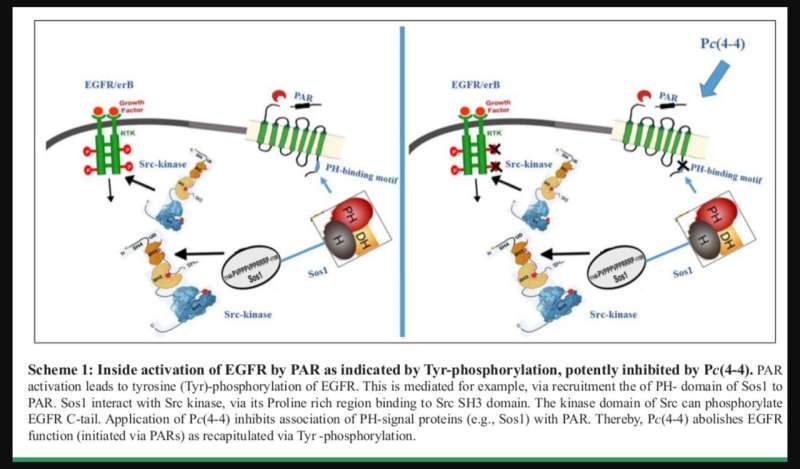
A new editorial paper was published in Oncoscience, titled “PH-binding motifs as a platform for drug design: Lessons from protease-activated receptors; PARs.”
While targeted cancer therapy is greatly dependent on specific oncogenic pathways or conferred by genetic alterations, it remains challenging and somewhat disappointing. The high level of failure relies on the interplay between the dose for desired therapy versus toxicity, namely the therapeutic index. Furthermore, one should take into consideration resistance response that develops with time to a given drug, contributing immensely to the given drawback.
In this new editorial, researchers Jeetendra Kumar Nag, Amnon Hoffman, Chaim Gilon, Beatrice Uziely, and Rachel Bar-Shavit from Hadassah-Hebrew University Medical Center and The Hebrew University highlight the need for alternative targeting routes.
“Although the contribution of G-protein-coupled receptors (GPCRs) in cancer malignancy is growing, GPCR-based therapies are rare,” write the researchers.
Importantly, GPCRs are involved in many aspects of tumorigenesis, including proliferation, invasion, survival at secondary sites, cancer stemness and cancer associated signaling pathways. Indeed, big data population analyses indicate the significance of GPCRs as valuable targets for therapy in cancer. Protease activated receptors (PARs), a subgroup of GPCRs, form a family of four members; PAR1-4.
“TCGA and GTEx database show that PAR2/F2RL1 is significantly overexpressed in many types of epithelial malignancies among of which are colon, breast and ovarian cancers,” conclude the authors.
More information:
Jeetendra Kumar Nag et al, PH-binding motifs as a platform for drug design: Lessons from protease-activated receptors; PARs, Oncoscience (2024). DOI: 10.18632/oncoscience.599
Provided by
Impact Journals LLC
Citation:
PH-binding motifs as a platform for drug design: Lessons from protease-activated receptors (2024, May 24)
retrieved 25 May 2024
from https://medicalxpress.com/news/2024-05-ph-motifs-platform-drug-lessons.html
This document is subject to copyright. Apart from any fair dealing for the purpose of private study or research, no
part may be reproduced without the written permission. The content is provided for information purposes only.

Khamrah by Lattafa for Men - 3.4 oz EDP Spray
4% Off
Ghost Sweetheart Eau de Toilette | Pineapple, Jasmine and Sandalwood | Perfume for Women 50 ml
50% Off
Marc Jacobs Dot Eau De Parfum for Women, 100 ml
42% Off
Ted Baker W Eau de Toilette for Her, Fig Leaf, White Peony and Violet Top Notes, Pink Orchid and Raspberry Middle Notes, 75ml
£11.77 (£15.69 / 100 ml) (as of 08/07/2026 03:55 GMT +01:00 - More infoProduct prices and availability are accurate as of the date/time indicated and are subject to change. Any price and availability information displayed on [relevant Amazon Site(s), as applicable] at the time of purchase will apply to the purchase of this product.)
Ted Baker Woman Pink Eau de Toilette Spray Floral Green Feminine Fragrance, Opening Notes are Fresh Peach, Bergamot and Tangerine with Warm Musk, Vanilla and Vetiver Base, 100ml
11% Off
Vera Wang Princess Eau de Toilette - 30 ml

Choco Musk 50ml Eau De Parfum for men and women | Chocolate Musk by Jannat Aromas
17% Off
Christina Aguilera Signature Eau de Parfum (50ml) Floral, Fruity & Exotic Scent, Luxury Fragrance for Women
9% Off
Calvin Klein - Eau De Toilette CKIN2U - Calvin Klein Women, Ladies Perfume, Women's Perfume, Calvin Klein Perfume, Calvin Klein One - 150 ml
5% Off
Jimmy Choo Flash Eau de Parfum, 60 ml (Pack of 1)
3% Off
Fruit of the Loom Men's Heavy T Shirt, White, XL UK
28% Off
ATNKE LED Lighted Beanie Cap,USB Rechargeable Running Hat Ultra Bright 4 LED Waterproof Light Winter Warm Gifts for Men and Women/Pink
17% Off
Men's 1/4 Zip Pullover UK Sale Clearance, Fleece Sweatshirt Casual Jumper Long Sleeve T-shirt Top Stand Collar Sweater Plain Pullover Sports Leisure Workwear Quarter Zip Sweater Lightweight Jumpers
£5.88 (as of 12/11/2025 00:52 GMT +01:00 - More infoProduct prices and availability are accurate as of the date/time indicated and are subject to change. Any price and availability information displayed on [relevant Amazon Site(s), as applicable] at the time of purchase will apply to the purchase of this product.)
Crevice Cleaning Brush, Bathroom Tile Groove Gap Cleaning Brush,Premium Crevice Cleaning Tool Aluminum Support with 15° Angle Magic Brush, Thin Brush for Home Kitchen
19% Off
Wireless Earbuds, Bluetooth 5.3 Headphones in Ear with HiFi Stereo Deep Bass, 4 ENC Noise Cancelling Mic Wireless Earphones 40H Playtime, Bluetooth Earbuds Dual LED Display, IP7 Waterproof, USB-C
42% Off