 [
[


Research led by Gui de Chauliac Hospital in Montpellier, France, and the University of Bologna in Italy reports that oveporexton improves wakefulness and reduces cataplexy episodes in patients with narcolepsy type 1. Findings suggest a potential therapeutic alternative to existing narcolepsy treatments without hepatotoxic effects associated with other treatment types.
Narcolepsy type 1 is a neurological disorder marked by excessive daytime sleepiness and episodes of muscle weakness known as cataplexy. Orexin, a neuropeptide crucial for regulating wakefulness and preventing rapid-eye-movement (REM) sleep transitions, is deficient in patients with narcolepsy type 1. Current treatments primarily address symptoms without targeting the underlying orexin system itself.
Previous efforts have successfully targeted orexin receptor 2 (OX2R) to restore wakefulness and reduce cataplexy in patients with OX2R-targeting drugs. Liver-related side effects have so far limited clinical use, and the need for safe OX2R-targeting agents remains.
In the study, “Oveporexton, an Oral Orexin Receptor 2–Selective Agonist, in Narcolepsy Type 1,” published in The New England Journal of Medicine, researchers conducted a Phase II, double-blind, randomized, placebo-controlled trial to evaluate the efficacy and safety of oveporexton in patients with narcolepsy type 1.
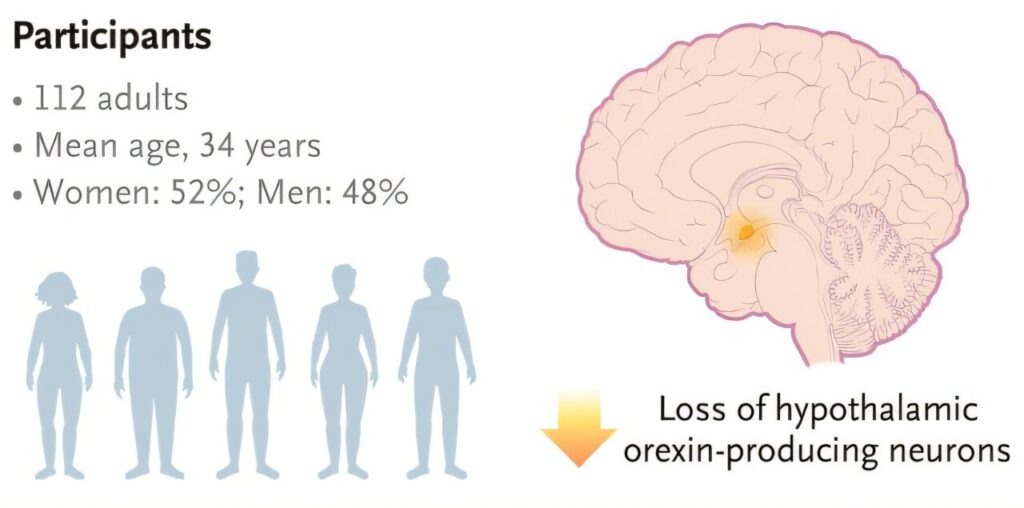
The trial included a total of 112 adults aged 18 to 70 from multiple international sites, including the United States, Europe, and Japan. Participants underwent randomization using interactive response technology to receive one of five dosing regimens administered orally over eight weeks: 0.5 mg twice daily, 2 mg twice daily, 2 mg followed by 5 mg daily, 7 mg once daily, or placebo.
Wakefulness was assessed using the Maintenance of Wakefulness Test (MWT), which measures the time it takes to fall asleep under soporific conditions.
Daytime sleepiness was quantified using the Epworth Sleepiness Scale (ESS), with higher scores indicating greater sleepiness. Cataplexy frequency was recorded through participant-reported diaries, with episodes averaged over two-week periods.
Participants receiving oveporexton demonstrated significant improvements in wakefulness and reductions in cataplexy episodes compared to those receiving placebo.
Average sleep latency on the Maintenance of Wakefulness Test (MWT) increased by 12.5 to 25.4 minutes across oveporexton dosing regimens, while the placebo group experienced a decrease of 1.2 minutes.
ESS scores decreased by 8.9 to 13.8 points among those receiving oveporexton, indicating reduced daytime sleepiness. The placebo group experienced a 2.5-point reduction.
Participants receiving placebo reported an average of 8.76 cataplexy episodes per week.
In comparison, the 0.5 mg twice-daily group averaged 4.24 episodes per week, the 2 mg twice-daily group averaged 3.14 episodes per week, and the 2 mg followed by 5 mg daily group averaged 2.48 episodes per week. Only the 2 mg twice-daily and 2 mg followed by 5 mg daily regimens demonstrated statistically significant reductions in cataplexy frequency, suggesting a dose-dependent effect in reducing cataplexy episodes.
Participants receiving oveporexton reported a high incidence of insomnia (48%), urinary urgency (33%), and urinary frequency (32%), though none of these adverse events led to treatment discontinuation. Significant improvements were observed in disease severity on the Narcolepsy Severity Scale for Clinical Trials (NSS-CT) and in quality-of-life scores on the 36-Item Short Form Survey (SF-36).
Researchers conclude that oveporexton significantly improved wakefulness, reduced daytime sleepiness, and lowered cataplexy frequency over the eight-week study period.
Unlike other orexin receptor agonists in development, oveporexton did not result in liver-related side effects, suggesting a potentially safer therapeutic profile for long-term use.
Further studies, including a Phase III trial and a long-term extension study, are ongoing to confirm the efficacy and safety of oveporexton.
More information:
Yves Dauvilliers et al, Oveporexton, an Oral Orexin Receptor 2–Selective Agonist, in Narcolepsy Type 1, New England Journal of Medicine (2025). DOI: 10.1056/NEJMoa2405847
© 2025 Science X Network
Citation:
Oveporexton shows promise in improving wakefulness in narcolepsy type 1 (2025, May 19)
retrieved 19 May 2025
from https://medicalxpress.com/news/2025-05-oveporexton-narcolepsy.html
This document is subject to copyright. Apart from any fair dealing for the purpose of private study or research, no
part may be reproduced without the written permission. The content is provided for information purposes only.

Khamrah by Lattafa for Men - 3.4 oz EDP Spray
4% Off
Ghost Sweetheart Eau de Toilette | Pineapple, Jasmine and Sandalwood | Perfume for Women 50 ml
50% Off
Marc Jacobs Dot Eau De Parfum for Women, 100 ml
42% Off
Ted Baker W Eau de Toilette for Her, Fig Leaf, White Peony and Violet Top Notes, Pink Orchid and Raspberry Middle Notes, 75ml
£11.77 (£15.69 / 100 ml) (as of 28/09/2026 05:08 GMT +01:00 - More infoProduct prices and availability are accurate as of the date/time indicated and are subject to change. Any price and availability information displayed on [relevant Amazon Site(s), as applicable] at the time of purchase will apply to the purchase of this product.)
Ted Baker Woman Pink Eau de Toilette Spray Floral Green Feminine Fragrance, Opening Notes are Fresh Peach, Bergamot and Tangerine with Warm Musk, Vanilla and Vetiver Base, 100ml
11% Off
Vera Wang Princess Eau de Toilette - 30 ml

Choco Musk 50ml Eau De Parfum for men and women | Chocolate Musk by Jannat Aromas
17% Off
Christina Aguilera Signature Eau de Parfum (50ml) Floral, Fruity & Exotic Scent, Luxury Fragrance for Women
9% Off
Calvin Klein - Eau De Toilette CKIN2U - Calvin Klein Women, Ladies Perfume, Women's Perfume, Calvin Klein Perfume, Calvin Klein One - 150 ml
5% Off
Jimmy Choo Flash Eau de Parfum, 60 ml (Pack of 1)
3% Off
Fruit of the Loom Men's Heavy T Shirt, White, XL UK
28% Off
ATNKE LED Lighted Beanie Cap,USB Rechargeable Running Hat Ultra Bright 4 LED Waterproof Light Winter Warm Gifts for Men and Women/Pink
17% Off
Men's 1/4 Zip Pullover UK Sale Clearance, Fleece Sweatshirt Casual Jumper Long Sleeve T-shirt Top Stand Collar Sweater Plain Pullover Sports Leisure Workwear Quarter Zip Sweater Lightweight Jumpers
£5.88 (as of 12/11/2025 00:52 GMT +01:00 - More infoProduct prices and availability are accurate as of the date/time indicated and are subject to change. Any price and availability information displayed on [relevant Amazon Site(s), as applicable] at the time of purchase will apply to the purchase of this product.)
Crevice Cleaning Brush, Bathroom Tile Groove Gap Cleaning Brush,Premium Crevice Cleaning Tool Aluminum Support with 15° Angle Magic Brush, Thin Brush for Home Kitchen
19% Off
Wireless Earbuds, Bluetooth 5.3 Headphones in Ear with HiFi Stereo Deep Bass, 4 ENC Noise Cancelling Mic Wireless Earphones 40H Playtime, Bluetooth Earbuds Dual LED Display, IP7 Waterproof, USB-C
42% Off