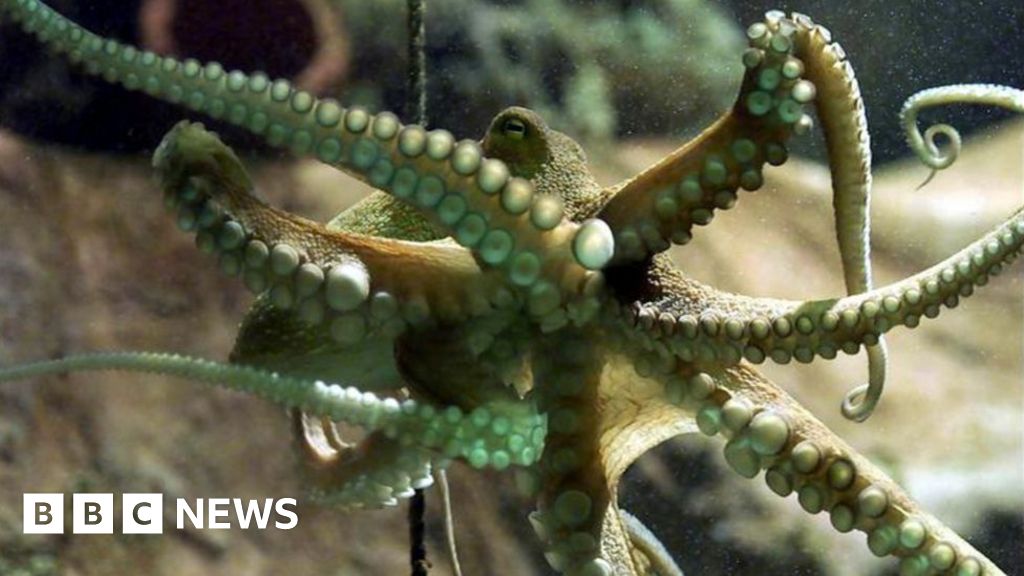
Scientists studying an explosion in octopus numbers in waters off the Channel Islands and south-west England want members of the fishing community to share their experiences to help them understand why it is happening.
Dr Simon Thomas, from the University of Plymouth, said this year’s increase – known as a bloom – was unusual as it was the second in four years, whereas normally they happened every 50 to 70 years.
He now wants “first-hand” accounts from people in the fishing industry, especially those catching crabs and lobsters.
Dr Thomas said: “I work on the theory that if you spend every day out there doing your living, you probably know a lot more about your area than I do.”
Common octopus (Octopus vulgaris) numbers have risen sharply since early this year.
Now Dr Thomas’s team has started working with the Marine Biological Association and Plymouth Marine Laboratory to understand why.
He said this year’s bloom started off the French coast, before moving to the Channel Islands and then to the south coast of England.
Dr Thomas said environmental factors like medium-term water temperature trends were “probably” partly to blame, but “we don’t know a lot of the reasons why this happened”.
Crab and fishing catches had “completely collapsed” where octopuses were present, he said.
“Some of these pots will have 10 or 12 octopus in them – and why they’re doing that we’re not entirely sure.”
He explained the behaviour was unusual as they were “normally a solitary species”.
He said: “To give you a bit of context, octopus are sort of the ultimate exponents of ‘live fast, die young’.
“So, they rapidly grow, they only live a couple of years and they produce a lot of offspring, [which end up] in the plankton.”
Dr Thomas said fishers were “absolutely vital” to understand why the bloom was happening, and he hoped the information could help them adapt if it became a more regular trend.
Some fishers were already adapting by catching octopuses, such as “one of the largest ever catches” which landed in Newlyn, Cornwall, recently.
However, he said small-scale fishers could struggle to sell catches.
“It’s decimating some fishermen’s livelihoods, which is never a good thing.”
BBC News

Khamrah by Lattafa for Men - 3.4 oz EDP Spray
4% Off
Ghost Sweetheart Eau de Toilette | Pineapple, Jasmine and Sandalwood | Perfume for Women 50 ml
50% Off
Marc Jacobs Dot Eau De Parfum for Women, 100 ml
42% Off
Ted Baker W Eau de Toilette for Her, Fig Leaf, White Peony and Violet Top Notes, Pink Orchid and Raspberry Middle Notes, 75ml
£11.77 (£15.69 / 100 ml) (as of 07/09/2026 04:59 GMT +01:00 - More infoProduct prices and availability are accurate as of the date/time indicated and are subject to change. Any price and availability information displayed on [relevant Amazon Site(s), as applicable] at the time of purchase will apply to the purchase of this product.)
Ted Baker Woman Pink Eau de Toilette Spray Floral Green Feminine Fragrance, Opening Notes are Fresh Peach, Bergamot and Tangerine with Warm Musk, Vanilla and Vetiver Base, 100ml
11% Off
Vera Wang Princess Eau de Toilette - 30 ml

Choco Musk 50ml Eau De Parfum for men and women | Chocolate Musk by Jannat Aromas
17% Off
Christina Aguilera Signature Eau de Parfum (50ml) Floral, Fruity & Exotic Scent, Luxury Fragrance for Women
9% Off
Calvin Klein - Eau De Toilette CKIN2U - Calvin Klein Women, Ladies Perfume, Women's Perfume, Calvin Klein Perfume, Calvin Klein One - 150 ml
5% Off
Jimmy Choo Flash Eau de Parfum, 60 ml (Pack of 1)
3% Off
Fruit of the Loom Men's Heavy T Shirt, White, XL UK
28% Off
ATNKE LED Lighted Beanie Cap,USB Rechargeable Running Hat Ultra Bright 4 LED Waterproof Light Winter Warm Gifts for Men and Women/Pink
17% Off
Men's 1/4 Zip Pullover UK Sale Clearance, Fleece Sweatshirt Casual Jumper Long Sleeve T-shirt Top Stand Collar Sweater Plain Pullover Sports Leisure Workwear Quarter Zip Sweater Lightweight Jumpers

Crevice Cleaning Brush, Bathroom Tile Groove Gap Cleaning Brush,Premium Crevice Cleaning Tool Aluminum Support with 15° Angle Magic Brush, Thin Brush for Home Kitchen
19% Off
Wireless Earbuds, Bluetooth 5.3 Headphones in Ear with HiFi Stereo Deep Bass, 4 ENC Noise Cancelling Mic Wireless Earphones 40H Playtime, Bluetooth Earbuds Dual LED Display, IP7 Waterproof, USB-C
42% Off