Louise CullenAgriculture and environment correspondent, BBC News NI

 BBC
BBCThousands of European oysters have been placed on the Belfast Lough seabed, in a bid to bring back native reefs that had almost disappeared.
The 2,000 adult oysters and 30,000 juveniles – called spat on shells – were brought to Belfast from a nursery in Scotland to support the return of the species.
It is part of efforts by Ulster Wildlife to restore the once-abundant native oyster beds that help provide clean water and healthy fisheries.
The charity’s marine conservation manager Dr Nick Baker-Horne said it marked “a significant step forward in helping to restore this small but mighty ocean superhero”.
Environmental, not edible
This seabed deployment is a first for Northern Ireland.
The project is supported by Ulster Wildlife members, Belfast Harbour and the Department of Agriculture, Environment and Rural Affairs via the Carrier Bag Levy.
Several native oyster nurseries have been created at Bangor Marina, Belfast Harbour, Glenarm and Carrickfergus.
In Belfast Lough, the oysters are placed on the seabed to form a natural reef over time and potentially provide habitat for spat from the nurseries to settle on.
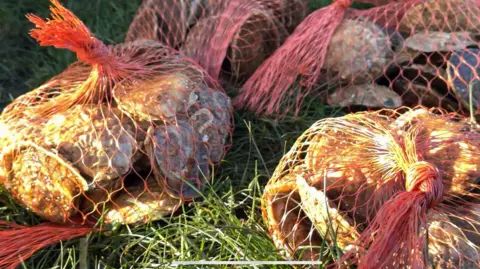
After measuring a sample, staff and volunteers from Ulster Wildlife put the oysters in biodegradable potato starch bags for laying on the seabed.
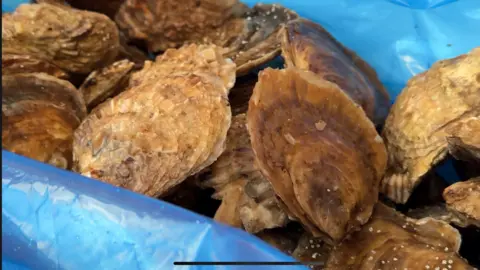
None of the oysters are suitable for consumption.
Instead, Baker-Horne points out, their purpose is purely environmental – removing nutrients from water and supporting countless other species in the reefs that they form.
“Oysters are a missing habitat, a missing species, that do fantastic things for biodiversity but also have some really fantastic supports for our environment – improving water quality, defending our coasts from big waves and also supporting juvenile fish as a fantastic habitat for those commercially important fish species.”
Water quality issues
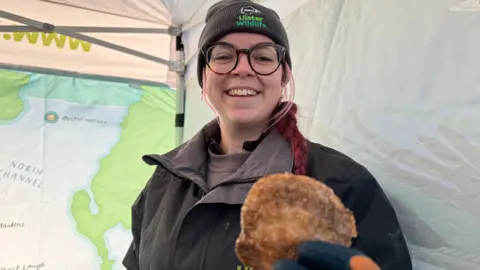
As filter feeders, shellfish like oysters contribute to improving water quality.
Jess Sennett-Seale, a Marine Restoration Assistant with the Oyster Project, says that’s not all.
“They also provide habitat because they build reefs together so they form clusters and that is really important not only for stopping wave energy and stabilising our shores and stopping so much coastal erosion, but it also forms habitats for baby animals.
“So they act as a little nursery for lots of different baby fish and crabs and other invertebrates.”
“First” for Northern Ireland
The native oyster all but disappeared from Belfast Lough in the early 20th century, due to over-fishing, pollution and habitat loss.
Outbreaks of typhoid at the time were in part blamed on sewage pollution of the water, contaminating the shellfish that were a large part of the diet for poorer communities.
Laws were then introduced prohibiting the gathering of any shellfish from Belfast Lough for consumption.
To this day, recreational fishing for shellfish in Belfast Lough remains forbidden.

While these oysters will not be eaten, this “first of its kind in Northern Ireland” project has been a labour of love for Belfast Harbour’s Marine Environment and Biodiversity Officer Simon Gibson, despite the challenges.
“It was a bit of a process trying to figure out how we can get this off the ground, working with Daera and the Crown Estate as well.
“It’s a great way to help boost the biodiversity in Belfast Lough, as well as looking at nature-based solutions for tackling water quality and biodiversity issues. The oysters are great for improving water quality.
“So I’m very excited now it’s actually happening and I think it’ll be a good way as a pilot programme that can be expanded in the future.”
BBC News

Khamrah by Lattafa for Men - 3.4 oz EDP Spray
4% Off
Ghost Sweetheart Eau de Toilette | Pineapple, Jasmine and Sandalwood | Perfume for Women 50 ml
50% Off
Marc Jacobs Dot Eau De Parfum for Women, 100 ml
42% Off
Ted Baker W Eau de Toilette for Her, Fig Leaf, White Peony and Violet Top Notes, Pink Orchid and Raspberry Middle Notes, 75ml
£11.77 (£15.69 / 100 ml) (as of 30/05/2026 03:24 GMT +01:00 - More infoProduct prices and availability are accurate as of the date/time indicated and are subject to change. Any price and availability information displayed on [relevant Amazon Site(s), as applicable] at the time of purchase will apply to the purchase of this product.)
Ted Baker Woman Pink Eau de Toilette Spray Floral Green Feminine Fragrance, Opening Notes are Fresh Peach, Bergamot and Tangerine with Warm Musk, Vanilla and Vetiver Base, 100ml
11% Off
Vera Wang Princess Eau de Toilette - 30 ml

Choco Musk 50ml Eau De Parfum for men and women | Chocolate Musk by Jannat Aromas
17% Off
Christina Aguilera Signature Eau de Parfum (50ml) Floral, Fruity & Exotic Scent, Luxury Fragrance for Women
9% Off
Calvin Klein - Eau De Toilette CKIN2U - Calvin Klein Women, Ladies Perfume, Women's Perfume, Calvin Klein Perfume, Calvin Klein One - 150 ml
5% Off
Jimmy Choo Flash Eau de Parfum, 60 ml (Pack of 1)
3% Off
Fruit of the Loom Men's Heavy T Shirt, White, XL UK
28% Off
ATNKE LED Lighted Beanie Cap,USB Rechargeable Running Hat Ultra Bright 4 LED Waterproof Light Winter Warm Gifts for Men and Women/Pink
17% Off
Men's 1/4 Zip Pullover UK Sale Clearance, Fleece Sweatshirt Casual Jumper Long Sleeve T-shirt Top Stand Collar Sweater Plain Pullover Sports Leisure Workwear Quarter Zip Sweater Lightweight Jumpers
£5.88 (as of 12/11/2025 00:52 GMT +01:00 - More infoProduct prices and availability are accurate as of the date/time indicated and are subject to change. Any price and availability information displayed on [relevant Amazon Site(s), as applicable] at the time of purchase will apply to the purchase of this product.)
Crevice Cleaning Brush, Bathroom Tile Groove Gap Cleaning Brush,Premium Crevice Cleaning Tool Aluminum Support with 15° Angle Magic Brush, Thin Brush for Home Kitchen
19% Off
Wireless Earbuds, Bluetooth 5.3 Headphones in Ear with HiFi Stereo Deep Bass, 4 ENC Noise Cancelling Mic Wireless Earphones 40H Playtime, Bluetooth Earbuds Dual LED Display, IP7 Waterproof, USB-C
42% Off