 [
[

Good sleep is essential for brain health. During sleep and rest, the glymphatic system, the brain’s waste-clearing process, helps remove metabolic waste that accumulates during waking hours. This activity is linked to memory processing, cognitive function and neural recovery. When sleep quality is poor, metabolic waste may accumulate, potentially disrupting cognitive function and memory formation.
A softer way to track sleep
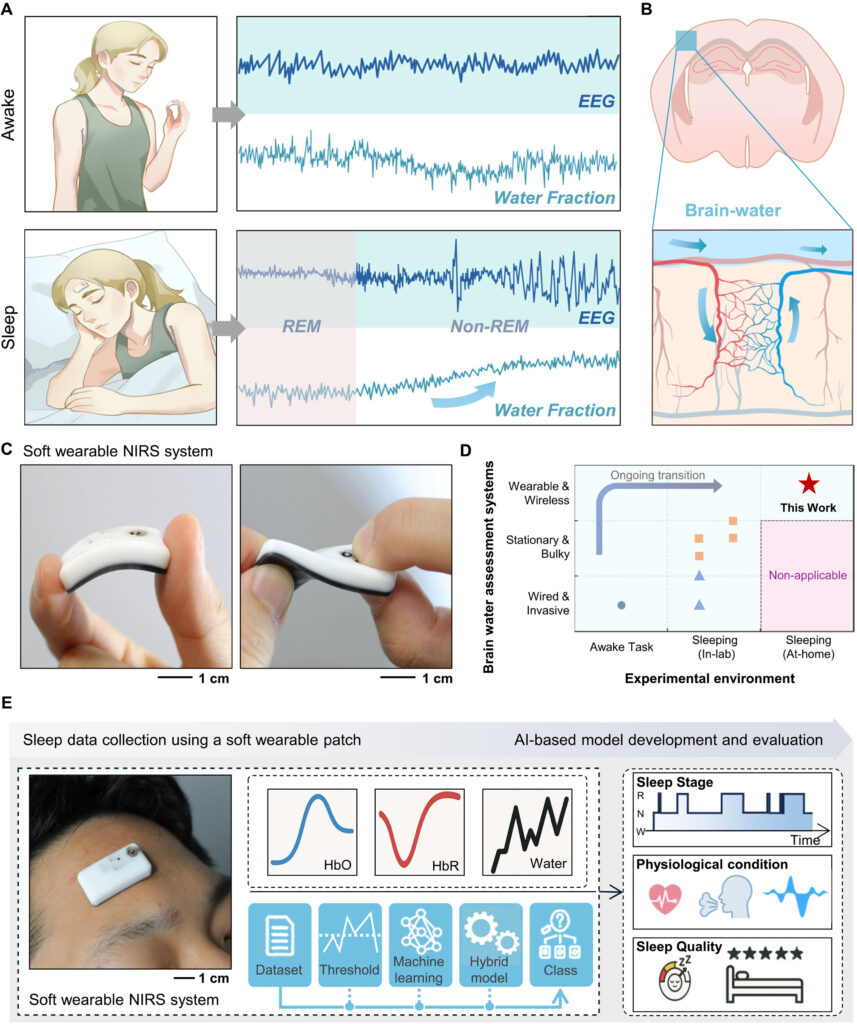
Traditional approaches to brain monitoring are often invasive, costly and limited to clinical settings. New research from Georgia Tech points to a more accessible approach. A study published in Science Advances shows that a soft, wireless wearable device could help enable home-based monitoring of physiological changes associated with sleep and brain health.
The research team, led by W. Hong Yeo, Peterson Endowed Professor in the Woodruff School of Mechanical Engineering and director of the Wearable Intelligent Systems and Healthcare Center and the Korea KIAT-Georgia Tech Semiconductor Electronics Center, developed a wearable device that uses light-based sensing and wireless communication to support natural sleep monitoring at home.
The device is designed to collect data outside of a clinical environment, allowing researchers to study sleep in a more comfortable and realistic setting.
“This paper introduces the first soft, wireless, and non-invasive wearable near-infrared spectroscopy system capable of continuously monitoring brain water and glymphatic clearance dynamics in a natural home sleep environment, overcoming the restrictive, costly, and invasive limitations of traditional methods like MRI and polysomnography,” Yeo said.
How the device reads signals
The device works by emitting LED light at specific wavelengths. That light interacts with tissue and fluid near the brain, and reflected signals are detected by a photodetector placed on the skin. The collected data is then transmitted wirelessly via Bluetooth to a nearby device for analysis.
The researchers note that the optical measurements can be influenced by factors beyond brain-related fluid changes. Breathing depth, slight shifts in forehead pressure, body position, motion and temperature drift can all affect the signal.
For that reason, the team focused on changes and trends over time rather than claiming precise measurements of brain water content. They also emphasize that some of the measured signal may reflect effects from the skin, scalp, device pressure or movement, in addition to changes associated with the brain.
Designed for real-world sleep studies
By making sleep monitoring more comfortable and accessible, this soft wearable technology could help advance future studies of sleep, glymphatic activity and brain health in real-world settings.
Publication details
Seunghyeb Ban et al, A soft wearable near-infrared spectroscopy system for detecting brain water dynamics linked to glymphatic activity during sleep, Science Advances (2026). DOI: 10.1126/sciadv.aed2056
Journal information:
Science Advances
Key medical concepts


Citation:
New soft wearable device could support at-home sleep monitoring (2026, July 10)
retrieved 11 July 2026
from https://medicalxpress.com/news/2026-07-soft-wearable-device-home.html
This document is subject to copyright. Apart from any fair dealing for the purpose of private study or research, no
part may be reproduced without the written permission. The content is provided for information purposes only.

Khamrah by Lattafa for Men - 3.4 oz EDP Spray
4% Off
Ghost Sweetheart Eau de Toilette | Pineapple, Jasmine and Sandalwood | Perfume for Women 50 ml
50% Off
Marc Jacobs Dot Eau De Parfum for Women, 100 ml
42% Off
Ted Baker W Eau de Toilette for Her, Fig Leaf, White Peony and Violet Top Notes, Pink Orchid and Raspberry Middle Notes, 75ml
£11.77 (£15.69 / 100 ml) (as of 11/07/2026 03:56 GMT +01:00 - More infoProduct prices and availability are accurate as of the date/time indicated and are subject to change. Any price and availability information displayed on [relevant Amazon Site(s), as applicable] at the time of purchase will apply to the purchase of this product.)
Ted Baker Woman Pink Eau de Toilette Spray Floral Green Feminine Fragrance, Opening Notes are Fresh Peach, Bergamot and Tangerine with Warm Musk, Vanilla and Vetiver Base, 100ml
11% Off
Vera Wang Princess Eau de Toilette - 30 ml

Choco Musk 50ml Eau De Parfum for men and women | Chocolate Musk by Jannat Aromas
17% Off
Christina Aguilera Signature Eau de Parfum (50ml) Floral, Fruity & Exotic Scent, Luxury Fragrance for Women
9% Off
Calvin Klein - Eau De Toilette CKIN2U - Calvin Klein Women, Ladies Perfume, Women's Perfume, Calvin Klein Perfume, Calvin Klein One - 150 ml
5% Off
Jimmy Choo Flash Eau de Parfum, 60 ml (Pack of 1)
3% Off
Fruit of the Loom Men's Heavy T Shirt, White, XL UK
28% Off
ATNKE LED Lighted Beanie Cap,USB Rechargeable Running Hat Ultra Bright 4 LED Waterproof Light Winter Warm Gifts for Men and Women/Pink
17% Off
Men's 1/4 Zip Pullover UK Sale Clearance, Fleece Sweatshirt Casual Jumper Long Sleeve T-shirt Top Stand Collar Sweater Plain Pullover Sports Leisure Workwear Quarter Zip Sweater Lightweight Jumpers
£5.88 (as of 12/11/2025 00:52 GMT +01:00 - More infoProduct prices and availability are accurate as of the date/time indicated and are subject to change. Any price and availability information displayed on [relevant Amazon Site(s), as applicable] at the time of purchase will apply to the purchase of this product.)
Crevice Cleaning Brush, Bathroom Tile Groove Gap Cleaning Brush,Premium Crevice Cleaning Tool Aluminum Support with 15° Angle Magic Brush, Thin Brush for Home Kitchen
19% Off
Wireless Earbuds, Bluetooth 5.3 Headphones in Ear with HiFi Stereo Deep Bass, 4 ENC Noise Cancelling Mic Wireless Earphones 40H Playtime, Bluetooth Earbuds Dual LED Display, IP7 Waterproof, USB-C
42% Off