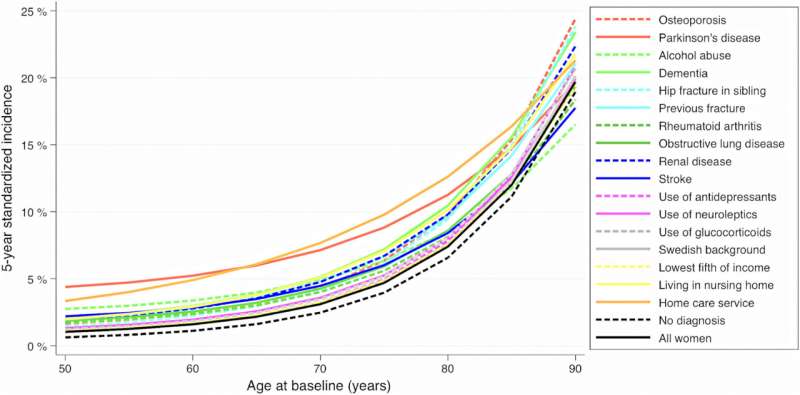


Researchers at Uppsala University have developed a clinical model that can accurately predict the risk of hip fractures in the elderly. The model is based on analyses of data from the entire Swedish population and can identify patients at high risk, without the need to measure skeletal strength. This can speed up the process for doctors and allow patients to receive preventive treatment. This is shown in a new study published in the journal eClinicalMedicine.
Around 15,000 hip fractures occur in Sweden each year. This causes both pain in patients and renders them more dependent on either relatives, friends or health care staff. As many as 25 percent of those affected die within the first year, which means that the mortality rate is higher than for incidents such as a stroke or a heart attack. This means that if you can predict who will be affected, you can take preventive action and save lives.
The new study is based on register data collected from the entire Swedish population. For five years, the researchers followed all people living in Sweden who were at least 50 years old in order to identify factors that increased the risk of hip fractures.
“The most surprising result was that we could predict hip fractures so accurately without using bone density, which has traditionally been an important factor. This means that more people can be identified in time and offered preventive treatment,” explains Peter Nordström, Professor and Consultant Physician who leads the research group.
Bone densitometry, which is currently the most commonly used method to assess fracture risk, has several limitations. It is a time-consuming examination that requires expensive equipment, and is therefore not available to all doctors. The model that has now been developed is based instead on variables that are easier to collect in clinical settings, such as diagnoses and medical treatments. This allows health care staff to carry out risk assessments without needing access to bone densitometry equipment.
“A major advantage of our model is that it is based on data already available in the clinic, which allows us to identify at-risk groups more quickly and easily. This in turn enables us to start preventive interventions earlier, such as medication for osteoporosis, and prevent serious complications that occur in hip fractures,” continues Nordström.
Based on 19 variables
The research model is based on 19 variables, with the strongest predictors—apart from advanced age—being the use of home-help services and diagnoses such as Parkinson’s disease and dementia. The model showed that women with home-help services had a 5-year risk of almost 8% of suffering a hip fracture, while the corresponding figure for men was 5%.
“A key insight from our research is that frailty, which home-help services can reflect, is a strong indicator of hip fractures. It helps us see that it’s not just about bone density but about the whole health situation of each individual,” notes Anna Nordström, one of the researchers behind the study.
Treatment can be started earlier
An important key finding of the study was that the researchers were able to establish a risk threshold for when treatment with bone-strengthening drugs should be considered. If a person has a 3 percent or higher risk of hip fracture within five years, preventive medication may be beneficial. According to the model, 36 women or 52 men would therefore need treatment to prevent a hip fracture.
“This model can have a major impact on elderly people, especially those who have not had their bone density measured. It gives us a tool to identify at-risk groups early and take preventive measures before a hip fracture occurs,” says Nordström.
The study has also been validated among individuals with a foreign background and proved to be equally accurate there. The results were recently published and the research may lead to new guidelines on how health care providers should manage the risk of hip fractures in older people.
The 19 factors on which the free-to-use algorithm is based are: age, gender, osteoporosis, Parkinson’s disease, alcohol abuse, dementia, hip fracture in siblings, previous fracture, rheumatoid arthritis, chronic lung obstructive disease, renal disease, stroke, depression or antidepressants, psychosis or neuroleptics, Swedish background, low income, nursing home resident, home-help services, and oral corticosteroids.
More information:
Peter Nordström et al, A novel clinical prediction model for hip fractures: a development and validation study in the total population of Sweden, eClinicalMedicine (2024). DOI: 10.1016/j.eclinm.2024.102877
Citation:
New clinical model for predicting hip fractures could save lives (2024, October 14)
retrieved 14 October 2024
from https://medicalxpress.com/news/2024-10-clinical-hip-fractures.html
This document is subject to copyright. Apart from any fair dealing for the purpose of private study or research, no
part may be reproduced without the written permission. The content is provided for information purposes only.

Khamrah by Lattafa for Men - 3.4 oz EDP Spray
4% Off
Ghost Sweetheart Eau de Toilette | Pineapple, Jasmine and Sandalwood | Perfume for Women 50 ml
50% Off
Marc Jacobs Dot Eau De Parfum for Women, 100 ml
42% Off
Ted Baker W Eau de Toilette for Her, Fig Leaf, White Peony and Violet Top Notes, Pink Orchid and Raspberry Middle Notes, 75ml
£11.77 (£15.69 / 100 ml) (as of 05/11/2026 05:40 GMT +00:00 - More infoProduct prices and availability are accurate as of the date/time indicated and are subject to change. Any price and availability information displayed on [relevant Amazon Site(s), as applicable] at the time of purchase will apply to the purchase of this product.)
Ted Baker Woman Pink Eau de Toilette Spray Floral Green Feminine Fragrance, Opening Notes are Fresh Peach, Bergamot and Tangerine with Warm Musk, Vanilla and Vetiver Base, 100ml
11% Off
Vera Wang Princess Eau de Toilette - 30 ml

Choco Musk 50ml Eau De Parfum for men and women | Chocolate Musk by Jannat Aromas
17% Off
Christina Aguilera Signature Eau de Parfum (50ml) Floral, Fruity & Exotic Scent, Luxury Fragrance for Women
9% Off
Calvin Klein - Eau De Toilette CKIN2U - Calvin Klein Women, Ladies Perfume, Women's Perfume, Calvin Klein Perfume, Calvin Klein One - 150 ml
5% Off
Jimmy Choo Flash Eau de Parfum, 60 ml (Pack of 1)
3% Off
Fruit of the Loom Men's Heavy T Shirt, White, XL UK
28% Off
ATNKE LED Lighted Beanie Cap,USB Rechargeable Running Hat Ultra Bright 4 LED Waterproof Light Winter Warm Gifts for Men and Women/Pink
17% Off
Men's 1/4 Zip Pullover UK Sale Clearance, Fleece Sweatshirt Casual Jumper Long Sleeve T-shirt Top Stand Collar Sweater Plain Pullover Sports Leisure Workwear Quarter Zip Sweater Lightweight Jumpers
£5.88 (as of 11/11/2025 23:52 GMT +00:00 - More infoProduct prices and availability are accurate as of the date/time indicated and are subject to change. Any price and availability information displayed on [relevant Amazon Site(s), as applicable] at the time of purchase will apply to the purchase of this product.)
Crevice Cleaning Brush, Bathroom Tile Groove Gap Cleaning Brush,Premium Crevice Cleaning Tool Aluminum Support with 15° Angle Magic Brush, Thin Brush for Home Kitchen
19% Off
Wireless Earbuds, Bluetooth 5.3 Headphones in Ear with HiFi Stereo Deep Bass, 4 ENC Noise Cancelling Mic Wireless Earphones 40H Playtime, Bluetooth Earbuds Dual LED Display, IP7 Waterproof, USB-C
42% Off