Researchers at QIMR Berghofer have developed a computer-based “growth chart” that could potentially transform the way pediatricians monitor child brain health and allow for earlier identification of neurodevelopmental delays.
Dr. Nathan Stevenson and Dr. Kartik Iyer, in collaboration with researchers and clinicians from Australia and Finland, designed a non-invasive AI application to chart a child’s brain age by monitoring their brain signals while asleep. The research is published in the journal eBioMedicine.
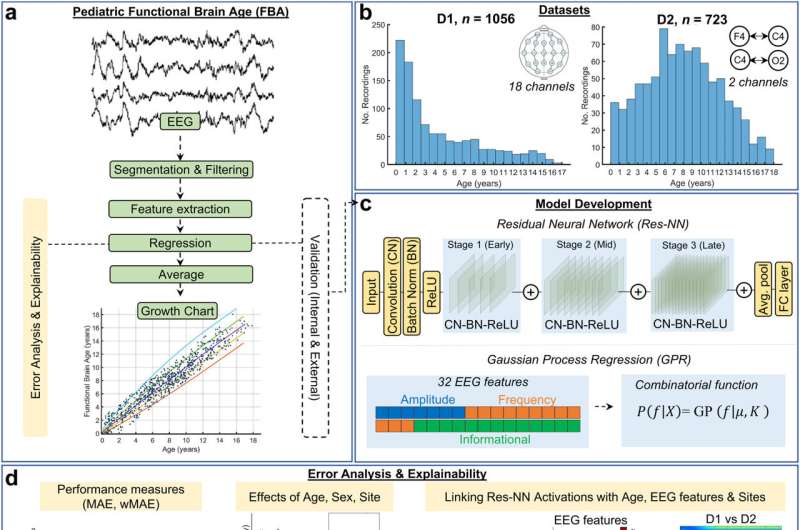
Using an electroencephalogram (EEG) to measure electrical activity in the brain, the QIMR Berghofer team developed the “growth chart” by applying machine learning algorithms to data from 2,000 children from Finland and Australia.
Dr. Stevenson said the tool could help clinicians identify neurological problems earlier, allowing for more effective therapeutic interventions and personalized management.
“Developmental delays affect the health of children and hinder their ability to reach their full potential,” he said.
“The European Brain Council and World Health Organization acknowledge the need for better measures of early brain development. Our brain ‘growth chart’ is one such measure.
“We have mirrored the widespread use of physical growth charts, to create a neurodevelopmental growth chart which facilitates rapid and easy clinical assessment of early-life brain maturation and health.”
More than 10% of children worldwide have a clinically relevant neurodevelopmental delay. Major contributors include prematurity, acquired brain injury, structural brain abnormalities, exposure to toxins, and childhood epilepsies.
Dr. Iyer said their tool charts a child’s neurodevelopmental age against their true birth age, to track brain health. The team last year applied similar AI technology to the electrocardiogram (ECG) heart monitoring data of pre-term babies to give pediatricians better information about development, but the brain age tool takes the technology to a new level.
“By extracting precise information from the EEG signal, we can predict brain age and measure how this differs from a child’s actual age. If brain age is lagging for example, this can help facilitate a conversation between a clinician and a child’s caregiver on their neurodevelopmental progress,” he said.
Dr. Jasneek Chawla, Pediatric Respiratory and Sleep Medicine Physician at the Queensland Children’s Hospital, collaborated with the QIMR Berghofer team on the project and said the new tool is an exciting development.
“Brain age is one of the most important measures we have for children. This brain growth chart is an easy to use tool which has the potential to advance clinicians’ understanding incredibly, helping to inform early intervention strategies and predict future cognitive status,” said Dr. Chawla.
The brain “growth chart” is applicable for children from infancy through adolescence.
More information:
Kartik K. Iyer et al, A growth chart of brain function from infancy to adolescence based on EEG, eBioMedicine (2024). DOI: 10.1016/j.ebiom.2024.105061
Provided by
QIMR Berghofer
Citation:
AI tool helps monitor brain development in children and identify neurodevelopmental delays (2024, June 4)
retrieved 4 June 2024
from https://medicalxpress.com/news/2024-06-ai-tool-brain-children-neurodevelopmental.html
This document is subject to copyright. Apart from any fair dealing for the purpose of private study or research, no
part may be reproduced without the written permission. The content is provided for information purposes only.

Khamrah by Lattafa for Men - 3.4 oz EDP Spray
4% Off
Ghost Sweetheart Eau de Toilette | Pineapple, Jasmine and Sandalwood | Perfume for Women 50 ml
50% Off
Marc Jacobs Dot Eau De Parfum for Women, 100 ml
42% Off
Ted Baker W Eau de Toilette for Her, Fig Leaf, White Peony and Violet Top Notes, Pink Orchid and Raspberry Middle Notes, 75ml
£11.77 (£15.69 / 100 ml) (as of 17/09/2026 05:04 GMT +01:00 - More infoProduct prices and availability are accurate as of the date/time indicated and are subject to change. Any price and availability information displayed on [relevant Amazon Site(s), as applicable] at the time of purchase will apply to the purchase of this product.)
Ted Baker Woman Pink Eau de Toilette Spray Floral Green Feminine Fragrance, Opening Notes are Fresh Peach, Bergamot and Tangerine with Warm Musk, Vanilla and Vetiver Base, 100ml
11% Off
Vera Wang Princess Eau de Toilette - 30 ml

Choco Musk 50ml Eau De Parfum for men and women | Chocolate Musk by Jannat Aromas
17% Off
Christina Aguilera Signature Eau de Parfum (50ml) Floral, Fruity & Exotic Scent, Luxury Fragrance for Women
9% Off
Calvin Klein - Eau De Toilette CKIN2U - Calvin Klein Women, Ladies Perfume, Women's Perfume, Calvin Klein Perfume, Calvin Klein One - 150 ml
5% Off
Jimmy Choo Flash Eau de Parfum, 60 ml (Pack of 1)
3% Off
Fruit of the Loom Men's Heavy T Shirt, White, XL UK
28% Off
ATNKE LED Lighted Beanie Cap,USB Rechargeable Running Hat Ultra Bright 4 LED Waterproof Light Winter Warm Gifts for Men and Women/Pink
17% Off
Men's 1/4 Zip Pullover UK Sale Clearance, Fleece Sweatshirt Casual Jumper Long Sleeve T-shirt Top Stand Collar Sweater Plain Pullover Sports Leisure Workwear Quarter Zip Sweater Lightweight Jumpers
£5.88 (as of 12/11/2025 00:52 GMT +01:00 - More infoProduct prices and availability are accurate as of the date/time indicated and are subject to change. Any price and availability information displayed on [relevant Amazon Site(s), as applicable] at the time of purchase will apply to the purchase of this product.)
Crevice Cleaning Brush, Bathroom Tile Groove Gap Cleaning Brush,Premium Crevice Cleaning Tool Aluminum Support with 15° Angle Magic Brush, Thin Brush for Home Kitchen
19% Off
Wireless Earbuds, Bluetooth 5.3 Headphones in Ear with HiFi Stereo Deep Bass, 4 ENC Noise Cancelling Mic Wireless Earphones 40H Playtime, Bluetooth Earbuds Dual LED Display, IP7 Waterproof, USB-C
42% Off