BBC News, Jerusalem

 BBC
BBCIsrael’s war in Gaza grinds on, but opposition is growing.
In recent weeks, thousands of Israeli reservists – from all branches of the military – have signed letters demanding that Prime Minister Benjamin Netanyahu’s government stop the fighting and concentrate instead on reaching a deal to bring back the remaining 59 hostages being held by Hamas.
Eighteen months ago, few Israelis doubted the war’s logic: to defeat Hamas and return the hostages.
For many, the January ceasefire and subsequent return of more than 30 hostages raised hopes that the war might soon end.
But after Israel broke the ceasefire and returned to war in mid-March, those hopes were dashed.
“We came to the conclusion that Israel is going to a very bad place,” Danny Yatom, a former head of the spy agency Mossad told me.
“We understand that what mainly bothers Netanyahu is his own interests. And in the list of priorities, his interests and the interests of having the government stable are the first ones, and not the hostages.”
Many of those signing recent letters are, like Yatom, long time critics of the prime minister. Some were involved in the anti-government protests that preceded the outbreak of war on 7 October 2023 following Hamas’s attack on Israel.
But Yatom says that’s not why he decided to speak out.
“I signed my name and I am participating in the demonstrations not because of any political reason, but because of a national reason,” he said.
“I am highly concerned that my country is going to lose its way.”
 Getty Images
The first open letter to be published, in early April, was signed by 1,000 air force reservists and retirees.
“The continuation of the war does not contribute to any of its declared goals,” they wrote, “and will lead to the death of the hostages”.
The signatories urged Israelis to follow their lead before time ran out on the estimated 24 hostages still thought to be alive in Gaza.
“Every day that passes is further risking their lives. Every moment of hesitation is a crying shame.”
In the weeks since, similar letters have appeared from almost every branch of the military, including elite fighting and intelligence units, along with a number of decorated commanders.
More than 12,000 signatures all.
After 7 October, hundreds of thousands of Israeli reservists answered the call, eager to serve.
But now, more and more are refusing, with reports suggesting that reserve attendance has dropped to as little as 50-60%.
For a military that depends heavily on reservists to fight its wars, it’s a looming crisis on a scale not seen since Israel’s first Lebanon war in 1982.
In a leafy Jerusalem park, I met “Yoav” (not his real name), an infantry reservist who asked not to be identified.
Yoav served in Gaza last summer but said he wouldn’t do it again.
“I had the feeling that I needed to go to help my brothers and sisters,” he told me.
“I believed I was doing something good. Complicated but good. But now, I don’t see it in the same way anymore.”
The government’s determination to keep fighting Hamas, while hostages risk death in the tunnels of Gaza, Yoav said, was misplaced.
“We are very strong and we can beat Hamas, but it’s not about beating Hamas,” he said. “It’s about losing our country.”
 Getty Images
During his time in Gaza, Yoav told me, he tried to be “the best moral soldier that a man can be”.
But the longer the war goes on, critics say, the harder it is for Israel to claim, as government officials often do, that its military is the most moral army in the world.
In a recent column in the left of centre newspaper Haaretz, the retired general Amiram Levin said it was time for soldiers – starting with senior commanders – to think about disobeying orders.
“The risk of being dragged into war crimes and suffering a fatal blow to the Israel Defense Forces and our social ethos,” he wrote, “make it impossible to stand idly by”.
Some of Israel’s critics, including those who have brought cases before the International Criminal Court and International Court of Justice, argue that such lines have already been crossed.
Netanyahu has lashed out at the protesters, dismissing their concerns as “propaganda lies”, spread by “a small handful of fringe elements – loud, anarchist and disconnected pensioners, most of whom haven’t served in years”.
But polls suggest the protest letters reflect a growing public conviction: that the release of the remaining hostages should come before everything.
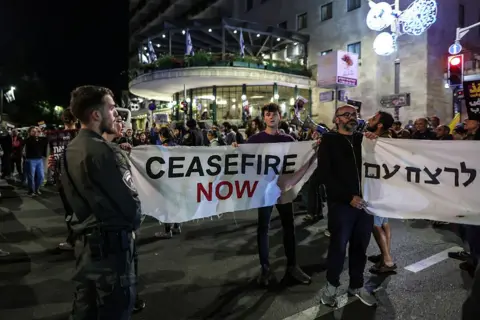
In Tel Aviv, where noisy anti-war demonstrations have been held for well over a year, images of the hostages are held aloft, while other protestors sit on the road, cradling pictures of Palestinian children killed during the war.
Amid the row generated by the letters, such emotive displays appear to have rattled the authorities.
On 20 April, the police briefly told protesters that “pictures of children or babies from Gaza” would not be permitted, along with posters displaying the words “genocide” or “ethnic cleansing”.
Following expressions of outrage from the organisers, the police quickly backed down.
Meanwhile, the prime minister continues to speak of his determination to defeat Hamas.
Military pressure, Netanyahu continues to insist, is the only way to bring the hostages home.
BBC News

Khamrah by Lattafa for Men - 3.4 oz EDP Spray
4% Off
Ghost Sweetheart Eau de Toilette | Pineapple, Jasmine and Sandalwood | Perfume for Women 50 ml
50% Off
Marc Jacobs Dot Eau De Parfum for Women, 100 ml
42% Off
Ted Baker W Eau de Toilette for Her, Fig Leaf, White Peony and Violet Top Notes, Pink Orchid and Raspberry Middle Notes, 75ml
£11.77 (£15.69 / 100 ml) (as of 14/07/2026 03:57 GMT +01:00 - More infoProduct prices and availability are accurate as of the date/time indicated and are subject to change. Any price and availability information displayed on [relevant Amazon Site(s), as applicable] at the time of purchase will apply to the purchase of this product.)
Ted Baker Woman Pink Eau de Toilette Spray Floral Green Feminine Fragrance, Opening Notes are Fresh Peach, Bergamot and Tangerine with Warm Musk, Vanilla and Vetiver Base, 100ml
11% Off
Vera Wang Princess Eau de Toilette - 30 ml

Choco Musk 50ml Eau De Parfum for men and women | Chocolate Musk by Jannat Aromas
17% Off
Christina Aguilera Signature Eau de Parfum (50ml) Floral, Fruity & Exotic Scent, Luxury Fragrance for Women
9% Off
Calvin Klein - Eau De Toilette CKIN2U - Calvin Klein Women, Ladies Perfume, Women's Perfume, Calvin Klein Perfume, Calvin Klein One - 150 ml
5% Off
Jimmy Choo Flash Eau de Parfum, 60 ml (Pack of 1)
3% Off
Fruit of the Loom Men's Heavy T Shirt, White, XL UK
28% Off
ATNKE LED Lighted Beanie Cap,USB Rechargeable Running Hat Ultra Bright 4 LED Waterproof Light Winter Warm Gifts for Men and Women/Pink

Men's 1/4 Zip Pullover UK Sale Clearance, Fleece Sweatshirt Casual Jumper Long Sleeve T-shirt Top Stand Collar Sweater Plain Pullover Sports Leisure Workwear Quarter Zip Sweater Lightweight Jumpers
£5.88 (as of 12/11/2025 00:52 GMT +01:00 - More infoProduct prices and availability are accurate as of the date/time indicated and are subject to change. Any price and availability information displayed on [relevant Amazon Site(s), as applicable] at the time of purchase will apply to the purchase of this product.)
Crevice Cleaning Brush, Bathroom Tile Groove Gap Cleaning Brush,Premium Crevice Cleaning Tool Aluminum Support with 15° Angle Magic Brush, Thin Brush for Home Kitchen
19% Off
Wireless Earbuds, Bluetooth 5.3 Headphones in Ear with HiFi Stereo Deep Bass, 4 ENC Noise Cancelling Mic Wireless Earphones 40H Playtime, Bluetooth Earbuds Dual LED Display, IP7 Waterproof, USB-C
42% Off