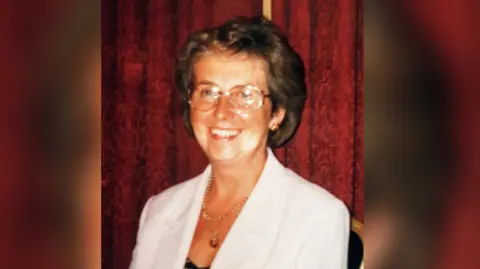
 Short Family
A mother-of-four who was killed in the Omagh bomb welcomed a grandchild just the day before the 1998 attack, a public inquiry has heard.
Veda Short, 56, met the baby boy in hospital the night before the explosion that “shattered” her family’s world.
The inquiry heard she had taken photographs of the baby and held him.
Veda was one of 29 people who were killed by the Real IRA bomb, including a woman who was pregnant with twins.
Taken away in a ‘brutal manner’
A lawyer speaking on behalf of Mrs Short’s children told the inquiry that the “family-orientated” clothes shop manager had just been getting over the death of her own mother the previous October.
She was described as a “loving wife, mother and grandmother” who was very active within her church.
Mrs Short and her husband, who “loved to play bowls in the church hall”, had recently returned home from holiday in Alicante.
Following Mrs Short’s death, the family said her husband was “a broken man” and subsequently had health troubles.
His death at 64, six years after the blast, was described as “another casualty” of the Omagh bomb.
 PA
PAMrs Short was a manager at Watterson’s, a clothes shop in the County Tyrone town.
She had been working on the day of the bomb and was evacuated, along with her colleagues, into Market Street.
She and two of her workmates, Ann McCombe and Geraldine Breslin, were among the 29 people who lost their lives.
Mrs Short’s children said their mother was taken away from them in a “brutal manner”.
Building ‘folded like a book’
The husband of a Philomena Skelton who was killed in the bomb has described how he found her lying face down in the rubble.
Kevin Skelton told the inquiry that the aftermath of the blast, in which his 39-year-old wife lost her life, was “pandemonium”.
He said: “I looked at things that no human being should have to look at.”
He said, of the sounds and smells, “I can’t get that out of my head”.
Mr Skelton, his wife and three of their four children had been shopping in Omagh town centre when the bomb went off.
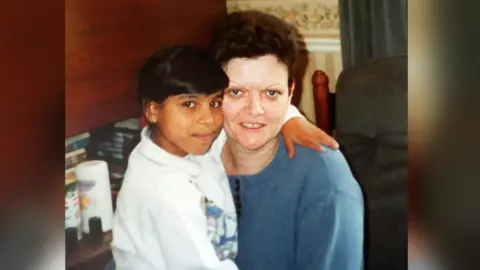 Skelton Family
Philomena only visited Omagh twice a year – once in summer and once at Christmas – and was in the town to buy school uniforms.
He said after he found Philomena, who was known as Mena, his focus turned to finding his daughters.
He told the inquiry he could still see the bomb go off, including how one building “folded like a book”.
“How so many people survived, it’s a mystery to me,” he said.
Mr Skelton told the inquiry that Mena had dedicated her life to her family.
He described how she spent her time at home looking after the children, knitting and reading Catherine Cookson books.
He said she would knit and read at the same time. “She was one of the greatest knitters I ever seen,” he said.
“People used to come and place orders.”
Mr Skelton said he and Mena, whom he described as a “homebird”, had been together “two weeks shy of 20 years”.
He said the couple were “like chalk and cheese” as his wife liked to stay at home knitting and reading, while he was out working and refereeing sports.
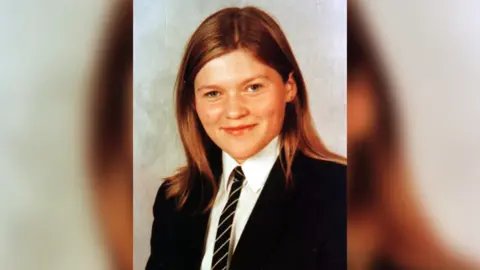 Wilson Family
Schoolgirl Lorraine Wilson was 15 when she when was killed alongside her best friend Samantha McFarland – they had been working in the town’s Oxfam shop.
She had hopes of becoming an air hostess.
Her coffin was draped with pink and white flowers as it was carried into the family’s church.
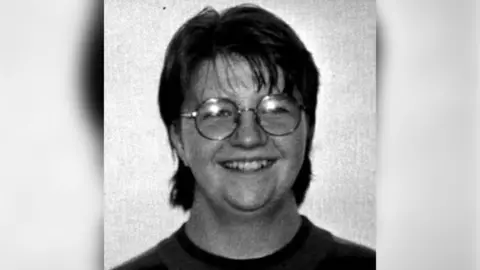 Hughes Family
A student at Dundee University, Julia Hughes was working in a photography shop in Omagh for the summer.
She was planning to return to Scotland the next month to complete the final year of her accountancy degree.
At her funeral, her father said there was “absolutely no answer on this side of eternity” as to why his 21-year-old daughter died.
Who carried out the Omagh bombing?
Three days after the 1998 attack, the Real IRA released a statement claiming responsibility for the explosion.
It apologised to “civilian” victims and said its targets had been commercial.
Almost 27 years on, no-one has been convicted of carrying out the murders by a criminal court.
In 2009, the judge in that case ruled four of the men – Michael McKevitt, Liam Campbell, Colm Murphy and Seamus Daly were all liable for the Omagh bomb.
The four men were ordered to pay a total of £1.6m in damages to the relatives, but appeals against the ruling delayed the compensation process.
A fifth man, Seamus McKenna, was acquitted in the civil action and later died in a roofing accident in 2013.
The public inquiry
After years of campaigning by relatives, the public inquiry was set to up examine if the Real IRA attack could have been prevented by UK authorities.
This phase of the inquiry is in its second week and is continuing to hear powerful individual testimonies from relatives who lost loved ones in the explosion.
Taking place at Strule Arts Centre in Omagh, the phase will last four weeks and will also hear evidence from first responders.
The bombers planned and launched the attack from the Republic of Ireland and the Irish government has promised to co-operate with the inquiry.
However, the victims’ relatives wanted the Irish government to order its own separate public inquiry.
Dublin previously indicated there was no new evidence to merit such a move.
BBC News

Khamrah by Lattafa for Men - 3.4 oz EDP Spray
4% Off
Ghost Sweetheart Eau de Toilette | Pineapple, Jasmine and Sandalwood | Perfume for Women 50 ml
50% Off
Marc Jacobs Dot Eau De Parfum for Women, 100 ml
42% Off
Ted Baker W Eau de Toilette for Her, Fig Leaf, White Peony and Violet Top Notes, Pink Orchid and Raspberry Middle Notes, 75ml
£11.77 (£15.69 / 100 ml) (as of 30/06/2026 03:52 GMT +01:00 - More infoProduct prices and availability are accurate as of the date/time indicated and are subject to change. Any price and availability information displayed on [relevant Amazon Site(s), as applicable] at the time of purchase will apply to the purchase of this product.)
Ted Baker Woman Pink Eau de Toilette Spray Floral Green Feminine Fragrance, Opening Notes are Fresh Peach, Bergamot and Tangerine with Warm Musk, Vanilla and Vetiver Base, 100ml
11% Off
Vera Wang Princess Eau de Toilette - 30 ml

Choco Musk 50ml Eau De Parfum for men and women | Chocolate Musk by Jannat Aromas
17% Off
Christina Aguilera Signature Eau de Parfum (50ml) Floral, Fruity & Exotic Scent, Luxury Fragrance for Women
9% Off
Calvin Klein - Eau De Toilette CKIN2U - Calvin Klein Women, Ladies Perfume, Women's Perfume, Calvin Klein Perfume, Calvin Klein One - 150 ml
5% Off
Jimmy Choo Flash Eau de Parfum, 60 ml (Pack of 1)
3% Off
Fruit of the Loom Men's Heavy T Shirt, White, XL UK
28% Off
ATNKE LED Lighted Beanie Cap,USB Rechargeable Running Hat Ultra Bright 4 LED Waterproof Light Winter Warm Gifts for Men and Women/Pink
17% Off
Men's 1/4 Zip Pullover UK Sale Clearance, Fleece Sweatshirt Casual Jumper Long Sleeve T-shirt Top Stand Collar Sweater Plain Pullover Sports Leisure Workwear Quarter Zip Sweater Lightweight Jumpers
£5.88 (as of 12/11/2025 00:52 GMT +01:00 - More infoProduct prices and availability are accurate as of the date/time indicated and are subject to change. Any price and availability information displayed on [relevant Amazon Site(s), as applicable] at the time of purchase will apply to the purchase of this product.)
Crevice Cleaning Brush, Bathroom Tile Groove Gap Cleaning Brush,Premium Crevice Cleaning Tool Aluminum Support with 15° Angle Magic Brush, Thin Brush for Home Kitchen
19% Off
Wireless Earbuds, Bluetooth 5.3 Headphones in Ear with HiFi Stereo Deep Bass, 4 ENC Noise Cancelling Mic Wireless Earphones 40H Playtime, Bluetooth Earbuds Dual LED Display, IP7 Waterproof, USB-C
42% Off