 [
[

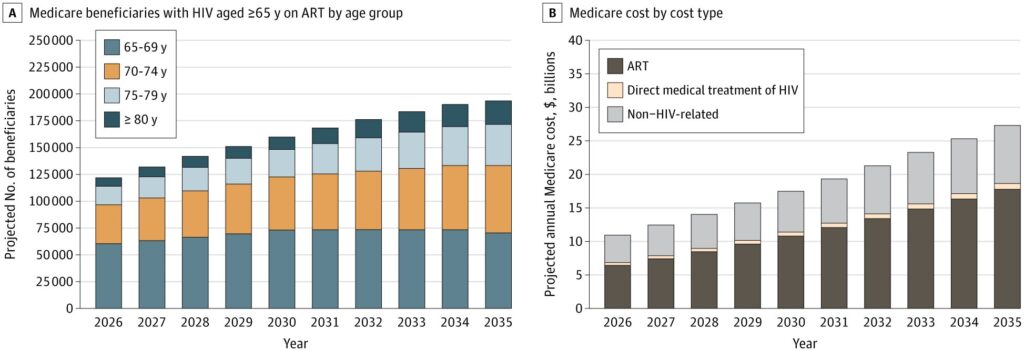
As more Americans with HIV live into older age, Medicare spending on their care is projected to rise dramatically from $10.9 billion in 2026 to $27.3 billion in 2035, with HIV medications accounting for nearly two-thirds of total costs.
Emily P. Hyle, MD, and Kenneth A. Freedberg, MD, of the Medical Practice Evaluation Center within the Department of Medicine at Mass General Brigham, are the lead and senior authors of a paper published in JAMA Network Open, “Ten-Year Cost Projections for Medicare Beneficiaries 65 Years or Older With HIV.”
What challenges or unmet needs make this study important?
Survival among people with HIV in the United States continues to improve due to highly effective antiretroviral therapy (ART), a lifelong treatment. As a result, costs to Medicare are expected to rise substantially as more adults with HIV live long enough to age into the program. However, it has been largely unknown how much the number of Medicare beneficiaries may increase over the next decade and how much the program’s spending could rise.
What central questions were you investigating?
Our team used simulation modeling to answer these three main questions:
- Over the next decade, how many people with HIV (who are receiving HIV care) age 65 and older are likely to be enrolled in Medicare?
- How much is Medicare estimated to spend on this population over this time period?
- How might policies or strategies to reduce the cost of ART affect these projections?
What methods or approach did you use?
We developed and populated a new model called CHARMED with projections from the previously validated CEPAC model, Medicare claims data and publicly available data. Our aim was to simulate a population of Medicare beneficiaries with HIV, age 65 and older, who are being treated with ART, and their associated costs.
To address uncertainty in model estimates and trends, we examined scenarios in which the size and associated costs of this group varied—for example, by assessing the potential impact of policies to reduce the cost of ART. Such policies included the Inflation Reduction Act (IRA), which allows Medicare to negotiate the cost of Biktarvy, the most commonly prescribed ART regimen in the United States, with lower prices to take effect in 2028. Additionally, generic dolutegravir is expected to become available in 2031, thereby enabling a highly effective, well-tolerated, fully generic ART regimen.
What did you find?
Our projections show that nearly 122,000 older adults receiving HIV care may be enrolled in Medicare by the end of 2026—a number that may increase to about 193,600 by the end of 2035. We also estimated that annual Medicare spending for this population may increase from $10.9 billion in 2026 to $27.3 billion in 2035.
Cumulative 10-year costs may reach $187.2 billion, with 63% attributable to ART costs alone. If ART costs were reduced by 60%, Medicare could potentially save $70.3 billion over the next decade. Moreover, if current prescribing patterns remain unchanged, policies such as the IRA and the availability of generic HIV medications could save Medicare approximately $19 billion between 2026 and 2035.
What are the real-world implications, particularly for patients?
Our findings demonstrate that the number of older adults living with HIV is likely to increase substantially over the next decade, driving up Medicare enrollment. Clinicians and health care systems must be prepared to address the medical needs of this growing population through comprehensive, person-centered care—especially given these individuals’ increased risk of comorbidities and polypharmacy (taking several medications regularly).
We also conclude that policymakers for Medicare and other public programs will likely seek ways to reduce the cost of HIV care. While recent proposals have included higher Medicare premiums, drug coverage reductions and stricter eligibility for drug assistance programs, our paper points to other promising strategies to reduce ART costs without increasing patient costs or limiting access.
Publication details
Emily P. Hyle et al, Ten-Year Cost Projections for Medicare Beneficiaries 65 Years or Older With HIV, JAMA Network Open (2026). DOI: 10.1001/jamanetworkopen.2026.21966
Journal information:
JAMA Network Open


Citation:
Q&A: Medicare spending on clinical care for people aging with HIV projected to rise steeply over next decade (2026, August 7)
retrieved 7 August 2026
from https://medicalxpress.com/news/2026-08-qa-medicare-clinical-people-aging.html
This document is subject to copyright. Apart from any fair dealing for the purpose of private study or research, no
part may be reproduced without the written permission. The content is provided for information purposes only.

Khamrah by Lattafa for Men - 3.4 oz EDP Spray
4% Off
Ghost Sweetheart Eau de Toilette | Pineapple, Jasmine and Sandalwood | Perfume for Women 50 ml
50% Off
Marc Jacobs Dot Eau De Parfum for Women, 100 ml
42% Off
Ted Baker W Eau de Toilette for Her, Fig Leaf, White Peony and Violet Top Notes, Pink Orchid and Raspberry Middle Notes, 75ml
£11.77 (£15.69 / 100 ml) (as of 07/08/2026 04:07 GMT +01:00 - More infoProduct prices and availability are accurate as of the date/time indicated and are subject to change. Any price and availability information displayed on [relevant Amazon Site(s), as applicable] at the time of purchase will apply to the purchase of this product.)
Ted Baker Woman Pink Eau de Toilette Spray Floral Green Feminine Fragrance, Opening Notes are Fresh Peach, Bergamot and Tangerine with Warm Musk, Vanilla and Vetiver Base, 100ml
11% Off
Vera Wang Princess Eau de Toilette - 30 ml

Choco Musk 50ml Eau De Parfum for men and women | Chocolate Musk by Jannat Aromas
17% Off
Christina Aguilera Signature Eau de Parfum (50ml) Floral, Fruity & Exotic Scent, Luxury Fragrance for Women
9% Off
Calvin Klein - Eau De Toilette CKIN2U - Calvin Klein Women, Ladies Perfume, Women's Perfume, Calvin Klein Perfume, Calvin Klein One - 150 ml
5% Off
Jimmy Choo Flash Eau de Parfum, 60 ml (Pack of 1)
3% Off
Fruit of the Loom Men's Heavy T Shirt, White, XL UK
28% Off
ATNKE LED Lighted Beanie Cap,USB Rechargeable Running Hat Ultra Bright 4 LED Waterproof Light Winter Warm Gifts for Men and Women/Pink
17% Off
Men's 1/4 Zip Pullover UK Sale Clearance, Fleece Sweatshirt Casual Jumper Long Sleeve T-shirt Top Stand Collar Sweater Plain Pullover Sports Leisure Workwear Quarter Zip Sweater Lightweight Jumpers
£5.88 (as of 12/11/2025 00:52 GMT +01:00 - More infoProduct prices and availability are accurate as of the date/time indicated and are subject to change. Any price and availability information displayed on [relevant Amazon Site(s), as applicable] at the time of purchase will apply to the purchase of this product.)
Crevice Cleaning Brush, Bathroom Tile Groove Gap Cleaning Brush,Premium Crevice Cleaning Tool Aluminum Support with 15° Angle Magic Brush, Thin Brush for Home Kitchen
19% Off
Wireless Earbuds, Bluetooth 5.3 Headphones in Ear with HiFi Stereo Deep Bass, 4 ENC Noise Cancelling Mic Wireless Earphones 40H Playtime, Bluetooth Earbuds Dual LED Display, IP7 Waterproof, USB-C
42% Off