 [
[

Managing a medical supply chain in low- and middle-income countries can mean navigating a landscape prone to extreme and unexpected disruptions. In Sierra Leone, for instance, external forces ranging from an attempted military coup and an infectious disease outbreak to a widespread electricity outage can complicate public health logistics.
The consequences are severe. Despite a national government initiative dedicated to providing free medical care and essential supplies to pregnant women and children under 5, Sierra Leone has one of the highest maternal mortality rates in the world, at 717 deaths per 100,000 live births, explains Hamsa Bastani, an operations researcher and statistician at the Wharton School.
A major driver is not always a lack of medicine but a failure to get the right supplies to the right place at the right time, says Bastani. Some clinics end up overstocked while others run dry.
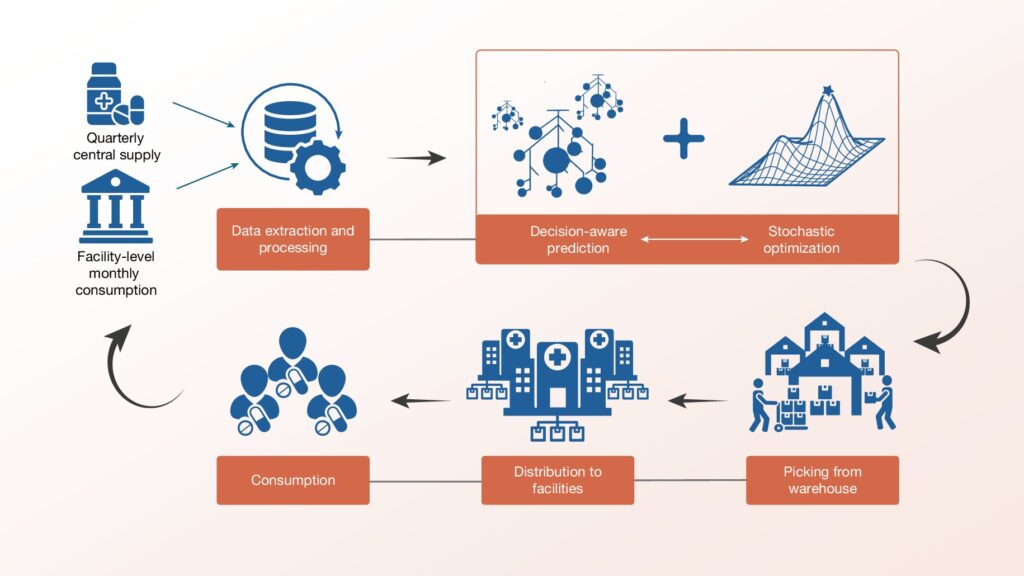
To address that mismatch, Bastani, computer scientist Osbert Bastani and Ph.D. candidate Angel Tsai-Hsuan Chung partnered with Sierra Leone’s government to build a low-cost decision-support system that uses machine learning to forecast demand and optimize how medicines are allocated.
Following a pilot rollout in five districts, the researchers found a 19% increase in consumption of allocated medical products in treated areas, a proxy for improved access. Their findings are published in Nature.
The tool predicts how much of each product individual facilities will likely need and then computes the most efficient way to distribute the limited national stock, explains first author Chung. It is “designed for a setting where data are sparse, noisy, and often incomplete.”
The new system also addresses previous inequities—facilities serving poorer, more remote populations that frequently experienced chronic stockouts saw a 32% surge in medicine consumption with the new tool.
Based on these results, the government scaled the system nationwide. Today, it supports allocation decisions for more than 70 essential products—including medicines to help with postpartum hemorrhaging and treat the seizures of eclampsia, alongside other essentials like tetanus vaccines, gloves and antimalarial medicines—across the country, reaching an estimated 2 million women and children under 5. The system runs on only $30 a month in server costs and requires no additional workforce.
Field work leads to real work
To build a tool capable of handling Sierra Leone’s highly varied logistical ecosystem, the researchers knew they could not rely solely on remote data feeds or Zoom calls, so Chung traveled to the capital, Freetown.
“Local officials were worried that an AI tool arriving from abroad might replace their jobs or leave them responsible if something went wrong,” Chung says.
To secure local buy-in and gain trust, she spent weeks conducting personalized training sessions, ensuring fair compensation for their time. She led the design of a web application that closely mirrored the agency’s preexisting spreadsheet workflows, reducing the friction of forcing workers to learn a complex, alien software system.
“Crucially,” adds Hamsa Bastani, “the system chiefly functions as a ‘decision-support’ tool wherein local officials always retain final say and can override recommendations.”
Under the hood of their AI system
Understaffed and under-resourced clinics are the least able to consistently report data, leading to data gaps clustered around the very places where need is greatest. That leads to a subtle distortion: If a model learns only from the cleanest data, it will favor the best-documented clinics—the ones already better served—while overlooking those where the record is thin but the need is acute.
The team circumvents this bias using multitask learning, which allows the model to borrow shared patterns—like seasonal demand—from places with richer data and apply them where records are sparse.
They paired that with a “backstop” built from external information, including census data and Google Earth images of the vegetation around the clinics, which indicate human activity. This approach helped define catchment areas based on travel time between those areas and the facilities. When those data were combined with census data on the proportion of women and children living within zones, the algorithm could tease out a baseline estimate for how much medicine the clinic needed based purely on the local demographics.
These estimates do not capture every local fluctuation, but they provide a stable baseline tied to population and geography.
Looking ahead
With ownership of the allocation tool now fully transferred to Sierra Leone’s government, the research team is turning outward. Chung is currently working on another project with officials from Somaliland, collaborating with Taiwanese partners to adapt similar data-driven approaches to other regional health systems.
Ultimately, the team hopes their work serves as a blueprint for the future, demonstrating that machine learning can improve health care delivery in resource-constrained environments at low cost.
Publication details
Angel Tsai-Hsuan Chung et al, Improving access to essential medicines via decision-aware machine learning, Nature (2026). DOI: 10.1038/s41586-026-10433-7
Journal information:
Nature


Citation:
Low-cost AI could transform health care logistics in low- and middle-income countries (2026, June 23)
retrieved 23 June 2026
from https://medicalxpress.com/news/2026-06-ai-health-logistics-middle-income.html
This document is subject to copyright. Apart from any fair dealing for the purpose of private study or research, no
part may be reproduced without the written permission. The content is provided for information purposes only.

Khamrah by Lattafa for Men - 3.4 oz EDP Spray
4% Off
Ghost Sweetheart Eau de Toilette | Pineapple, Jasmine and Sandalwood | Perfume for Women 50 ml
50% Off
Marc Jacobs Dot Eau De Parfum for Women, 100 ml
42% Off
Ted Baker W Eau de Toilette for Her, Fig Leaf, White Peony and Violet Top Notes, Pink Orchid and Raspberry Middle Notes, 75ml
£11.77 (£15.69 / 100 ml) (as of 12/08/2026 04:10 GMT +01:00 - More infoProduct prices and availability are accurate as of the date/time indicated and are subject to change. Any price and availability information displayed on [relevant Amazon Site(s), as applicable] at the time of purchase will apply to the purchase of this product.)
Ted Baker Woman Pink Eau de Toilette Spray Floral Green Feminine Fragrance, Opening Notes are Fresh Peach, Bergamot and Tangerine with Warm Musk, Vanilla and Vetiver Base, 100ml
11% Off
Vera Wang Princess Eau de Toilette - 30 ml

Choco Musk 50ml Eau De Parfum for men and women | Chocolate Musk by Jannat Aromas
17% Off
Christina Aguilera Signature Eau de Parfum (50ml) Floral, Fruity & Exotic Scent, Luxury Fragrance for Women
9% Off
Calvin Klein - Eau De Toilette CKIN2U - Calvin Klein Women, Ladies Perfume, Women's Perfume, Calvin Klein Perfume, Calvin Klein One - 150 ml
5% Off
Jimmy Choo Flash Eau de Parfum, 60 ml (Pack of 1)
3% Off
Fruit of the Loom Men's Heavy T Shirt, White, XL UK
28% Off
ATNKE LED Lighted Beanie Cap,USB Rechargeable Running Hat Ultra Bright 4 LED Waterproof Light Winter Warm Gifts for Men and Women/Pink
17% Off
Men's 1/4 Zip Pullover UK Sale Clearance, Fleece Sweatshirt Casual Jumper Long Sleeve T-shirt Top Stand Collar Sweater Plain Pullover Sports Leisure Workwear Quarter Zip Sweater Lightweight Jumpers
£5.88 (as of 12/11/2025 00:52 GMT +01:00 - More infoProduct prices and availability are accurate as of the date/time indicated and are subject to change. Any price and availability information displayed on [relevant Amazon Site(s), as applicable] at the time of purchase will apply to the purchase of this product.)
Crevice Cleaning Brush, Bathroom Tile Groove Gap Cleaning Brush,Premium Crevice Cleaning Tool Aluminum Support with 15° Angle Magic Brush, Thin Brush for Home Kitchen
19% Off
Wireless Earbuds, Bluetooth 5.3 Headphones in Ear with HiFi Stereo Deep Bass, 4 ENC Noise Cancelling Mic Wireless Earphones 40H Playtime, Bluetooth Earbuds Dual LED Display, IP7 Waterproof, USB-C
42% Off