


Tom EdwardsLondon transport and environment correspondent

 BBC
BBCRegarded as one of the toughest memory and navigational exams in the world, the Knowledge is a test that every London black cab driver has to get through.
Since it began 160 years ago, it has thwarted and frustrated prospective drivers and takes roughly three to four years to pass, sometimes more.
Speak to a black cab driver about it and you will detect a mix of fear, dread, relief and overwhelming pride that they passed.
So how much of London do you need to memorise and does it really change the shape of your brain?
Peter Laszlo passed the Knowledge this summer.
He is 72 and one of the oldest black cabbies to have passed the test. It took him six years.
“I found it very, very difficult but I had to keep on persevering and finally made it,” he said.
He practised the routes by riding on a bicycle, although other cabbies prefer mopeds and scooters.
“I did it because first of all as a child I had these childhood fantasies of driving a cab or a bus or train so I suppose as I got older, and I had free time, I thought rather than just sitting around and reading the newspaper and watching TV I’ll do something like drive a cab in London.”

The Knowledge refers to the rigorous memorisation required to become a licensed London black cab driver, involving learning every street and landmark within a six-mile (about 9.6km) radius of Charing Cross.
Cabbies have to memorise 320 routes or “runs”, about 25,000 streets and 20,000 points of interest such as hotels, hospitals or railway stations.
They also have to memorise the quickest route between all of them and are tested on that.
 Getty Images
Introduced in 1865, the story goes that the Knowledge was brought in after the Great Exhibition of 1851, held at the Crystal Palace in Hyde Park.
Hundreds of thousands of people visited the event – with many going on to complain to the authorities about just how bad their journeys had been because cabmen didn’t know the route.
New cabbie Peter says there is no room for error during the test: “You have to describe to the examiner, how to get from point A to point B and there’s four questions.
“If you get the name wrong or you get a street name wrong or it is not the quickest, direct route then failure is looming.”
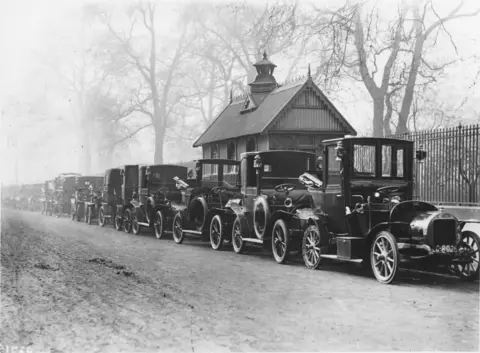 Photo by Hulton Archive/Getty Images
Scientists have also discovered that the process of memorising all of the information, actually changes parts of the brain.
Peter says his memory has improved: “Since I did the knowledge, I had to write everything down.
“I now can memorise things. You can say see you next week on Wednesday at 11 and I will remember that. So it has made a big difference.”
We tested him on his Knowledge and asked him how to get to BBC London at New Broadcasting House from Charing Cross. He quickly listed the street names taking the most direct route door to door.


The Knowledge has changed over the years.
Transport for London (TfL) says applications to start the Knowledge of London have increased by 68.6%, growing from 440 in 2022 to 742 at the end of November 2025.
The average time required to complete the Knowledge has fallen significantly, from 5.25 years in 2020, to three years in 2025.
TfL says it is continuing to modernise the process to attract new entrants to the trade.
As for Peter, who passed in June, has his childhood dream lived up to the reality?
“I love it,” he said.
“It’s my little space where I can get in there, and I’m seeing things around me.
“The customers so far, have been wonderful, all of them. I’ve got no complaints.”
BBC News

Khamrah by Lattafa for Men - 3.4 oz EDP Spray
4% Off
Ghost Sweetheart Eau de Toilette | Pineapple, Jasmine and Sandalwood | Perfume for Women 50 ml
50% Off
Marc Jacobs Dot Eau De Parfum for Women, 100 ml
42% Off
Ted Baker W Eau de Toilette for Her, Fig Leaf, White Peony and Violet Top Notes, Pink Orchid and Raspberry Middle Notes, 75ml
£11.77 (£15.69 / 100 ml) (as of 04/10/2026 05:09 GMT +01:00 - More infoProduct prices and availability are accurate as of the date/time indicated and are subject to change. Any price and availability information displayed on [relevant Amazon Site(s), as applicable] at the time of purchase will apply to the purchase of this product.)
Ted Baker Woman Pink Eau de Toilette Spray Floral Green Feminine Fragrance, Opening Notes are Fresh Peach, Bergamot and Tangerine with Warm Musk, Vanilla and Vetiver Base, 100ml
11% Off
Vera Wang Princess Eau de Toilette - 30 ml

Choco Musk 50ml Eau De Parfum for men and women | Chocolate Musk by Jannat Aromas
17% Off
Christina Aguilera Signature Eau de Parfum (50ml) Floral, Fruity & Exotic Scent, Luxury Fragrance for Women
9% Off
Calvin Klein - Eau De Toilette CKIN2U - Calvin Klein Women, Ladies Perfume, Women's Perfume, Calvin Klein Perfume, Calvin Klein One - 150 ml
5% Off
Jimmy Choo Flash Eau de Parfum, 60 ml (Pack of 1)
3% Off
Fruit of the Loom Men's Heavy T Shirt, White, XL UK
28% Off
ATNKE LED Lighted Beanie Cap,USB Rechargeable Running Hat Ultra Bright 4 LED Waterproof Light Winter Warm Gifts for Men and Women/Pink
17% Off
Men's 1/4 Zip Pullover UK Sale Clearance, Fleece Sweatshirt Casual Jumper Long Sleeve T-shirt Top Stand Collar Sweater Plain Pullover Sports Leisure Workwear Quarter Zip Sweater Lightweight Jumpers
£5.88 (as of 12/11/2025 00:52 GMT +01:00 - More infoProduct prices and availability are accurate as of the date/time indicated and are subject to change. Any price and availability information displayed on [relevant Amazon Site(s), as applicable] at the time of purchase will apply to the purchase of this product.)
Crevice Cleaning Brush, Bathroom Tile Groove Gap Cleaning Brush,Premium Crevice Cleaning Tool Aluminum Support with 15° Angle Magic Brush, Thin Brush for Home Kitchen
19% Off
Wireless Earbuds, Bluetooth 5.3 Headphones in Ear with HiFi Stereo Deep Bass, 4 ENC Noise Cancelling Mic Wireless Earphones 40H Playtime, Bluetooth Earbuds Dual LED Display, IP7 Waterproof, USB-C
42% Off