
 [
[


Tuberculosis (TB) is an infectious disease that kills more than a million people worldwide every year. The pathogen that causes the disease, Mycobacterium tuberculosis, is deadly in part because of its complex outer envelope, which helps it evade immune responses of infected hosts.
In an ACS Infectious Diseases paper, researchers developed a chemical probe to study a key component of this envelope. Their results provide a step toward finding new ways of inactivating the bacterium.
Because curing TB requires taking drugs for months, which can result in TB resistance to some antibiotics, scientists are working to develop new treatments. One possible target is the bacterium’s outermost layer, called the mycomembrane, which protects the bacteria from stressors. When M. tuberculosis is attacked by a host’s macrophage immune cells, the mycomembrane produces compounds that suppress the infected host’s immune response.
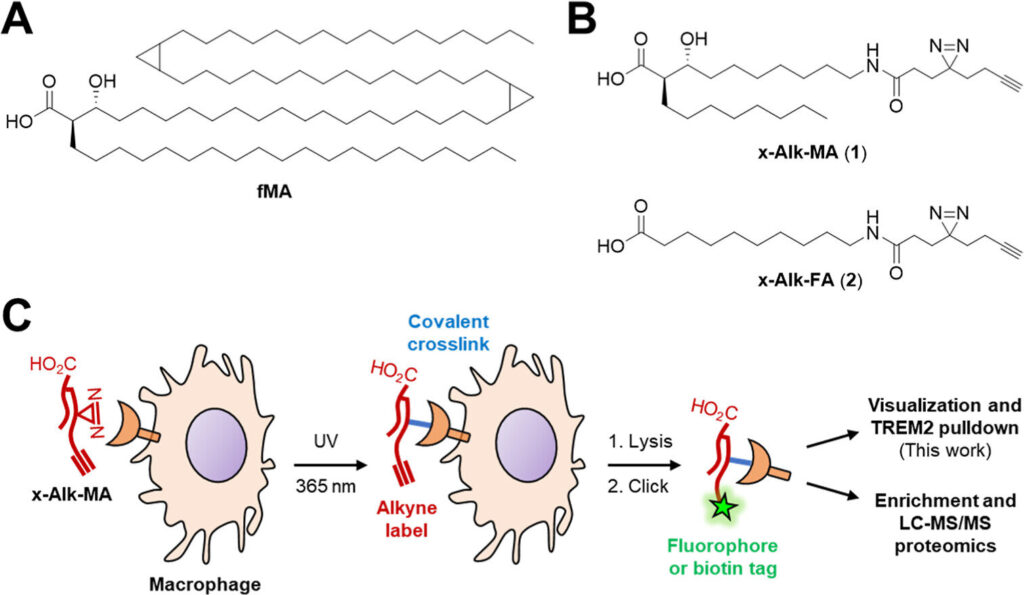
Previously, Ben Swarts, Sloan Siegrist and colleagues developed light-activated chemical probes that mimic some of these compounds and studied how they might interact with a host’s immune cells. Now, the researchers have developed a chemical probe for another mycomembrane component called mycolic acid. They designed the mycolic acid probe to enable the capture of interacting proteins within host immune cells—information that could help scientists better understand how M. tuberculosis survives in the assaulting environment of the host.
In an enzyme immunoassay, the probe stimulated an immune response similar to real mycolic acid in cultured macrophage cells from mice. Using fluorescence scanning, the researchers observed that the mycolic acid probe photo-labeled proteins in the macrophage cells. An immunoblotting technique determined that the probe interacts with a specific receptor—a protein known as TREM2—on macrophage cells, which suppresses immune cell activation.
Swarts and colleagues say their strategy provides researchers with a way to investigate the role of mycolic acids in M. tuberculosis pathogenesis. “Chemical probes can be valuable for discovering and characterizing host–pathogen interactions that are otherwise difficult to investigate,” Swarts explains.
“Knowing the molecular details of how M. tuberculosis cell envelope components manipulate the host response may inform new treatment strategies for TB in the future, such as immunotherapies targeting host proteins.”
More information:
Kingsley C. Agu et al, A Photoactivatable Free Mycolic Acid Probe to Investigate Mycobacteria–Host Interactions, ACS Infectious Diseases (2025). DOI: 10.1021/acsinfecdis.5c00068
Citation:
Light-activated probe reveals how tuberculosis evades immune defenses (2025, April 21)
retrieved 21 April 2025
from https://medicalxpress.com/news/2025-04-probe-reveals-tuberculosis-evades-immune.html
This document is subject to copyright. Apart from any fair dealing for the purpose of private study or research, no
part may be reproduced without the written permission. The content is provided for information purposes only.

Khamrah by Lattafa for Men - 3.4 oz EDP Spray
4% Off
Ghost Sweetheart Eau de Toilette | Pineapple, Jasmine and Sandalwood | Perfume for Women 50 ml
50% Off
Marc Jacobs Dot Eau De Parfum for Women, 100 ml
42% Off
Ted Baker W Eau de Toilette for Her, Fig Leaf, White Peony and Violet Top Notes, Pink Orchid and Raspberry Middle Notes, 75ml
£11.77 (£15.69 / 100 ml) (as of 20/10/2026 06:36 GMT +01:00 - More infoProduct prices and availability are accurate as of the date/time indicated and are subject to change. Any price and availability information displayed on [relevant Amazon Site(s), as applicable] at the time of purchase will apply to the purchase of this product.)
Ted Baker Woman Pink Eau de Toilette Spray Floral Green Feminine Fragrance, Opening Notes are Fresh Peach, Bergamot and Tangerine with Warm Musk, Vanilla and Vetiver Base, 100ml
11% Off
Vera Wang Princess Eau de Toilette - 30 ml

Choco Musk 50ml Eau De Parfum for men and women | Chocolate Musk by Jannat Aromas
17% Off
Christina Aguilera Signature Eau de Parfum (50ml) Floral, Fruity & Exotic Scent, Luxury Fragrance for Women
9% Off
Calvin Klein - Eau De Toilette CKIN2U - Calvin Klein Women, Ladies Perfume, Women's Perfume, Calvin Klein Perfume, Calvin Klein One - 150 ml
5% Off
Jimmy Choo Flash Eau de Parfum, 60 ml (Pack of 1)
3% Off
Fruit of the Loom Men's Heavy T Shirt, White, XL UK
28% Off
ATNKE LED Lighted Beanie Cap,USB Rechargeable Running Hat Ultra Bright 4 LED Waterproof Light Winter Warm Gifts for Men and Women/Pink
17% Off
Men's 1/4 Zip Pullover UK Sale Clearance, Fleece Sweatshirt Casual Jumper Long Sleeve T-shirt Top Stand Collar Sweater Plain Pullover Sports Leisure Workwear Quarter Zip Sweater Lightweight Jumpers
£5.88 (as of 12/11/2025 00:52 GMT +01:00 - More infoProduct prices and availability are accurate as of the date/time indicated and are subject to change. Any price and availability information displayed on [relevant Amazon Site(s), as applicable] at the time of purchase will apply to the purchase of this product.)
Crevice Cleaning Brush, Bathroom Tile Groove Gap Cleaning Brush,Premium Crevice Cleaning Tool Aluminum Support with 15° Angle Magic Brush, Thin Brush for Home Kitchen
19% Off
Wireless Earbuds, Bluetooth 5.3 Headphones in Ear with HiFi Stereo Deep Bass, 4 ENC Noise Cancelling Mic Wireless Earphones 40H Playtime, Bluetooth Earbuds Dual LED Display, IP7 Waterproof, USB-C
42% Off