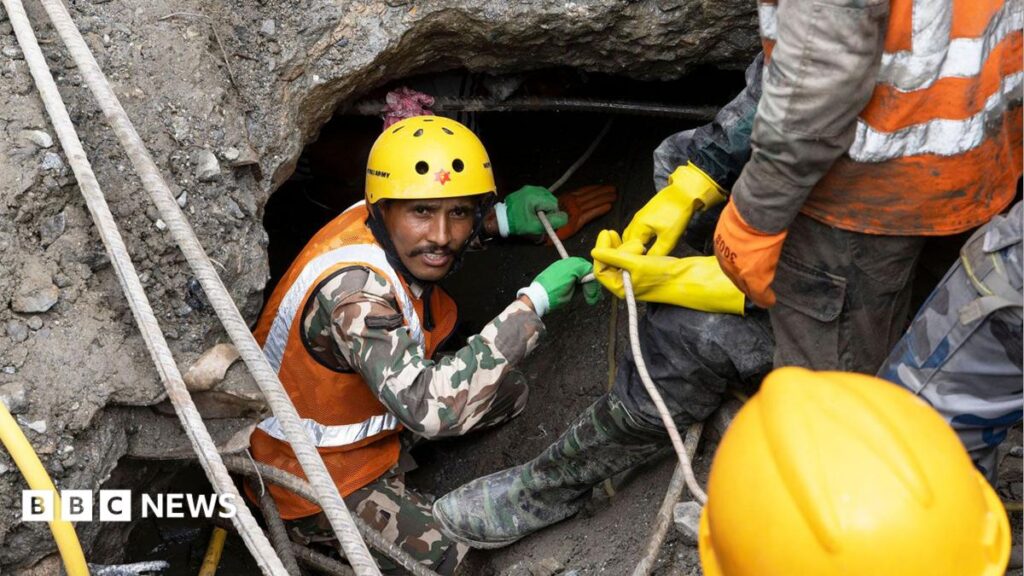
A tunnelling expert involved in the rescue operation at a blocked Nepalese hydropower tunnel has described to the BBC how they managed to reach survivors.
Arnold Dix has been advising Nepal’s hydropower authorities on how to dig through the blocked tunnel to Trishuli 3A Hydropower Station, which was one of several stations hit by last week’s massive flash flood on the Nepal-Tibet border.
“It’s like layer upon layer of layer of miracles” that they found two men on Friday, he said, given the multiple challenges that they faced.
The first hurdle was to locate the hydropower station, in a landscape rendered nearly unrecognisable by the flood that has so far killed 1,300 people.
“I’ve never known a rescue operation where you had to look for an entrance of a tunnel that was previously up the hill, that was now underground. You can imagine the enormity of the avalanche, it completely buried the entrance,” said Dix, who is the president of the International Tunnelling and Underground Space Association.
Using engineering techniques, old topographic maps, satellite imagery of the area after the disaster, video footage from helicopters and “anything else we could find on the surface of the mountain such as power poles”, Dix and his team triangulated the likely position of the entrance and started digging.
They found it – but the next challenge was to locate the survivors.
“We knew they would be up ahead, but we didn’t know where exactly. So you just have to start digging in the right direction. And you listen out if you can hear anybody,” he said.
Rescuers had to get through a tunnel blocked entirely by mud and rocks – some bigger than cars – and had to resort to using explosives to clear the way.
“We had to use explosives which we normally never do because of the risk of blowing up people [trapped in the tunnel] and blowing ourselves up,” said Dix.
He credited the Nepalese army for doing “a wonderful job” in managing the explosions with precision to ensure they would not destabilise the tunnel.
At the same time, they discovered the tunnel was still full of water.
Using excavators and pumping machines, Nepalese rescuers dug a series of trenches from the tunnel all the way to the river outside, so they could drain the water.
BBC News

Khamrah by Lattafa for Men - 3.4 oz EDP Spray
4% Off
Ghost Sweetheart Eau de Toilette | Pineapple, Jasmine and Sandalwood | Perfume for Women 50 ml
50% Off
Marc Jacobs Dot Eau De Parfum for Women, 100 ml
42% Off
Ted Baker W Eau de Toilette for Her, Fig Leaf, White Peony and Violet Top Notes, Pink Orchid and Raspberry Middle Notes, 75ml
£11.77 (£15.69 / 100 ml) (as of 04/09/2026 04:57 GMT +01:00 - More infoProduct prices and availability are accurate as of the date/time indicated and are subject to change. Any price and availability information displayed on [relevant Amazon Site(s), as applicable] at the time of purchase will apply to the purchase of this product.)
Ted Baker Woman Pink Eau de Toilette Spray Floral Green Feminine Fragrance, Opening Notes are Fresh Peach, Bergamot and Tangerine with Warm Musk, Vanilla and Vetiver Base, 100ml
11% Off
Vera Wang Princess Eau de Toilette - 30 ml

Choco Musk 50ml Eau De Parfum for men and women | Chocolate Musk by Jannat Aromas
17% Off
Christina Aguilera Signature Eau de Parfum (50ml) Floral, Fruity & Exotic Scent, Luxury Fragrance for Women
9% Off
Calvin Klein - Eau De Toilette CKIN2U - Calvin Klein Women, Ladies Perfume, Women's Perfume, Calvin Klein Perfume, Calvin Klein One - 150 ml
5% Off
Jimmy Choo Flash Eau de Parfum, 60 ml (Pack of 1)
3% Off
Fruit of the Loom Men's Heavy T Shirt, White, XL UK
28% Off
ATNKE LED Lighted Beanie Cap,USB Rechargeable Running Hat Ultra Bright 4 LED Waterproof Light Winter Warm Gifts for Men and Women/Pink
17% Off
Men's 1/4 Zip Pullover UK Sale Clearance, Fleece Sweatshirt Casual Jumper Long Sleeve T-shirt Top Stand Collar Sweater Plain Pullover Sports Leisure Workwear Quarter Zip Sweater Lightweight Jumpers
£5.88 (as of 12/11/2025 00:52 GMT +01:00 - More infoProduct prices and availability are accurate as of the date/time indicated and are subject to change. Any price and availability information displayed on [relevant Amazon Site(s), as applicable] at the time of purchase will apply to the purchase of this product.)
Crevice Cleaning Brush, Bathroom Tile Groove Gap Cleaning Brush,Premium Crevice Cleaning Tool Aluminum Support with 15° Angle Magic Brush, Thin Brush for Home Kitchen
19% Off
Wireless Earbuds, Bluetooth 5.3 Headphones in Ear with HiFi Stereo Deep Bass, 4 ENC Noise Cancelling Mic Wireless Earphones 40H Playtime, Bluetooth Earbuds Dual LED Display, IP7 Waterproof, USB-C
42% Off