


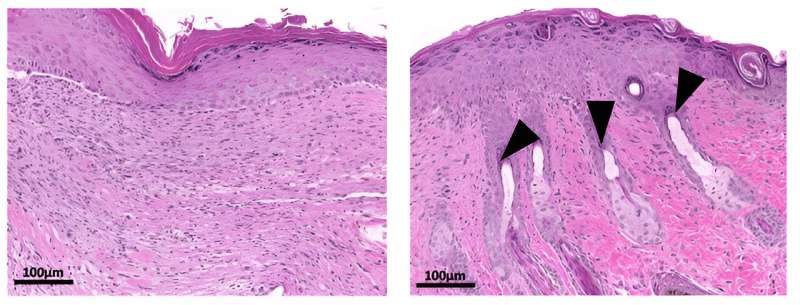
Researchers at Rutgers University in New Jersey have discovered that a protein produced by parasitic worms in the gut enhances wound healing in mice. The study, appearing in the journal Life Science Alliance, reveals that applying the protein to skin wounds speeds up wound closure, improves skin regeneration, and inhibits the formation of scar tissue. Whether the protein can be harnessed to enhance wound healing in human patients remains to be seen.
Skin wounds must be rapidly closed in order to prevent infection, but rapid wound closure can favor the development of scar tissue instead of properly regenerated skin. The balance between scarring and successful tissue regeneration is strongly influenced by immune cells recruited to the wound site, and many researchers are interested in finding ways to boost the activity of immune cell types that promote regeneration while inhibiting the activity of immune cells that promote tissue scarring.
Recent studies have suggested that molecules secreted by parasitic worms might modulate the host’s immune system in ways that promote tissue regeneration. In the new study, a team led by William C. Gause, Director of the Center for Immunity and Inflammation at Rutgers, investigated a protein called TGM that is produced by Heligmosomoides polygyrus, a parasitic roundworm that lives in the intestines of mice and other rodents.
Gause and colleagues found that daily topical applications of TGM accelerated the closure of skin wounds in mice. Moreover, TGM treatment reduced the formation of scar tissue while enhancing skin regeneration. For example, unlike untreated animals, TGM-treated mice were able to form new hair follicles within the wounded region of the skin.
The researchers determined that TGM works by binding to a signaling protein, called the TGF-b receptor, that is found on the surface of many cell types in mice and humans, including immune cells. TGM treatment appears to stimulate the recruitment of immune cells known as macrophages into wounds and reprograms them to promote tissue regeneration.
“In this study, we have developed a novel therapy for the treatment of skin wounds that favors regenerative wound healing over tissue fibrosis and scarring,” Gause says. “It provides a significant framework for the potential use of an easy-to-produce parasite protein as a therapy to promote cutaneous wound healing.”
More information:
Helminth protein enhances wound healing by inhibiting fibrosis and promoting tissue regeneration, Life Science Alliance (2024). DOI: 10.26508/lsa.202302249
Citation:
Intestinal parasite could hold key to scar-free wound healing, study suggests (2024, August 23)
retrieved 23 August 2024
from https://medicalxpress.com/news/2024-08-intestinal-parasite-key-scar-free.html
This document is subject to copyright. Apart from any fair dealing for the purpose of private study or research, no
part may be reproduced without the written permission. The content is provided for information purposes only.

Khamrah by Lattafa for Men - 3.4 oz EDP Spray
4% Off
Ghost Sweetheart Eau de Toilette | Pineapple, Jasmine and Sandalwood | Perfume for Women 50 ml
50% Off
Marc Jacobs Dot Eau De Parfum for Women, 100 ml
42% Off
Ted Baker W Eau de Toilette for Her, Fig Leaf, White Peony and Violet Top Notes, Pink Orchid and Raspberry Middle Notes, 75ml
£11.77 (£15.69 / 100 ml) (as of 10/10/2026 06:33 GMT +01:00 - More infoProduct prices and availability are accurate as of the date/time indicated and are subject to change. Any price and availability information displayed on [relevant Amazon Site(s), as applicable] at the time of purchase will apply to the purchase of this product.)
Ted Baker Woman Pink Eau de Toilette Spray Floral Green Feminine Fragrance, Opening Notes are Fresh Peach, Bergamot and Tangerine with Warm Musk, Vanilla and Vetiver Base, 100ml
11% Off
Vera Wang Princess Eau de Toilette - 30 ml

Choco Musk 50ml Eau De Parfum for men and women | Chocolate Musk by Jannat Aromas
17% Off
Christina Aguilera Signature Eau de Parfum (50ml) Floral, Fruity & Exotic Scent, Luxury Fragrance for Women
9% Off
Calvin Klein - Eau De Toilette CKIN2U - Calvin Klein Women, Ladies Perfume, Women's Perfume, Calvin Klein Perfume, Calvin Klein One - 150 ml
5% Off
Jimmy Choo Flash Eau de Parfum, 60 ml (Pack of 1)
3% Off
Fruit of the Loom Men's Heavy T Shirt, White, XL UK
28% Off
ATNKE LED Lighted Beanie Cap,USB Rechargeable Running Hat Ultra Bright 4 LED Waterproof Light Winter Warm Gifts for Men and Women/Pink
17% Off
Men's 1/4 Zip Pullover UK Sale Clearance, Fleece Sweatshirt Casual Jumper Long Sleeve T-shirt Top Stand Collar Sweater Plain Pullover Sports Leisure Workwear Quarter Zip Sweater Lightweight Jumpers
£5.88 (as of 12/11/2025 00:52 GMT +01:00 - More infoProduct prices and availability are accurate as of the date/time indicated and are subject to change. Any price and availability information displayed on [relevant Amazon Site(s), as applicable] at the time of purchase will apply to the purchase of this product.)
Crevice Cleaning Brush, Bathroom Tile Groove Gap Cleaning Brush,Premium Crevice Cleaning Tool Aluminum Support with 15° Angle Magic Brush, Thin Brush for Home Kitchen
19% Off
Wireless Earbuds, Bluetooth 5.3 Headphones in Ear with HiFi Stereo Deep Bass, 4 ENC Noise Cancelling Mic Wireless Earphones 40H Playtime, Bluetooth Earbuds Dual LED Display, IP7 Waterproof, USB-C
42% Off


