


Hope Webb and
Emma Clifford BellBBC Scotland

 BBC
BBCFalkirk and Grangemouth sit just over three miles from each other and share a grim bond – both towns have been hit with hundreds of redundancies in the past year.
The Petroineos refinery plant in Grangemouth is in the process of closing down with the loss of over 400 jobs.
Most workers there have agreed to voluntary redundancy deals with work coming to an end in the coming months.
Down the road in Falkirk, bus builder Alexander Dennis plans to cease its operations in Scotland, putting a further 400 jobs at risk.
The UK and Scottish governments are currently working with the company to save jobs but some posts have already gone.
 Getty Images
What this all means is that hundreds are searching for stable work in the small area with limited jobs on offer.
Martin Hunter had worked at the Grangemouth refinery for over 20 years when he was told last year that he was to be made redundant.
He told BBC Scotland News: “I’m quite a skilled person.
“I’ve got a lot of qualifications so I thought it would be easy for me.
“I spent eight months looking for a job and I’ve just got a job in the past month.”
He’s also studying at Forth Valley College in a health and safety course that will hopefully allow him to upgrade his career options.
“No one wants to be in a position where you don’t know if you’re going to be able to feed your family, don’t know where your next pay check is coming from. I’m in that position, but I’ve been staying positive.”
Retraining has become the only viable option for many.
Since the refinery announced its closure, 121 former workers have completed training courses at Forth Valley College and 72 are currently studying there.
Their learning is being supported by a scheme created by Petroineos, the Scottish and UK governments, and Falkirk Council.
But it’s not just the staff at the Grangemouth refinery who have suffered the consequences of work drying up.
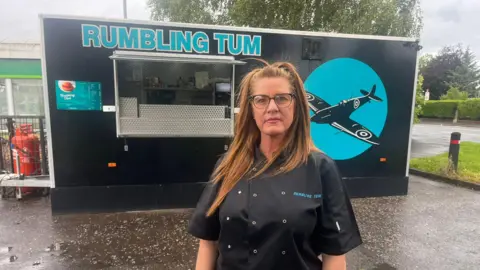
The Rumbling Tum snack van has served refinery workers for over 30 years. Brenda Bolton took over the business from her mum.
She’s been forced to cut staff hours and open at weekends because of dwindling business.
She said: “There was a drastic change when the closure was first announced, I think there was an initial fear put into people about their spending.
“We started to get them back, slowly but surely, but in the past four months it has deteriorated week by week.
“I have noticed the sombre mood and just the whole atmosphere changing. It’s devastating.”
 PA Media
In a double blow to Brenda, her son lost his job at Alexander Dennis late last year.
“He comes in, and he says, ‘Mum, I’ve lost my job’.
“Every one of the apprentices, they all lost their jobs. It was devastating, especially at Christmas time, and it took him to March to get a job, he was trying everything.”
Union leaders had hoped that the Petroineos facility could remain open for longer to provide time for a greener fuel alternative to be established at the site.
The company is to convert the refinery into a terminal able to import petrol, diesel, aviation fuel and kerosene into Scotland, but only 65 of the 400 jobs on site are expected to be retained.
Brenda is worried. “The future does not look great for families, unless somebody steps up and does something. It’s not looking great for the whole economy, the whole town.
“I mean, it’s just not affecting people like me, it is all the subcontractors that went in there. There’s actually thousands that it’s affecting.”
Talks are still ongoing with the hopes of saving roles at nearby bus-maker Alexander Dennis. A consultation on its plans to end manufacturing in Scotland, which would result in the loss of 400 jobs, is underway.
Meanwhile, the Scottish government said officials had met the company to discuss the possibility of a furlough scheme.

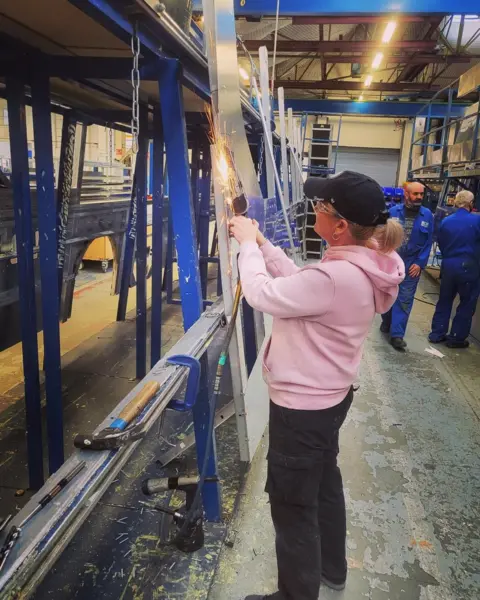
Until recently, Laura Pollard was the company’s only female coach builder. She’d worked at the firm for 35 years, specialising in everything from design to part fitting. But with orders fizzling out, she was also made redundant.
She told BBC Scotland News: “It was pretty bad. We started to notice that a lot of the lines were shutting down. Originally there were six and it sort of went down to three, two and then just one. Lots of people were coming into work and having to sit around the factory with nothing to do.
“I loved my job. I loved making things and I worked in all different departments in the factory. The fun kind of came out of it when we realized that it wasn’t going to be there anymore.”
Alexander Dennis is proposing to centralise its bus building in Scarborough.
The firm’s managing director, Paul Davies, previously told a Holyrood committee it would need to win orders for at least 70 new buses this year before it could keep its Scottish sites open.
Mr Davies said the company would then need to win 300 additional orders next year.
The Scottish government said it would continue to meet with the firm to discuss a potential furlough scheme, that would aim to prevent compulsory redundancies until new orders came in.
A majority of Unite union members have now voted in favour of the scheme.
But Brenda says not enough is being done: “They need to save jobs. I mean, there’s so much talent in this country and they’re just letting it go to waste. That’s disappointing to me.”
Brenda was a mental health first aider while working at Alexander Dennis and was an outlet for people struggling.
She still keeps up with many of her former colleagues, some who are still waiting to learn the fate of their jobs: “I’ll be there for them, you know, when the inevitable happens. Hopefully we can stay friends and help each other for a long time to come.”
BBC News

Khamrah by Lattafa for Men - 3.4 oz EDP Spray
4% Off
Ghost Sweetheart Eau de Toilette | Pineapple, Jasmine and Sandalwood | Perfume for Women 50 ml
50% Off
Marc Jacobs Dot Eau De Parfum for Women, 100 ml
42% Off
Ted Baker W Eau de Toilette for Her, Fig Leaf, White Peony and Violet Top Notes, Pink Orchid and Raspberry Middle Notes, 75ml
£11.77 (£15.69 / 100 ml) (as of 02/10/2026 05:09 GMT +01:00 - More infoProduct prices and availability are accurate as of the date/time indicated and are subject to change. Any price and availability information displayed on [relevant Amazon Site(s), as applicable] at the time of purchase will apply to the purchase of this product.)
Ted Baker Woman Pink Eau de Toilette Spray Floral Green Feminine Fragrance, Opening Notes are Fresh Peach, Bergamot and Tangerine with Warm Musk, Vanilla and Vetiver Base, 100ml
11% Off
Vera Wang Princess Eau de Toilette - 30 ml

Choco Musk 50ml Eau De Parfum for men and women | Chocolate Musk by Jannat Aromas
17% Off
Christina Aguilera Signature Eau de Parfum (50ml) Floral, Fruity & Exotic Scent, Luxury Fragrance for Women
9% Off
Calvin Klein - Eau De Toilette CKIN2U - Calvin Klein Women, Ladies Perfume, Women's Perfume, Calvin Klein Perfume, Calvin Klein One - 150 ml
5% Off
Jimmy Choo Flash Eau de Parfum, 60 ml (Pack of 1)
3% Off
Fruit of the Loom Men's Heavy T Shirt, White, XL UK
28% Off
ATNKE LED Lighted Beanie Cap,USB Rechargeable Running Hat Ultra Bright 4 LED Waterproof Light Winter Warm Gifts for Men and Women/Pink
17% Off
Men's 1/4 Zip Pullover UK Sale Clearance, Fleece Sweatshirt Casual Jumper Long Sleeve T-shirt Top Stand Collar Sweater Plain Pullover Sports Leisure Workwear Quarter Zip Sweater Lightweight Jumpers
£5.88 (as of 12/11/2025 00:52 GMT +01:00 - More infoProduct prices and availability are accurate as of the date/time indicated and are subject to change. Any price and availability information displayed on [relevant Amazon Site(s), as applicable] at the time of purchase will apply to the purchase of this product.)
Crevice Cleaning Brush, Bathroom Tile Groove Gap Cleaning Brush,Premium Crevice Cleaning Tool Aluminum Support with 15° Angle Magic Brush, Thin Brush for Home Kitchen
19% Off
Wireless Earbuds, Bluetooth 5.3 Headphones in Ear with HiFi Stereo Deep Bass, 4 ENC Noise Cancelling Mic Wireless Earphones 40H Playtime, Bluetooth Earbuds Dual LED Display, IP7 Waterproof, USB-C
42% Off