Louise CullenAgriculture and environment correspondent, BBC News NI

 PA Media
How do you solve a problem like Lough Neagh?
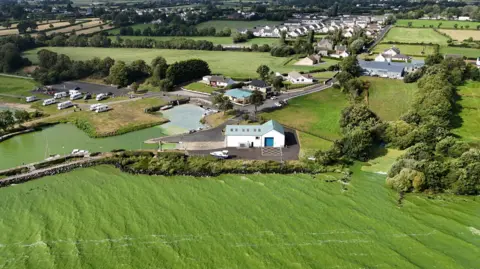
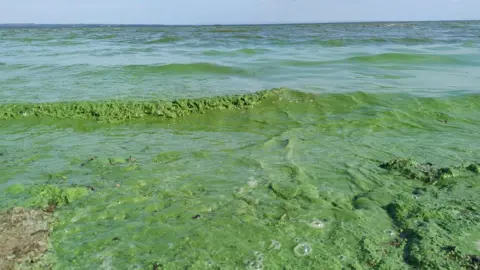
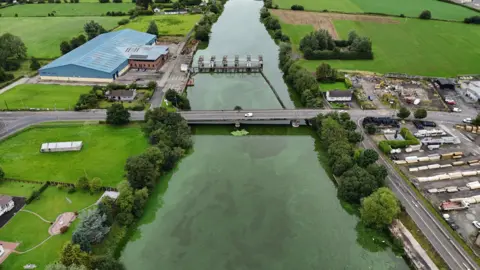
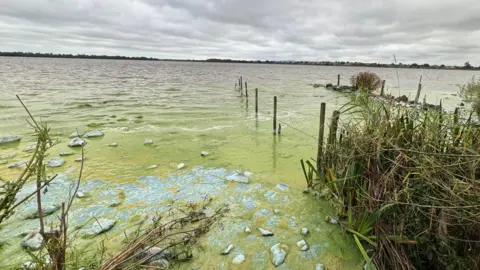
Blue-green algae has been detected in the lough intermittently over the past six decades.
But the past three summers have seen the biggest blooms since the 1970s.
Why are the blooms happening?
“We have this massive surplus of nutrients that means it’s an enriched broth,” is how Dr Adam Mellor from the Agri-Food and Biosciences Institute (AFBI) describes Lough Neagh.
Those nutrients are primarily phosphorus – one of the building blocks of life – and they come from many sources.
“We have waste water as one of the significant contributors and we have land use and agriculture probably as the other large contributor.
“But we also have individual contributions through septic tanks and what we individually put into the wastewater system.”
It’s not just what goes into the lough; it is also what is already there.
Algae or phytoplankton are almost always present in water.
But the ecology of Lough Neagh changed after the introduction of the Zebra Mussel.
The invasive species eats algae, but not blue-green algae which is bacteria.
“They’re reducing the number of good phytoplankton in the lough that would normally compete with the nuisance phytoplankton,” says Prof Mark Emmerson from Queen’s University Belfast.
“That’s releasing them (blue-green algae) from competition for limited resources which are nutrients, and they’re blooming.”
 Lough Neagh Partnership/PA Wire
Almost half of Northern Ireland’s land mass drains into Lough Neagh, which means that what goes on that land ends up in water.
Those nutrients get locked in the sediment.
But the temperature of the water they flow into is rising at an “alarmingly fast” rate because of climate change, according to retired agricultural researcher Jim McAdam.
“Since 1995, Lough Neagh has actually increased about one degree in temperature,” he said.
“That may not seem a lot, but whenever you think your average temperature is seven or eight degrees, it’s a lot.”
Warmer water means the sediment is gradually releasing its locked-away phosphorus, providing a “constant resupply” of about half the nutrients that are in the water, according to Prof Emmerson.
 PA Media
Is agriculture responsible?
An exercise carried out by AFBI determined that agriculture was responsible for about 60% of the nutrient load in the lough, wastewater approximately a quarter and the rest from septic tanks, industry and households.
John McLenaghan of the Ulster Farmers’ Union said there has been “behavioural change” around how nutrients and animal slurries are managed at farms.
“We have seen that long-term trend in terms of those nutrient losses into our waterways decreasing over that period of time.
“But we still have a Lough Neagh situation.”
Some of the decrease in agricultural water pollution is due to the Nitrates Action Plan, introduced in 2007.
Now called the Nutrients Action Programme, the latest version has proved controversial.
Nature-base solution
Some farmers, like former UFU President Ian Marshall, have turned to nature-based solutions “mining the nutrients out of the wastewater”.
He has installed underground swales – shallow drains – for nutrient-rich agricultural run-off from his 300-acre south Armagh farm.
That run-off feeds the roots of comfrey plants, which absorb nutrients to keep them out of the streams and rivers that ultimately lead to Lough Neagh.
“Every time a harvest is taken off or an animal grazes it, the plant regrows vigorously and draws more nutrients out of the soil,” Mr Marshall said.
“What we wanted to do is get a nature-based solution that didn’t mean we had to buy a big piece of equipment, didn’t take a lot of electricity and diesel to run it all time and just worked away on its own.
“Four years on, it’s working very well.”
 PA Media
Water is one thing – slurry is another
Government-funded research projects are studying the potential for using animal sewage to produce heat and power.
But what about human sewage?
NI Water has about 300 wastewater treatment works in the 4,500km² catchment of Lough Neagh.
They return treated water to the system, with “70-80%” of the phosphorus it originally contained removed, according to Engineering and Sustainability director Gary Curran.
NI Water believes it is responsible for about 20% of the nutrient load in the lough, with “only about 2%” coming from storm overflows.
Angela Halpenny of NI Water said better awareness of what is appropriate to put down the toilet or drains would help reduce problem overflows.
She estimates that “every person discharges 1kg of phosphorus per year into the wastewater system” from a combination of diet and human waste.
“But there’s also the chemicals and the cleaning products, laundry detergents that are used in the home that also contain phosphorus,” she said.
NI Water has been underfunded since it came into existence in 2007.
 Niall Carson/PA Wire
‘There are solutions’
Other projects are under way to test means of monitoring and managing algal blooms, without impacting the ecology of the lough or adding to its environmental issues.
They include using space technology to detect where and when blooms may form, solar-powered booms to contain algal mats and even removing chunks of them for biomass fuel.
But methods already tried elsewhere in the world, like adding substances to the water or using mechanical means to filter it, may not suit Lough Neagh, Dr Adam Mellor warned.
“Some of the techniques that we’ve seen across the world have been used on drinking water reservoirs, things that are not natural systems, so using them on natural systems can present a challenge here.
“And the scale of deploying some of these solutions in such a massive body of water may not work out and either be logistically or commercially, economically viable.”
But he is hopeful, adding: “We know that there are solutions – so it’s not a dead end.”
People are central to the changes
Forever Lough Neagh is a project based on the Forever Mournes response to wildfire damage.
The National Trust is a lead partner on both projects and Chief Executive Heather MacLachlan believes the problems of Lough Neagh are “bigger” than the lough itself.
“We all drink water, we all go to the toilet, and both of those things are impacting that water source,” she said.
“So there is something about everyone taking their role and responsibility in helping to find solutions for Lough Neagh.”
BBC News

Khamrah by Lattafa for Men - 3.4 oz EDP Spray
4% Off
Ghost Sweetheart Eau de Toilette | Pineapple, Jasmine and Sandalwood | Perfume for Women 50 ml
50% Off
Marc Jacobs Dot Eau De Parfum for Women, 100 ml
42% Off
Ted Baker W Eau de Toilette for Her, Fig Leaf, White Peony and Violet Top Notes, Pink Orchid and Raspberry Middle Notes, 75ml
£11.77 (£15.69 / 100 ml) (as of 16/07/2026 03:58 GMT +01:00 - More infoProduct prices and availability are accurate as of the date/time indicated and are subject to change. Any price and availability information displayed on [relevant Amazon Site(s), as applicable] at the time of purchase will apply to the purchase of this product.)
Ted Baker Woman Pink Eau de Toilette Spray Floral Green Feminine Fragrance, Opening Notes are Fresh Peach, Bergamot and Tangerine with Warm Musk, Vanilla and Vetiver Base, 100ml
11% Off
Vera Wang Princess Eau de Toilette - 30 ml

Choco Musk 50ml Eau De Parfum for men and women | Chocolate Musk by Jannat Aromas
17% Off
Christina Aguilera Signature Eau de Parfum (50ml) Floral, Fruity & Exotic Scent, Luxury Fragrance for Women
9% Off
Calvin Klein - Eau De Toilette CKIN2U - Calvin Klein Women, Ladies Perfume, Women's Perfume, Calvin Klein Perfume, Calvin Klein One - 150 ml
5% Off
Jimmy Choo Flash Eau de Parfum, 60 ml (Pack of 1)
3% Off
Fruit of the Loom Men's Heavy T Shirt, White, XL UK
28% Off
ATNKE LED Lighted Beanie Cap,USB Rechargeable Running Hat Ultra Bright 4 LED Waterproof Light Winter Warm Gifts for Men and Women/Pink
17% Off
Men's 1/4 Zip Pullover UK Sale Clearance, Fleece Sweatshirt Casual Jumper Long Sleeve T-shirt Top Stand Collar Sweater Plain Pullover Sports Leisure Workwear Quarter Zip Sweater Lightweight Jumpers
£5.88 (as of 12/11/2025 00:52 GMT +01:00 - More infoProduct prices and availability are accurate as of the date/time indicated and are subject to change. Any price and availability information displayed on [relevant Amazon Site(s), as applicable] at the time of purchase will apply to the purchase of this product.)
Crevice Cleaning Brush, Bathroom Tile Groove Gap Cleaning Brush,Premium Crevice Cleaning Tool Aluminum Support with 15° Angle Magic Brush, Thin Brush for Home Kitchen
19% Off
Wireless Earbuds, Bluetooth 5.3 Headphones in Ear with HiFi Stereo Deep Bass, 4 ENC Noise Cancelling Mic Wireless Earphones 40H Playtime, Bluetooth Earbuds Dual LED Display, IP7 Waterproof, USB-C
42% Off