 [
[

Colibactin is a powerful toxin produced by Escherichia coli and other bacteria living in the human gut. This highly unstable bacterial product causes mutations in DNA that have been linked to colorectal cancer. Because it breaks down quickly, isolating and studying it has been difficult, but now scientists in the U.S. have discovered exactly how colibactin attacks DNA.
Using advanced tools such as mass spectrometry (MS) and nuclear magnetic resonance (NMR) spectroscopy, the team studied the toxin at the atomic level, as reported in a paper published in the journal Science. The scientists overcame colibactin’s instability by growing toxin-producing bacteria directly next to strands of DNA in the lab. Consequently, colibactin attacked the genetic material almost as soon as it was made.
An unstable glue
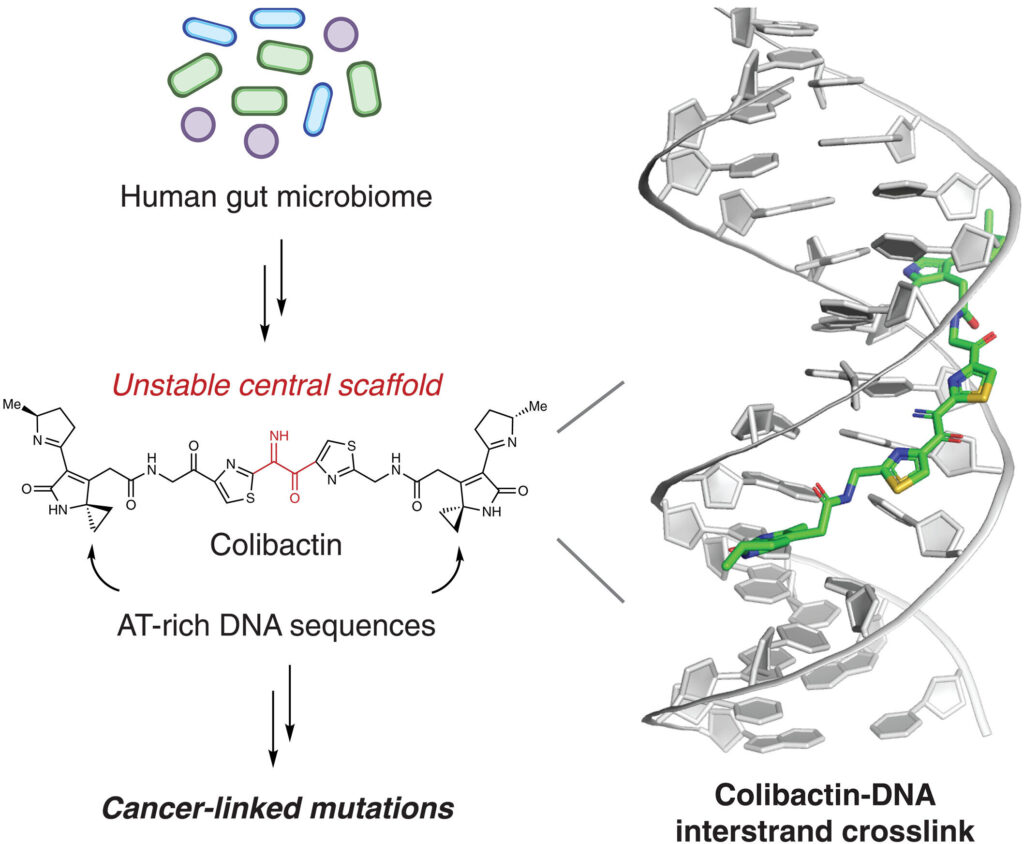
The study authors discovered that the toxin doesn’t target genetic material at random. It homes in on DNA sequences with high quantities of adenine and thymine bases. The way it damages DNA is by creating a bridge-like connection, called an interstrand cross-link (ICL), between the two strands of the DNA helix. In effect, the toxin acts like glue, binding the two strands together. This damage is permanent and prevents the cell from correctly reading or copying its DNA, which ultimately results in genetic errors that can lead to cancer.
The researchers also revealed that the damage occurs at the same place, in the minor groove. This is the narrow, shallow groove that is formed where the DNA’s backbones are closest together. And the reason is the toxin has an unstable, positively charged core that is attracted to the negatively charged, AT-rich minor groove. So they fit together like a lock and key.
“Our study reveals a strategy for DNA alkylation distinctive among natural products, enhancing our understanding of colibactin’s chemical structure, its recognition of and reaction with DNA, and its downstream effects on the host genome,” commented the scientists in their paper.
Implications for human health
The research is a significant advance in our understanding of the direct link between gut microflora and cancer risk. The discovery that colibactin binds to DNA at a specific site explains the characteristic DNA mutations doctors observe in colorectal cancer patients.
Now that scientists know the structure of the ICL bridge and the mechanism of attack, it can help them develop diagnostic tools to screen people at higher risk and design therapeutics to neutralize the unstable core. It could even inform new ways to reduce cancer risk through dietary changes or treatments that reduce the number of colibactin-producing bacteria in the gut.
Written for you by our author Paul Arnold, edited by Lisa Lock, and fact-checked and reviewed by Robert Egan—this article is the result of careful human work. We rely on readers like you to keep independent science journalism alive.
If this reporting matters to you,
please consider a donation (especially monthly).
You’ll get an ad-free account as a thank-you.
More information:
Erik S. Carlson et al, The specificity and structure of DNA cross-linking by the gut bacterial genotoxin colibactin, Science (2025). DOI: 10.1126/science.ady3571
Orlando D. Schärer, Molecular basis of DNA cross-linking by bacteria, Science (2025). DOI: 10.1126/science.aec9205
© 2025 Science X Network
Citation:
Gut bacteria’s hidden toxin acts as DNA glue, fueling colorectal cancer risk (2025, December 5)
retrieved 6 December 2025
from https://medicalxpress.com/news/2025-12-gut-bacteria-hidden-toxin-dna.html
This document is subject to copyright. Apart from any fair dealing for the purpose of private study or research, no
part may be reproduced without the written permission. The content is provided for information purposes only.

Khamrah by Lattafa for Men - 3.4 oz EDP Spray
4% Off
Ghost Sweetheart Eau de Toilette | Pineapple, Jasmine and Sandalwood | Perfume for Women 50 ml
50% Off
Marc Jacobs Dot Eau De Parfum for Women, 100 ml
42% Off
Ted Baker W Eau de Toilette for Her, Fig Leaf, White Peony and Violet Top Notes, Pink Orchid and Raspberry Middle Notes, 75ml
£11.77 (£15.69 / 100 ml) (as of 03/05/2026 03:10 GMT +01:00 - More infoProduct prices and availability are accurate as of the date/time indicated and are subject to change. Any price and availability information displayed on [relevant Amazon Site(s), as applicable] at the time of purchase will apply to the purchase of this product.)
Ted Baker Woman Pink Eau de Toilette Spray Floral Green Feminine Fragrance, Opening Notes are Fresh Peach, Bergamot and Tangerine with Warm Musk, Vanilla and Vetiver Base, 100ml
11% Off
Vera Wang Princess Eau de Toilette - 30 ml

Choco Musk 50ml Eau De Parfum for men and women | Chocolate Musk by Jannat Aromas
17% Off
Christina Aguilera Signature Eau de Parfum (50ml) Floral, Fruity & Exotic Scent, Luxury Fragrance for Women
9% Off
Calvin Klein - Eau De Toilette CKIN2U - Calvin Klein Women, Ladies Perfume, Women's Perfume, Calvin Klein Perfume, Calvin Klein One - 150 ml
5% Off
Jimmy Choo Flash Eau de Parfum, 60 ml (Pack of 1)
3% Off
Fruit of the Loom Men's Heavy T Shirt, White, XL UK
28% Off
ATNKE LED Lighted Beanie Cap,USB Rechargeable Running Hat Ultra Bright 4 LED Waterproof Light Winter Warm Gifts for Men and Women/Pink
17% Off
Men's 1/4 Zip Pullover UK Sale Clearance, Fleece Sweatshirt Casual Jumper Long Sleeve T-shirt Top Stand Collar Sweater Plain Pullover Sports Leisure Workwear Quarter Zip Sweater Lightweight Jumpers
£5.88 (as of 12/11/2025 00:52 GMT +01:00 - More infoProduct prices and availability are accurate as of the date/time indicated and are subject to change. Any price and availability information displayed on [relevant Amazon Site(s), as applicable] at the time of purchase will apply to the purchase of this product.)
Crevice Cleaning Brush, Bathroom Tile Groove Gap Cleaning Brush,Premium Crevice Cleaning Tool Aluminum Support with 15° Angle Magic Brush, Thin Brush for Home Kitchen
19% Off
Wireless Earbuds, Bluetooth 5.3 Headphones in Ear with HiFi Stereo Deep Bass, 4 ENC Noise Cancelling Mic Wireless Earphones 40H Playtime, Bluetooth Earbuds Dual LED Display, IP7 Waterproof, USB-C
42% Off