 [
[

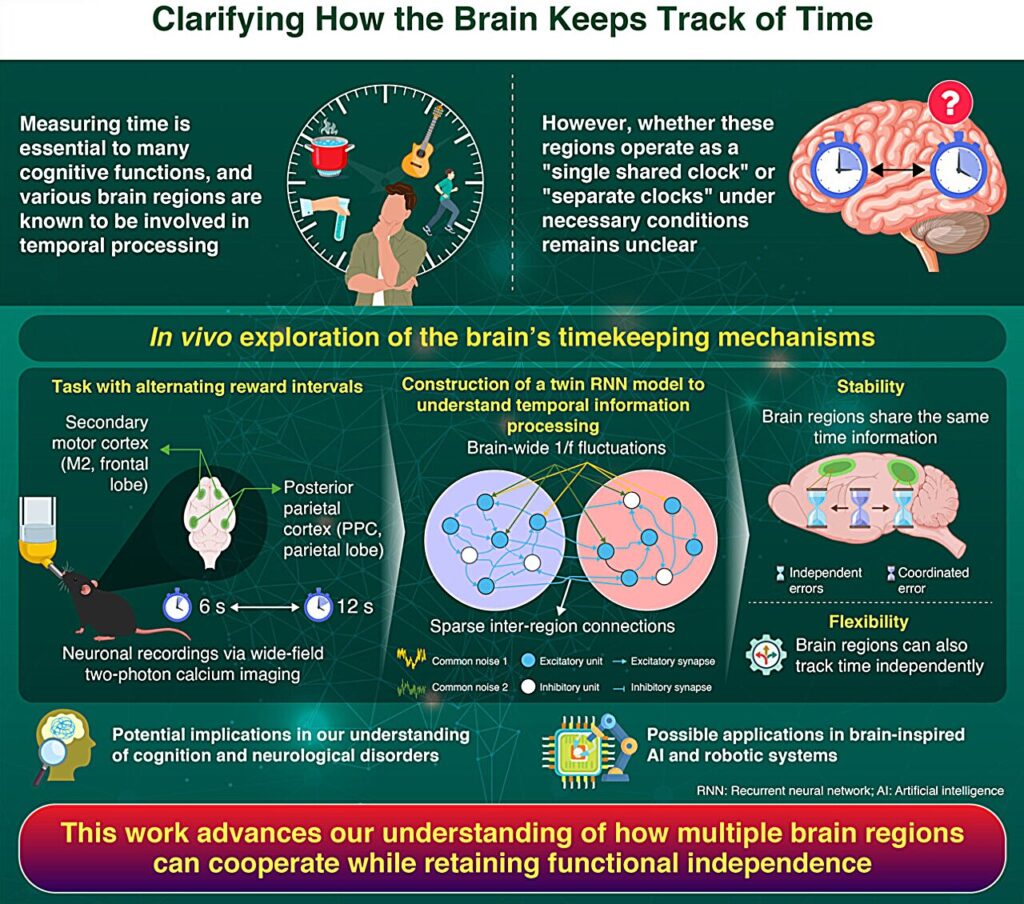
A study in mice suggests the brain does not rely on a single internal clock but can flexibly switch between shared and independent timing across regions, as reported by researchers from Science Tokyo. By recording thousands of neurons simultaneously in two brain areas during an alternating timing task, the team found that these areas sometimes tracked time together and sometimes separately. The findings, published in Nature Communications, provide a new framework for understanding how brain regions are coordinated.
The brain is constantly keeping track of time, even if one does not consciously notice it. This ability to sense elapsed time underlies many mental processes, such as movement, planning, working memory, decision-making and learning. Several brain regions can represent time in some way, especially areas in the frontal and parietal cortex involved in higher-order cognition. But if timing information shows up in many different areas of the brain at once, how do they stay in sync with each other?
Scientists have long wondered whether multiple brain regions all follow a single shared internal clock or whether each region can keep its own local clock when needed. Both possibilities could be useful; sometimes brain regions must stay aligned to a single event, while in other situations they may need to track different streams of information independently. However, testing this idea has proven difficult, as it requires recording the activity of large numbers of neurons at the same time while animals perform well-designed tasks.
Testing two clocks at once
To tackle this knowledge gap, a research team led by Associate Professor Riichiro Hira from the Department of Physiology and Cell Biology, Institute of Science Tokyo (Science Tokyo), Japan, investigated how two brain regions coordinate their sense of time. In their study, the researchers examined the secondary motor cortex and posterior parietal cortex in mice during an innovative time-tracking task.
The researchers first trained the mice to predict the timing of rewards as they alternated between 6-second and 12-second intervals. Over time, the mice learned this pattern and began to anticipate both the short and long reward intervals. The team then used wide-field two-photon calcium imaging to record the activity of thousands of neurons simultaneously in the two brain regions while the animals performed the task.
When timing drifted apart
In both areas, the team observed sequential patterns of activity, with different neurons becoming active at different moments, indicating that both regions were representing elapsed time. Through decoding analyses, the researchers then estimated what point in time each brain region was representing on a given trial. This approach revealed two kinds of errors: cases where both regions misjudged time similarly and cases where only one region drifted off. This suggests these regions are neither perfectly synchronized nor fully independent.
To explain this phenomenon, the team built a computational model consisting of twin connected recurrent neural networks. By analyzing neural activity in this model, the researchers gained insights into the brain’s timekeeping mechanisms.
Weak links, flexible coordination
As Hira explains, “We found sparse inter-regional connectivity promotes synchronization between the two regions, whereas widespread fluctuations prevent complete synchronization, allowing each region to preserve its own temporal representation.” In other words, the brain may use a combination of weak coupling and global activity patterns to balance stability with flexibility across regions.
Taken together, these findings provide a new framework for understanding how the brain can share information across regions without forcing every area into the same exact state. “In the future, our results may contribute to a better understanding of cognition, neurological disorders involving disrupted inter-regional coordination, and the development of brain-inspired artificial intelligence and robotic control systems that combine stability with flexibility,” Hira concludes.
Publication details
Hiroto Imamura et al, Independence and coherence in temporal sequence computation across the fronto-parietal network, Nature Communications (2026). DOI: 10.1038/s41467-026-73999-w
Journal information:
Nature Communications
Key medical concepts
Clinical categories
Who’s behind this story?


Citation:
Flexible clocks can sync up or drift apart across brain regions in mice (2026, July 20)
retrieved 20 July 2026
from https://medicalxpress.com/news/2026-07-flexible-clocks-sync-drift-brain.html
This document is subject to copyright. Apart from any fair dealing for the purpose of private study or research, no
part may be reproduced without the written permission. The content is provided for information purposes only.

Khamrah by Lattafa for Men - 3.4 oz EDP Spray
4% Off
Ghost Sweetheart Eau de Toilette | Pineapple, Jasmine and Sandalwood | Perfume for Women 50 ml
50% Off
Marc Jacobs Dot Eau De Parfum for Women, 100 ml
42% Off
Ted Baker W Eau de Toilette for Her, Fig Leaf, White Peony and Violet Top Notes, Pink Orchid and Raspberry Middle Notes, 75ml
£11.77 (£15.69 / 100 ml) (as of 25/08/2026 04:40 GMT +01:00 - More infoProduct prices and availability are accurate as of the date/time indicated and are subject to change. Any price and availability information displayed on [relevant Amazon Site(s), as applicable] at the time of purchase will apply to the purchase of this product.)
Ted Baker Woman Pink Eau de Toilette Spray Floral Green Feminine Fragrance, Opening Notes are Fresh Peach, Bergamot and Tangerine with Warm Musk, Vanilla and Vetiver Base, 100ml
11% Off
Vera Wang Princess Eau de Toilette - 30 ml

Choco Musk 50ml Eau De Parfum for men and women | Chocolate Musk by Jannat Aromas
17% Off
Christina Aguilera Signature Eau de Parfum (50ml) Floral, Fruity & Exotic Scent, Luxury Fragrance for Women
9% Off
Calvin Klein - Eau De Toilette CKIN2U - Calvin Klein Women, Ladies Perfume, Women's Perfume, Calvin Klein Perfume, Calvin Klein One - 150 ml
5% Off
Jimmy Choo Flash Eau de Parfum, 60 ml (Pack of 1)
3% Off
Fruit of the Loom Men's Heavy T Shirt, White, XL UK
28% Off
ATNKE LED Lighted Beanie Cap,USB Rechargeable Running Hat Ultra Bright 4 LED Waterproof Light Winter Warm Gifts for Men and Women/Pink
17% Off
Men's 1/4 Zip Pullover UK Sale Clearance, Fleece Sweatshirt Casual Jumper Long Sleeve T-shirt Top Stand Collar Sweater Plain Pullover Sports Leisure Workwear Quarter Zip Sweater Lightweight Jumpers
£5.88 (as of 12/11/2025 00:52 GMT +01:00 - More infoProduct prices and availability are accurate as of the date/time indicated and are subject to change. Any price and availability information displayed on [relevant Amazon Site(s), as applicable] at the time of purchase will apply to the purchase of this product.)
Crevice Cleaning Brush, Bathroom Tile Groove Gap Cleaning Brush,Premium Crevice Cleaning Tool Aluminum Support with 15° Angle Magic Brush, Thin Brush for Home Kitchen
19% Off
Wireless Earbuds, Bluetooth 5.3 Headphones in Ear with HiFi Stereo Deep Bass, 4 ENC Noise Cancelling Mic Wireless Earphones 40H Playtime, Bluetooth Earbuds Dual LED Display, IP7 Waterproof, USB-C
42% Off